2507 Super Duplex Stainless Steel: Where It Beats 2205 and Where It Does Not
2507 is often sold as a stronger, more corrosion-resistant step above 2205. That is true in the right chloride service. It is also an incomplete buying argument.
Super duplex 2507 brings higher strength and stronger chloride resistance, but it also raises the standard for welding control, inspection, availability, and supplier discipline. A buyer who treats it like ordinary stainless stock can create the very delay the upgrade was meant to avoid.
The grade makes sense when the project has a real chloride stress corrosion, pitting, crevice, or strength problem. It makes less sense when the job only needs a familiar duplex grade with manageable fabrication.
| Decision point | 2205 duplex | 2507 super duplex |
|---|---|---|
| Strength need | High strength for many pressure and structural parts | Higher strength where wall reduction or severe duty matters |
| Chloride exposure | Good resistance for many industrial services | Better margin in aggressive chloride environments |
| Fabrication control | Still needs duplex welding discipline | Needs tighter heat input, filler, and inspection control |
| Buying risk | Often easier to source | Check form, thickness, and lead time early |
What problem is 2507 actually solving?
The buying judgement
2507 solves a combined problem: chloride corrosion plus strength. If the part only needs higher strength, another material or design change may be cheaper. If it only needs corrosion resistance, 904L, 2205, or a nickel alloy may be a better fit depending on the chemistry.
The grade is strongest in seawater, desalination, offshore, high-chloride process equipment, and compact pressure designs where both corrosion margin and mechanical strength matter.
The RFQ control
A buyer should ask what failure mode the upgrade prevents. Pitting, crevice corrosion, stress corrosion cracking, wall loss, and deformation are not the same problem.
Where can 2507 create new procurement risk?
The buying judgement
2507 creates risk when the supplier can sell the grade but cannot control the process. Welding, heat input, filler selection, interpass temperature, cleaning, and inspection all affect the final part.
The same caution applies to plate cutting, bending, and machined components. Higher strength can help the design, but it can also make forming less forgiving. A drawing that worked with 316L or 2205 should not be copied blindly.
The RFQ control
Put the weld procedure, NDT requirement, dimensional tolerance, and surface cleanup into the RFQ. If those details arrive after production starts, the project is already negotiating with rework.
When does 2205 remain the better choice?
The buying judgement
2205 remains a better buying choice when chloride exposure is moderate, fabrication is complex, or delivery speed matters more than extra corrosion margin. It is not a weak grade. It is often the practical duplex baseline.
Many buyers over-upgrade because they compare only property tables. The field question is narrower: has 2205 failed in this environment, or is the buyer simply trying to remove uncertainty with alloy cost?
The RFQ control
If the application has good drainage, known chemistry, controlled temperature, and routine inspection, 2205 may give enough safety margin without the supply and fabrication burden of 2507.
How should buyers compare 2507 quotes?
The buying judgement
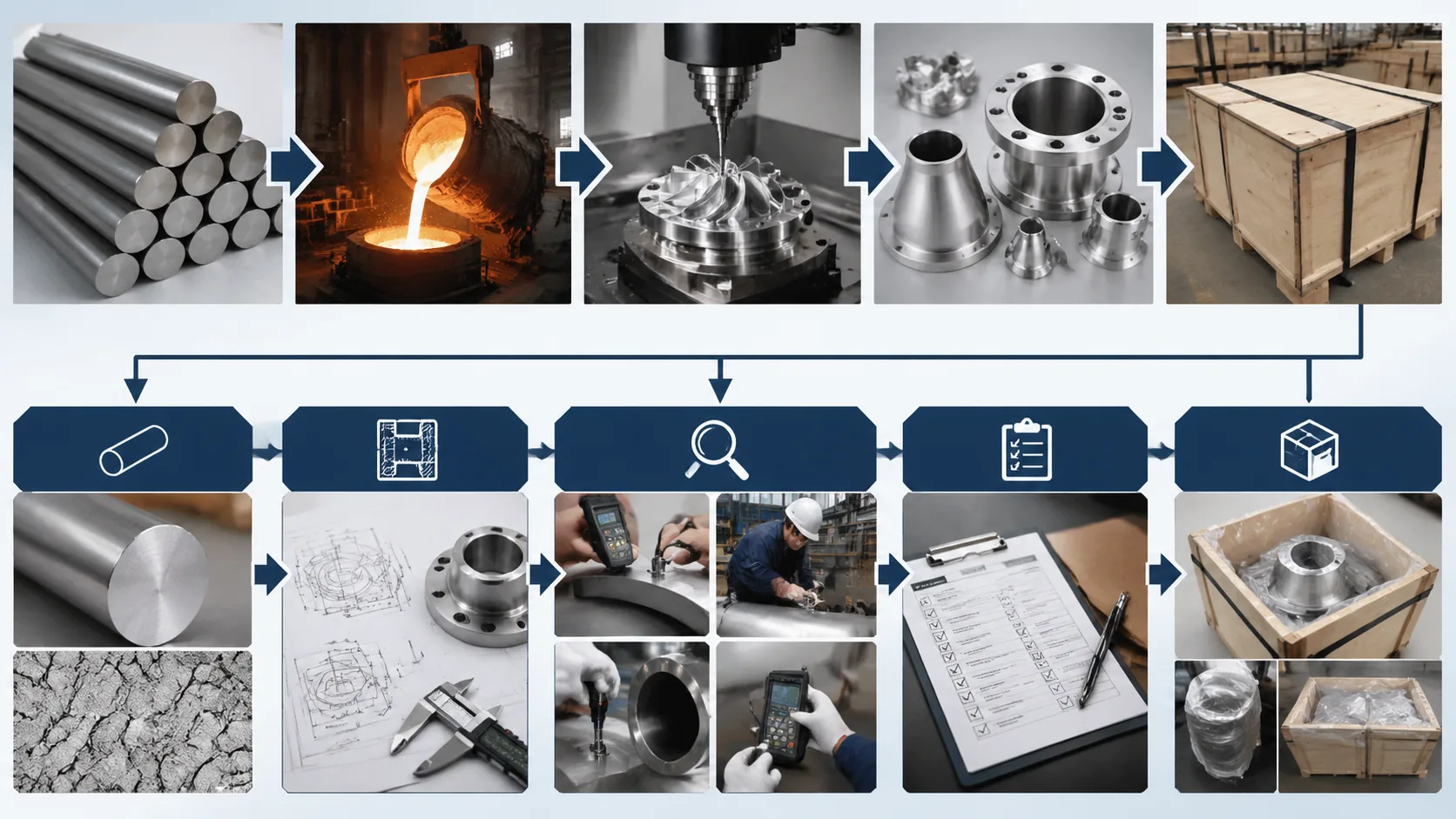
Compare more than unit price. Check product form, standard, heat treatment condition, thickness tolerance, MTC chemistry, mechanical values, delivery time, welding scope, inspection scope, and packing.
A quote for raw plate is not comparable with a quote for cut, bevelled, welded, and inspected parts. A quote with no inspection line is not comparable with one that includes third-party review.
The RFQ control
For plates, tubes, bars, or processed stainless parts, NewQiujing can support the quote more accurately when the drawing, service environment, and inspection expectation are included from the start.
What should be checked before shipment?
The buying judgement
Before shipment, check MTC values, heat number marking, product dimensions, surface condition, edge condition, weld cleanup if applicable, packing photos, and any third-party inspection report.
The high alloy cost makes traceability more important, not less. If material is cut into parts, the heat number needs a practical marking plan so the buyer can match received pieces back to documents.
The RFQ control
Delivery speed only matters if the material arrives usable. For 2507, usable means documented, traceable, correctly processed, and protected from avoidable surface damage.
How should competing supplier quotes be compared?
Normalize the scope first
Put every quote into the same scope before comparing price. The scope should include material form, standard, size tolerance, surface condition, processing, inspection, packing, and document requirements. If one quote includes cutting and another quote only covers raw material, the lower number is not evidence of a cheaper supplier.
Look for missing risk lines
The missing line item usually becomes the later argument. Common gaps include MTC format, heat number marking after cutting, surface protection, edge condition, dimensional inspection, packing photos, and third-party inspection. Ask suppliers to revise the quote instead of trying to remember verbal promises.
Treat lead time as a technical variable
Lead time is not only a logistics number. Fast shipment can mean standard stock, but it can also mean the supplier skipped processing, inspection, or packing details. Slow shipment can be reasonable when the order needs non-stock thickness, special finish, strict tolerance, or outside inspection. Compare usable delivery, not calendar days alone.
What should receiving inspection check?
Documents
Start with the documents because they are easier to correct before unloading than after production starts. Match the purchase order, invoice, packing list, MTC, grade, heat number, size, quantity, and any inspection report. If the heat number on the material does not match the MTC, stop the material before it enters production.
Dimensions and surface
Check size, thickness, wall, width, length, straightness, flatness, edge condition, and surface finish against the RFQ. For processed material, check the drawing revision too. A small dimensional mismatch can create more cost than a visible surface defect because it may not be found until the next operation.
Packing and handling damage
Inspect packing before removing it. Water marks, broken straps, crushed edges, torn film, and mixed labels tell the buyer how the shipment was handled. Take photos while the material is still packed. That evidence is much stronger than a complaint written after parts have been moved around the shop.
What should the buyer check before sending the PO?
A final RFQ check should be boring. That is the point. If the grade, form, standard, tolerance, finish, processing scope, inspection, marking, and packing are all named, the supplier has less room to guess.
| RFQ control | Why it matters for 2507 |
|---|---|
| Service chemistry | Confirms that super duplex is justified |
| Welding notes | Protects duplex balance and weld-area corrosion resistance |
| Inspection plan | Prevents late disputes on NDT and dimensions |
| Heat marking | Keeps traceability after cutting |
| Packing photos | Reduces surface and edge damage risk |
The buyer should also keep one internal note that explains why the selected grade or form is acceptable for the service. That note does not need to be long. It only needs to name the exposure, the part function, and the failure mode being avoided.
For repeat orders, keep the approved wording as a purchasing template. That prevents a future buyer from shortening the RFQ back to a grade name and quantity, which is how many avoidable material disputes return six months later.
Conclusion
2507 beats 2205 when the service really needs more chloride resistance and higher strength. It does not beat 2205 when the project cannot control welding, inspection, or lead time. The best buying decision starts with failure mode, not grade prestige. Name the environment, fabrication route, inspection level, and document requirement first; then decide whether 2507 is the correct margin or an expensive distraction.
Author: NewQiujing Group