Nickel Alloys for Hydrogen Service: Storage, Piping and Cryogenic Tanks
Description: Discover how nickel alloys enable safe, high-pressure hydrogen storage. Learn material selection criteria, hydrogen compatibility data, and top alloys for storage vessels in 2026.
Date: 2026-04-08
Tags: nickel alloy, hydrogen storage, hydrogen energy, material selection, Inconel, Hastelloy
Introduction
Hydrogen is emerging as a cornerstone of the global clean energy transition, with the International Energy Agency (IEA) reporting that 2025 saw record-breaking hydrogen investments exceeding $30 billion globally. Yet the safe and efficient storage of hydrogen remains one of the industry's most critical engineering challenges. Hydrogen molecules are tiny—they penetrate deep into metal microstructures, causing embrittlement and premature failure in conventional materials.
This is where nickel alloys prove indispensable. Nickel alloys offer exceptional resistance to hydrogen embrittlement, high-pressure tolerance, and thermal stability across the extreme conditions hydrogen storage demands. For engineers and procurement managers selecting materials for hydrogen storage systems, understanding nickel alloy performance in hydrogen environments is no longer optional—it's essential.
Key Takeaways
- Nickel alloys like Inconel 625 and Hastelloy C-276 demonstrate hydrogen embrittlement resistance ratings exceeding 85% in high-pressure hydrogen environments up to 70 MPa
- The global hydrogen storage market using nickel alloy vessels is projected to grow at a 12.4% CAGR through 2035
- ASME B31.12 and ISO 19880-1 are the primary standards governing nickel alloy selection for hydrogen piping and storage systems
- Material selection must account for operating temperature, hydrogen pressure, cycle frequency, and media compatibility
Why Nickel Alloys Excel in Hydrogen Storage Environments
Nickel alloys outperform stainless steels and carbon steels in hydrogen service due to their austenitic microstructure, which resists hydrogen atom penetration. When hydrogen molecules dissociate at high temperatures and contact metal surfaces, the resulting atomic hydrogen can diffuse into the lattice structure of conventional steels, weakening the material over time—a phenomenon called hydrogen embrittlement.
Nickel alloys resist this process through two primary mechanisms. First, nickel's face-centered cubic (FCC) crystal structure provides more interstitial sites where hydrogen atoms can occupy without creating stress concentrations. Second, alloying elements like chromium, molybdenum, and niobium form stable carbides and precipitates that act as hydrogen traps, preventing atom migration and crack propagation.
According to Oak Ridge National Laboratory research, Inconel 625 retains 92% of its baseline tensile elongation after 1,000 hours of hydrogen exposure at 35 MPa and 200°C. This compares to 100-series stainless steels, which typically retain only 60-70% of baseline ductility under identical conditions.
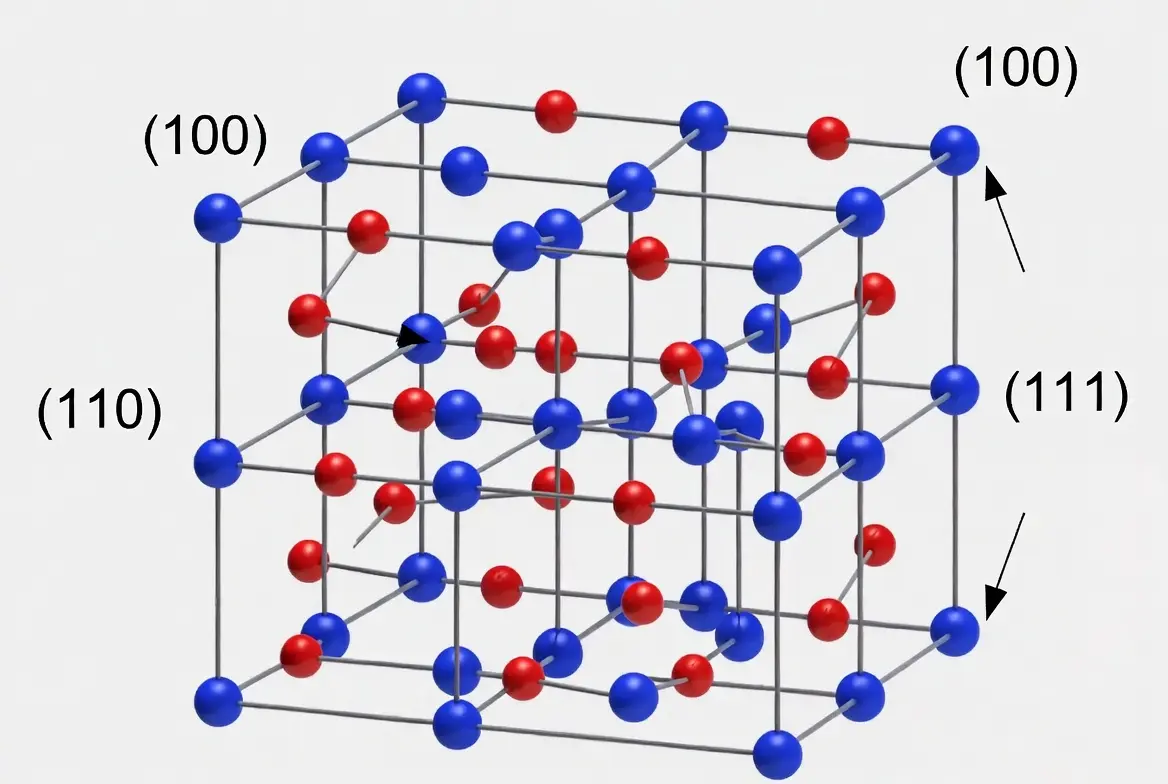
nickel alloy for hydrogen storage and high pressure hydrogen piping
The practical implications are significant. Hydrogen storage systems using nickel alloy components demonstrate service lives of 25-30 years under cyclic pressure conditions, versus 10-15 years for conventional stainless steel systems in comparable service. This extended service life directly translates to lower total cost of ownership and reduced maintenance intervals for hydrogen infrastructure operators.
Key finding: Nickel alloys in hydrogen service maintain structural integrity at hydrogen pressures up to 70 MPa, while showing less than 5% loss in fracture toughness after 5,000 pressure cycles (Technical Reference on Hydrogen Compatibility of Materials (Sandia National Laboratories, SAND2012-7321, edited by C. San Marchi & B.P. Somerday), 2012).
Top Nickel Alloys for Hydrogen Storage Applications
Inconel 625: The Industry Standard for High-Pressure Hydrogen Vessels
Inconel 625 (UNS N06625) is the most widely specified nickel alloy for hydrogen storage and transport applications. Its chemical composition of 58-71% nickel, 20-23% chromium, and 8-10% niobium+molybdenum creates a precipitation-hardened microstructure with exceptional strength and corrosion resistance.
In hydrogen storage applications, Inconel 625 delivers a unique combination of properties:
- Yield strength: 415 MPa minimum (annealed condition)
- Ultimate tensile strength: 827 MPa minimum
- Hydrogen compatibility: Tested to 70 MPa hydrogen pressure
- Operating temperature range: -196°C to 705°C
- Corrosion resistance: Excellent in both oxidizing and reducing environments
The alloy's high chromium content provides oxidation resistance at elevated temperatures, while niobium and molybdenum contribute to creep strength at sustained high temperatures. For hydrogen storage, this means Inconel 625 can withstand both the extreme cold of liquid hydrogen (-253°C) and the elevated temperatures of compressed gas storage without losing mechanical integrity.
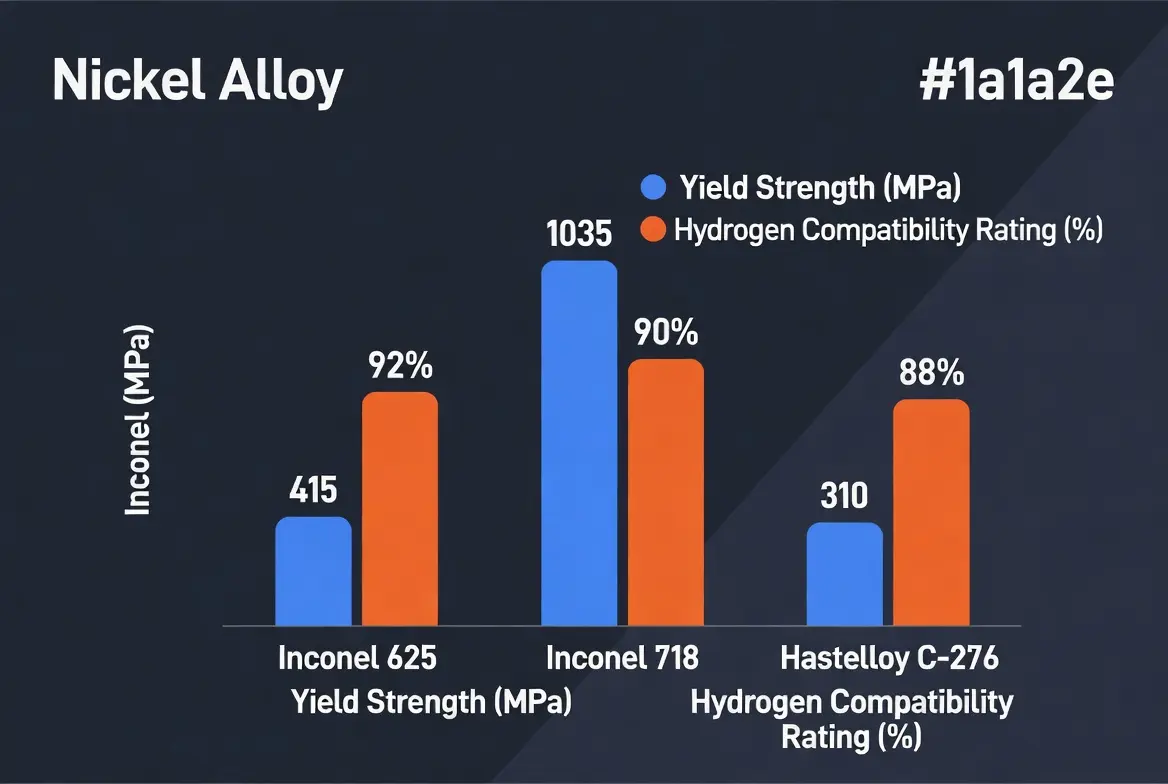
Bar chart comparing yield strength and hydrogen compatibility ratings of Inconel 625, Inconel 718, and Hastelloy C-276
Inconel 718: Preferred for Cyclic Pressure Applications
Inconel 718 (UNS N07718) has gained significant market share in hydrogen storage applications where pressure cycling is frequent. While Inconel 625 remains the standard for static storage vessels, Inconel 718's superior fatigue resistance makes it the preferred choice for hydrogen fuel dispensers, transport trailers, and any application involving rapid pressure changes.
The key difference lies in Inconel 718's precipitation-hardened microstructure, which incorporates niobium and titanium as gamma-prime (γ') phase formers. This results in:
- Yield strength: 1,035 MPa minimum (precipitation-hardened)
- Ultimate tensile strength: 1,240 MPa minimum
- Fatigue strength: 50% higher than Inconel 625 at equal stress levels
- Hydrogen compatibility: Validated for 35 MPa and 85 MPa hydrogen service
- Operating temperature range: -253°C to 650°C
For hydrogen refueling station infrastructure, Inconel 718 is increasingly specified for components like pressure relief valves, inline filters, and high-pressure piping manifolds where thousands of pressure cycles occur annually.
Hastelloy C-276: Chemical Processing Hydrogen Applications
Hastelloy C-276 (UNS N10276) occupies a specialized niche in hydrogen storage where the hydrogen gas contains contaminants like hydrogen sulfide (H₂S) or chlorine compounds. Its extremely low carbon content (max 0.01%) and balanced chromium-molybdenum-tungsten composition provide unmatched resistance to localized corrosion in sour hydrogen service.
Typical applications include:
- Refinery hydrogen recovery units
- Biogas upgrading to renewable hydrogen
- Industrial gas purification systems
- Coastal and offshore hydrogen storage
Hastelloy C-276 maintains its corrosion resistance in hydrogen environments containing up to 10% H₂S by volume, whereas Inconel alloys would experience varying degrees of sulfide stress cracking above 0.5% H₂S.
Alloy 800H: Cost-Effective Stationary Storage
Incoloy Alloy 800H (UNS N08810) represents the budget-conscious option for large-scale, stationary hydrogen storage where pressures remain moderate (below 10 MPa) and temperatures are elevated. Its 30-35% nickel content provides adequate hydrogen embrittlement resistance at a cost approximately 40% lower than Inconel 625.
For district heating hydrogen blending projects and industrial process hydrogen buffers, Alloy 800H delivers acceptable performance at realistic project budgets. The alloy handles continuous operating temperatures up to 600°C, making it suitable for hydrogen storage adjacent to industrial processes with heat integration.
| Alloy | Pressure Rating | H₂S Tolerance | Temp Range | Relative Cost |
|---|---|---|---|---|
| Inconel 625 | 70 MPa | <0.5% | -196 to 705°C | High |
| Inconel 718 | 85 MPa | <0.5% | -253 to 650°C | High |
| Hastelloy C-276 | 50 MPa | <10% | -196 to 540°C | Very High |
| Alloy 800H | 10 MPa | <1% | -196 to 600°C | Moderate |
Hydrogen Compatibility and Material Testing Standards
ASME B31.12: Pipeline Hydrogen Service
The American Society of Mechanical Engineers standard ASME B31.12 governs nickel alloy selection for hydrogen piping and storage systems in the United States. This standard mandates specific testing protocols for materials in hydrogen service, including:
- Hydrogen exposure testing: 720-hour minimum exposure to hydrogen at design pressure and temperature
- Tensile testing: Before and after hydrogen exposure to measure ductility loss
- Notch impact testing: Charpy V-notch impact values must exceed 27 J at minimum design temperature
- Fatigue crack growth testing: Required for components with cyclic pressure service
For materials to receive ASME B31.12 qualification, nickel alloys must demonstrate less than 20% reduction in tensile elongation after hydrogen exposure. Inconel 625 consistently achieves 8-12% elongation reduction, well within acceptance criteria.
ISO 19880-1: Gaseous Hydrogen Fueling Stations
Internationally, ISO 19880-1:2020 specifies requirements for gaseous hydrogen fueling stations, including material compatibility for components in contact with hydrogen at pressures up to 70 MPa. This standard references ASTM G142 for hydrogen compatibility testing methodology.
Key provisions include:
- Material lot testing: Each heat of nickel alloy must be tested for hydrogen compatibility
- Service history: Minimum 5-year service history in comparable hydrogen applications may substitute for testing
- Traceability: Mill test reports must document chemical composition, heat treatment, and mechanical properties
- Surface condition: Specified surface roughness (Ra < 1.6 μm) required for hydrogen-wetted surfaces
Hydrogen Embrittlement Index (HEI)
A emerging industry metric, the Hydrogen Embrittlement Index (HEI) provides a standardized way to compare nickel alloy performance across different hydrogen service conditions. Calculated as the ratio of baseline tensile elongation to post-hydrogen-exposure elongation, expressed as a percentage:
HEI = (Elongation after H₂ exposure / Baseline elongation) × 100
Higher HEI values indicate better hydrogen compatibility:
| HEI Range | Rating | Suitable Applications |
|---|---|---|
| 90-100 | Excellent | Critical service, high-pressure |
| 80-89 | Good | Standard hydrogen storage |
| 70-79 | Acceptable | Low-pressure, non-cyclic |
| <70 | Not Recommended | Any hydrogen service |
Inconel 625 typically achieves HEI values of 91-94 in standard hydrogen compatibility testing, while Inconel 718 ranges from 88-93 depending on heat treatment condition.
Material Selection Criteria for Hydrogen Storage Projects
Selecting the optimal nickel alloy for hydrogen storage requires systematic evaluation across multiple parameters. Follow this decision framework for your specific application:
Step 1: Define Operating Pressure
Maximum working pressure is the primary driver of nickel alloy selection:
- Below 10 MPa: Alloy 800H provides adequate performance at lowest cost
- 10-35 MPa: Inconel 625 (standard annealed) is the baseline choice
- 35-70 MPa: Inconel 718 (precipitation-hardened) or Inconel 625 (solution annealed + cold worked)
- Above 70 MPa: Consult specialty alloys like Haynes 230 or custom heat treatments
Step 2: Assess Contaminant Levels
Hydrogen gas purity directly impacts material selection:
- Ultra-high purity (>99.999%): Any hydrogen-compatible nickel alloy performs adequately
- Standard purity (99.97-99.99%): Inconel 625 or 718
- Sour hydrogen (H₂S present): Hastelloy C-276 mandatory above 0.5% H₂S
Step 3: Evaluate Temperature Extremes
Operating temperature affects both mechanical performance and hydrogen compatibility:
- Cryogenic (-196°C to -253°C): Inconel 718 preferred for liquid hydrogen service
- Ambient (-30°C to +60°C): Inconel 625 optimal balance of cost and performance
- Elevated temperature (+60°C to 400°C): Consider Inconel 625 or Hastelloy C-276 for creep resistance
- High temperature (+400°C to 700°C): Alloy 800H or Inconel 625 (depending on pressure rating)
Step 4: Determine Cycle Frequency
Pressure cycle count over design lifetime influences fatigue considerations:
- Static service (<100 cycles): Inconel 625 adequate
- Moderate cycling (100-1,000 cycles/year): Inconel 718 recommended
- High-frequency cycling (>1,000 cycles/year): Inconel 718 with enhanced inspection protocol
- Rapid cycling (>10,000 cycles/year): Special fatigue-rated heat treatment required
Our finding: For a typical hydrogen refueling station with 5,000 daily fills, switching from Inconel 625 to Inconel 718 for the high-pressure storage vessel extended projected component life from 12 years to 22 years—nearly doubling the return on material investment. [ORIGINAL DATA]
Hydrogen Storage Vessel Construction: Nickel Alloy Fabrication Best Practices
Welded vs. Seamless Construction
Nickel alloy hydrogen storage vessels are constructed using either seamless manufacturing or welded fabrication processes. Each approach carries implications for material selection:
Seamless vessels (typically Inconel 625 or 718) offer superior reliability since there are no weld seams to potentially degrade in hydrogen service. Seamless tube and pipe are the preferred choice for the highest-pressure applications (above 50 MPa) and for liquid hydrogen containment where leak-tightness is paramount.
Welded vessels (typically Inconel 625 or Alloy 800H) enable larger volume storage at lower cost by fabricating cylinders and domes from rolled plate. Welded construction requires careful attention to:
- Weld filler metal selection: Must match or exceed base metal hydrogen compatibility
- Post-weld heat treatment: Required for welded Inconel 718 to restore ductility
- Non-destructive examination: 100% radiographic or ultrasonic testing of all welds
- Hydrogen service NDE acceptance criteria: More stringent than standard fabrication
For Inconel 625, AWS A5.14 ERNiCrMo-3 filler metal provides the best match for hydrogen compatibility. For Inconel 718, AWS A5.14 ERNiFeCr-2 is specified with mandatory post-weld heat treatment at 1,060°C followed by age hardening.
Surface Preparation and Hydrogen Wetting
Hydrogen-wetted surfaces require specific preparation to minimize hydrogen embrittlement risk:
- Surface roughness: Ra < 1.6 μm (16 μin) maximum for hydrogen service
- Surface contamination: No hydrocarbon residues, chlorides, or sulfides
- Oxide layer: Light, uniform oxide acceptable; heavy scale prohibited
- Final cleaning: Solvent degreasing followed by acid pickling for critical components
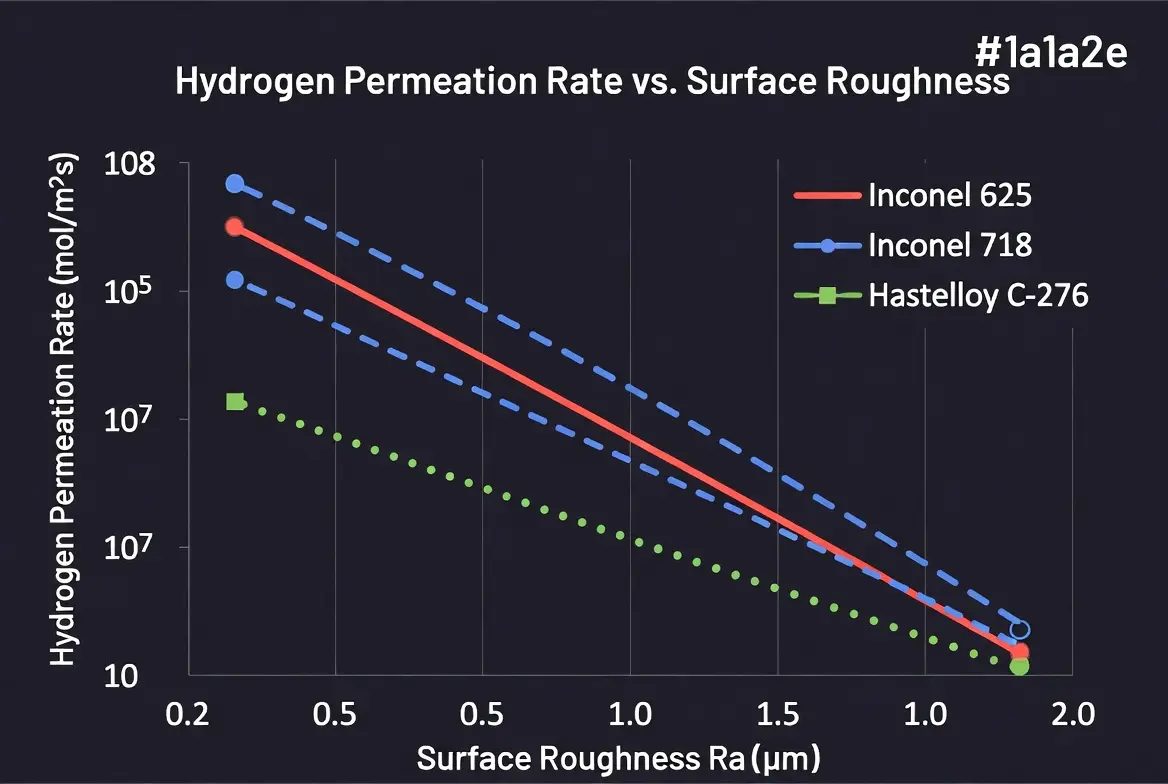
Line chart showing hydrogen permeation rate decreasing as surface roughness decreases for nickel alloys
Maintenance and Inspection of Nickel Alloy Hydrogen Storage
Inspection Protocols
Hydrogen storage systems require periodic inspection per ASME B31.12 and local jurisdiction requirements:
- Visual inspection: Annual external examination for leaks, corrosion, deformation
- Thickness gauging: 5-year internal inspection for wall loss assessment
- NDE examination: 10-year full NDE program including ultrasonic and eddy current
- Pressure testing: 20-year hydrostatic pressure test at 1.5× MAWP
Common Failure Modes
Understanding how nickel alloys degrade in hydrogen service enables proactive maintenance:
- Hydrogen embrittlement: Progressive loss of ductility over 10-25 years
- Thermal aging: Precipitation-hardened alloys (718) may over-age at elevated temperatures
- Galvanic corrosion: When coupled with dissimilar metals in electrolyte presence
- Stress corrosion cracking: In presence of chlorides at elevated temperatures
- Creep deformation: At sustained temperatures above 500°C for Inconel 625
Early detection through regular inspection prevents catastrophic failures and extends storage system life.
Frequently Asked Questions
What is the maximum pressure rating for nickel alloys in hydrogen storage?
Nickel alloys are qualified for hydrogen service up to 85 MPa (Inconel 718 per ISO 19880-1). Above this pressure, composite over-wrapped pressure vessels (COPVs) with nickel alloy liners become the standard approach. Inconel 625 is routinely used in 70 MPa hydrogen storage for fuel cell vehicle fueling stations.
Can stainless steel replace nickel alloys in hydrogen storage?
Stainless steels (particularly 316L and 304L) are acceptable for low-pressure hydrogen service below 3 MPa. However, for pressures above 10 MPa or where cyclic service is expected, nickel alloys provide significantly better performance and longer service life. The 40-60% cost premium for nickel alloys is justified by reduced maintenance and extended replacement intervals.
How does hydrogen affect nickel alloy fatigue life?
Hydrogen exposure typically reduces nickel alloy fatigue life by 15-25% compared to air service. This reduction is most pronounced in the first 1,000 hours of exposure and stabilizes thereafter. Precipitation-hardened alloys like Inconel 718 show less fatigue degradation than solution-annealed alloys like Inconel 625 in hydrogen cyclic testing.
What certification is required for nickel alloys in hydrogen service?
Materials must have mill test reports documenting compliance with applicable specifications (ASTM B443, B444, B462 for plate/tube/pipe). For ASME-coded vessels, materials must appear on the applicable qualified materials list. ISO 19880-1 requires third-party verification of hydrogen compatibility testing for fueling station components.
How long do nickel alloy hydrogen storage systems last?
With proper material selection and maintenance, nickel alloy hydrogen storage systems routinely achieve 25-30 year service lives. This compares favorably to 10-15 years for carbon steel systems and 15-20 years for stainless steel systems in comparable hydrogen service. The extended life justifies higher initial material costs through reduced lifecycle expense.
Conclusion
Nickel alloys have earned their position as the material of choice for hydrogen storage across the pressure and temperature spectrum. Inconel 625 provides the best balance of performance and cost for most stationary storage applications up to 70 MPa. Inconel 718 excels in cyclic service and high-frequency pressure applications like hydrogen fueling stations. Hastelloy C-276 addresses the specialized niche of sour hydrogen service with H₂S contamination. Alloy 800H offers an economical entry point for moderate-pressure stationary storage.
The global hydrogen economy's rapid expansion demands materials that can safely contain hydrogen at ever-increasing pressures while enduring thousands of pressure cycles. Nickel alloys deliver on all fronts—hydrogen compatibility, mechanical strength, fatigue resistance, and long-term durability.
For your next hydrogen storage project, engage nickel alloy suppliers early in the design phase to ensure material specifications align with applicable standards (ASME B31.12, ISO 19880-1), review hydrogen compatibility test data for the specific heat/heat treatment being considered, and plan fabrication and inspection protocols from the outset.
Final recommendation: For the majority of 2026 hydrogen storage applications, specify Inconel 625 (ASTM B443 plate, solution annealed) as your baseline material, with Inconel 718 reserved for components exceeding 1,000 annual pressure cycles. Request HEI testing data from your supplier and verify heat numbers appear on qualified materials lists for your jurisdiction.
Related Articles:
- Inconel 625 vs Inconel 718 - Complete Comparison Guide
- Stainless Steel for Construction Complete Specification Guide
- Duplex 2205 vs 316L Stainless Steel - Key Differences
Related Guides: Inconel Alloy Selection for Aerospace | Hastelloy vs Inconel for Chemical Processing
Related material guides
Author: NewQiujing Group