How to Read a Stainless Steel MTC: A Buyer Checklist for Heat, Grade, and Standard
A stainless steel MTC is not a document you file after the shipment arrives. It is one of the last chances to catch a wrong grade, wrong standard, missing heat traceability, or incomplete inspection scope before the material moves into cutting, welding, assembly, or site installation.
The common mistake is reading the certificate like a chemistry table. Chemistry matters, but it is not the first question. The first question is simpler: does this certificate actually belong to the material you received and the order you placed?
A useful supplier answers with documents, not adjectives. When the MTC is clear, the buyer can connect the purchase order, product form, grade, standard, heat number, dimensions, chemistry, mechanical values, and inspection statement. When that chain is broken, the shipment should be held for clarification.
Start by Matching the Certificate to the Order
Confirm the material identity
Before checking chromium, nickel, molybdenum, yield strength, or elongation, compare the MTC against the purchase order and packing list. The certificate should match the ordered material identity.
Look for the supplier or mill name, customer or order reference, material description, product form, grade, standard, size, quantity, and shipment batch. If the purchase order says 316L stainless steel sheet and the MTC describes a different grade, a different product form, or a vague “stainless steel material,” stop there. The problem is not a minor formatting issue.
Product form is especially important. Stainless sheet, plate, coil, bar, tube, pipe, and wire are not interchangeable just because they share a grade name. If the order is flat product, the applicable standard may differ from a bar or tube order. This is the same reason buyers should understand ASTM A240 vs A276 before comparing offers.
| MTC field | What the buyer should check | Why it matters |
|---|---|---|
| Product form | Sheet, plate, coil, tube, pipe, bar, rod, or wire | The standard and test values depend on the form. |
| Grade | 304, 304L, 316L, 2205, 430, 310S, or other ordered grade | Similar grade names are not proof of equivalence. |
| Standard | ASTM, EN, JIS, GB, or project specification | The certificate must be judged against the ordered rule. |
| Size | Thickness, width, length, diameter, wall, or tolerance | Wrong dimensions can make correct chemistry commercially useless. |
| Quantity | Weight, pieces, bundles, coils, or plates | The certificate must cover the delivered batch. |
If a supplier cannot connect the MTC to the order in a clean way, ask for a corrected certificate or a traceability explanation before release.
Check Heat Number Traceability Before Chemistry
Follow the heat number through the shipment
The heat number is the bridge between the test report and the physical material. It identifies the melt or production batch that produced the material. If the heat number on the MTC does not match the marking, label, tag, bundle, coil, or packing list, the chemistry values may be true for some material, but not proven for yours.
For simple orders, this check is straightforward. One heat number appears on the certificate, the bundle tag, and the material marking. For mixed orders, processed orders, or cut-to-size orders, the check takes more discipline.
If stainless steel sheets are laser cut, slit, nested, or separated into several packages, traceability can disappear unless the supplier controls it. Ask how heat numbers are preserved after processing. For high-risk projects, each cut part, bundle, or package may need a label that links back to the original heat.
This is where procurement and fabrication meet. NewQiujing supplies stainless steel product forms and processing services, but the buyer still needs to define the traceability expectation in the RFQ. “MTC required” is not enough if the material will be cut, bent, or packed into several lots before shipment.
Read Chemistry and Mechanical Values Against the Standard
Compare numbers to the ordered rule
After identity and traceability are clear, read the chemical composition. For stainless steel, the usual attention points include carbon, chromium, nickel, molybdenum, manganese, silicon, phosphorus, sulfur, nitrogen, and sometimes copper or other alloying elements.
Do not judge these numbers from memory. Compare them with the ordered grade and standard. A 304L order needs low carbon. A 316L order needs molybdenum and low carbon. Duplex grades need a different chemistry balance. Heat-resistant grades such as 310S or 309S are not evaluated the same way as common 304 sheet.
Mechanical values should also be read in context. Yield strength, tensile strength, elongation, hardness, flattening, flaring, or impact data may appear depending on product form and standard. A sheet order and a tube order will not necessarily show the same test set.
| Value group | Common fields | Buyer question |
|---|---|---|
| Chemistry | C, Cr, Ni, Mo, Mn, Si, P, S, N | Does the heat meet the ordered grade range? |
| Mechanical properties | Yield, tensile, elongation, hardness | Does the material meet the standard and project requirement? |
| Dimensional data | Thickness, width, length, wall, diameter | Does the certificate describe the delivered form? |
| Inspection statement | Certificate type, test condition, authorized signature | Is the inspection scope clear enough for acceptance? |
A value that looks unusual is not automatically wrong, but it should be explained by the standard, product form, or test condition. Do not accept “it is close enough” as the only explanation for an out-of-range value.
Watch for Product-Form and Processing Mismatches
Separate material proof from process proof
Many MTC problems are not dramatic. They are small mismatches that only become expensive later.
One common mismatch is using the wrong standard for the product form. A buyer may request stainless steel plate but receive a certificate tied to a bar standard. Another common mismatch is a grade name without the full designation required by the project, such as 316 versus 316L, or a national equivalent without confirmation.
Processing can also create confusion. If the supplier provides stainless steel product forms plus cutting, bending, or welding, the MTC normally proves the original material. It does not automatically prove final part dimensions, edge condition, bend quality, weld quality, or surface condition. Those need separate inspection requirements.
For processed stainless orders, decide which documents are needed before production starts:
| Order condition | MTC covers | Additional check often needed |
|---|---|---|
| Raw sheet or plate | Grade, heat, chemistry, mechanical values | Size, surface finish, packing condition |
| Cut-to-size sheet | Original material certificate | Cut tolerance, burr level, heat traceability after cutting |
| Bent part | Original material certificate | Bend radius, angle tolerance, surface marks, grain direction |
| Welded assembly | Original material certificate | Weld procedure, heat tint removal, final inspection |
The MTC proves the starting material. The RFQ still has to define the finished condition.
Buyer Checklist Before Shipment Acceptance
Decide whether to accept, hold, or question
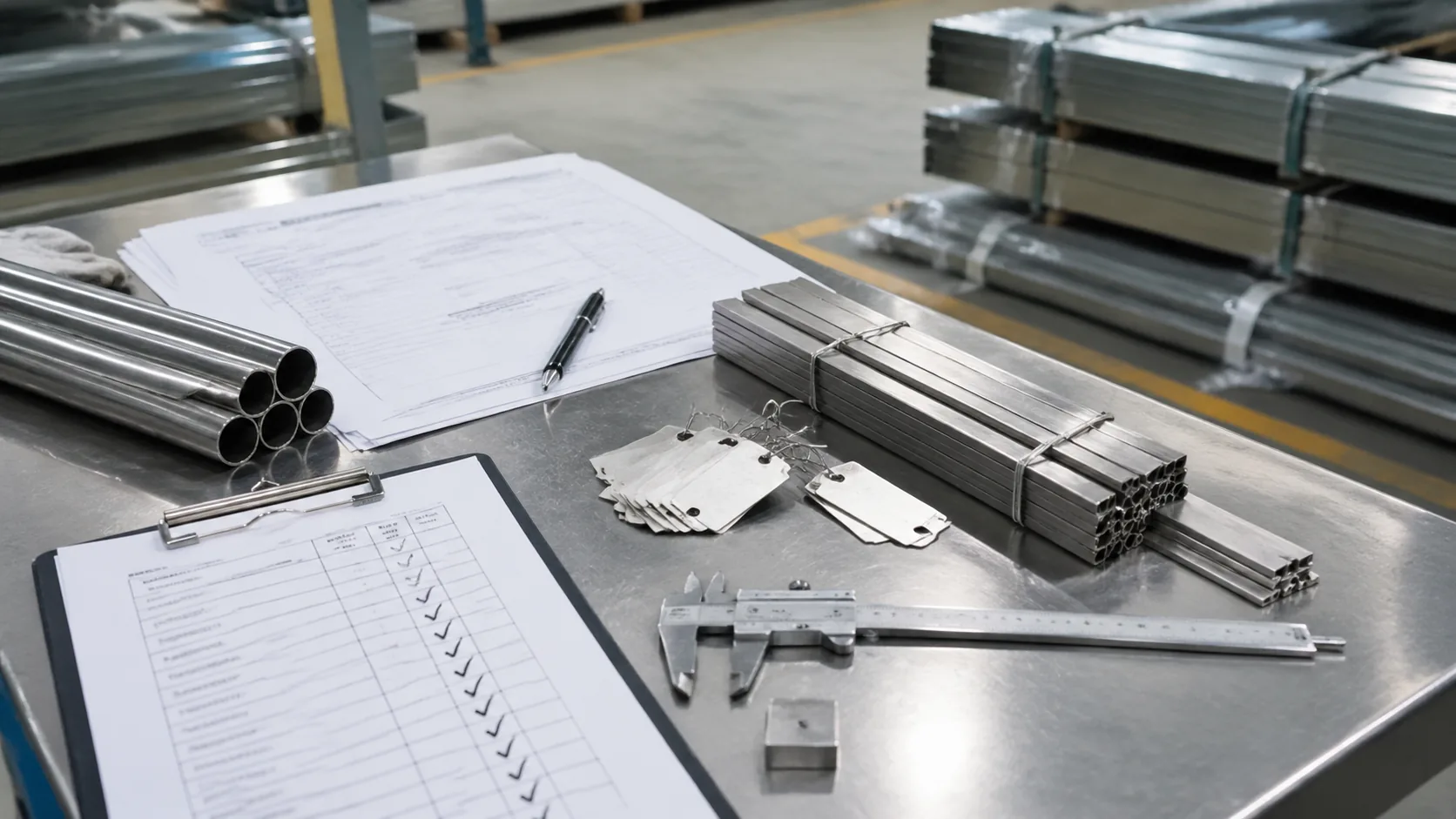
Use the MTC review as an acceptance checklist, not as a document collection habit.
| Checkpoint | Accept if | Hold shipment if |
|---|---|---|
| Order match | Grade, form, size, quantity, and standard match the PO | Certificate describes a different form, unclear grade, or missing standard |
| Heat traceability | Heat number matches tags, labels, packing list, and material marking | Heat number is absent, inconsistent, or lost after processing |
| Chemistry | Values meet the ordered grade and standard | Any required element is out of range or omitted |
| Mechanical values | Required values meet the standard or project spec | Required tests are missing or unexplained |
| Certificate type | Inspection statement and issuer are acceptable for the project | Certificate type is unclear or weaker than the order required |
| Processed material | Cutting, bending, or packing traceability is documented | Processed parts cannot be linked back to the heat |
For supplier qualification, the MTC review should also be part of the broader document discipline. A serious supplier should respond with a complete certificate, explain traceability, and correct document inconsistencies quickly. The same logic applies when evaluating a stainless steel processing supplier: documentation is part of quality, not an administrative extra.
If the project requires third-party inspection, put that into the RFQ before production. Do not wait until the material is packed and then ask for a new inspection scope.
Conclusion
Read a stainless steel MTC in this order: match it to the order, confirm heat traceability, verify the standard and product form, check chemistry, review mechanical values, and only then release the shipment.
The certificate is not there to make the file look complete. It is there to prove that the material delivered is the material ordered. If that proof is incomplete, the lowest price on the quote sheet stops mattering.
Author: NewQiujing Group