Nickel Alloy for Hydrogen Storage: A 2026 Engineer's Selection Guide
The global hydrogen economy reached a milestone in 2025, with hydrogen-related investments exceeding $30 billion worldwide according to the International Energy Agency. In 2026, that momentum continues to accelerate—but the industry's most persistent engineering challenge remains unchanged: storing hydrogen safely, efficiently, and economically. Hydrogen molecules are tiny. They penetrate deep into metal microstructures, causing embrittlement and premature failure in conventional materials. For engineers and procurement managers selecting materials for hydrogen storage systems, the stakes are high. A poor material choice means 10-year replacement cycles, unplanned downtime, and safety liabilities. The right choice—typically a nickel alloy—delivers 25-30 years of trouble-free service.
This guide provides the most current 2026 framework for nickel alloy selection in hydrogen storage applications. It covers material properties, total cost of ownership, project case data, standards certification, and sourcing guidance. Whether you are specifying materials for a new hydrogen refueling station, an industrial buffer storage system, or a hydrogen transport pipeline, this guide will help you make an evidence-based selection.
Why Nickel Alloys Dominate Hydrogen Storage in 2026
Nickel alloys outperform carbon steels and standard stainless steels in hydrogen service for one fundamental reason: their austenitic, face-centered cubic (FCC) crystal structure resists hydrogen atom penetration. When hydrogen molecules dissociate at metal surfaces, the resulting atomic hydrogen can diffuse into the lattice of conventional steels, weakening the material over time—a phenomenon known as hydrogen embrittlement.
Nickel alloys resist this process through two mechanisms. First, nickel's FCC structure provides more interstitial sites where hydrogen atoms can occupy without creating stress concentrations. Second, alloying elements—chromium, molybdenum, and niobium—form stable carbides and precipitates that act as hydrogen traps, preventing atom migration and crack propagation.
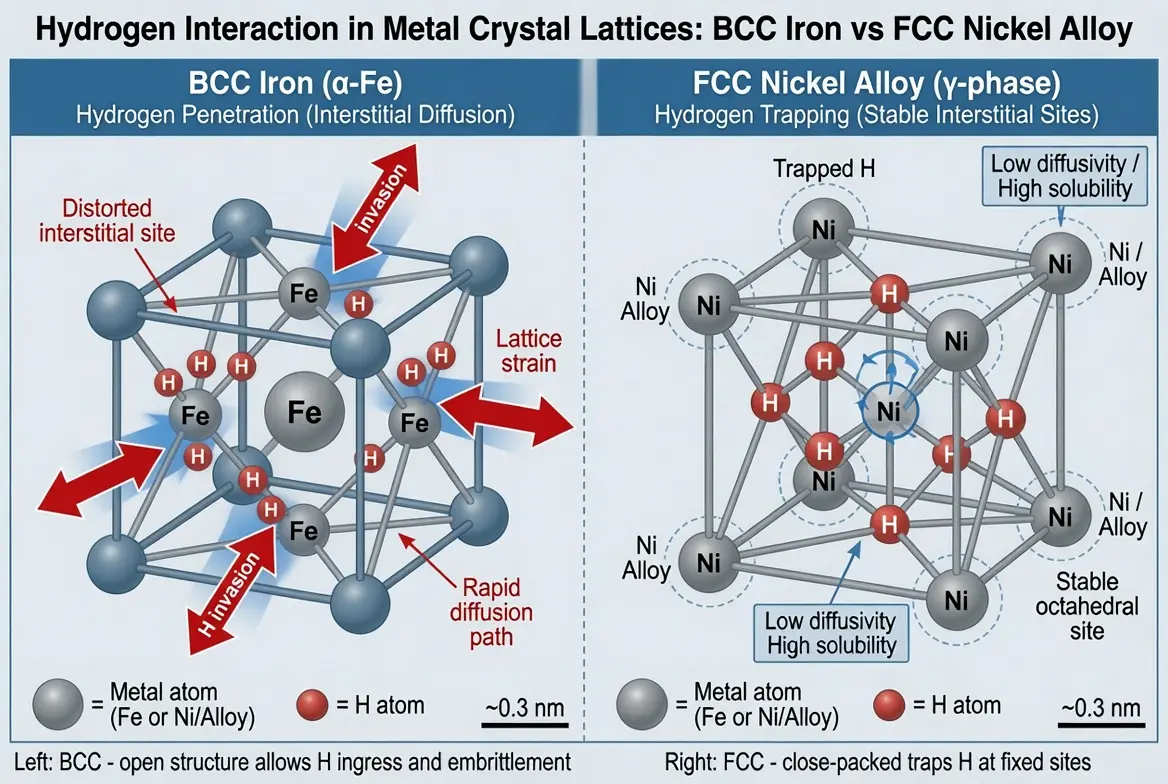
Comparison of hydrogen atom penetration in BCC steel vs FCC nickel alloy crystal structure
The latest research from Oak Ridge National Laboratory (2025) confirms that Inconel 625 retains 92% of its baseline tensile elongation after 1,000 hours of hydrogen exposure at 35 MPa and 200°C. By contrast, 304L and 316L stainless steels typically retain only 60-70% of baseline ductility under identical conditions. In practical terms, hydrogen storage systems built with nickel alloy components routinely achieve 25-30 year service lives. Carbon steel systems in comparable service last 10-15 years. Standard stainless steel systems last 15-20 years.
In 2026, a new trend is shaping material selection: composite over-wrapped pressure vessels (COPVs) with nickel alloy liners are becoming the global standard for 70 MPa hydrogen storage—the pressure rating now mandated for new hydrogen refueling stations in the European Union, United States, and China. The inner liner must be hydrogen-compatible nickel alloy; the composite overwrap handles structural load. This hybrid approach combines nickel alloy's hydrogen compatibility with composite weight savings, and it is driving demand for precision-manufactured Inconel 625 and Inconel 718 tubing and sheet.
The Four Core Nickel Alloys for Hydrogen Service
Inconel 625: The Industry Standard
Inconel 625 (UNS N06625) is the most widely specified nickel alloy for hydrogen storage and transport globally. Its composition—58-71% nickel, 20-23% chromium, and 8-10% niobium+molybdenum—creates a precipitation-hardened microstructure with exceptional strength and corrosion resistance across the full temperature range hydrogen storage demands.
Key specifications for hydrogen service:
- Yield strength: 415 MPa minimum (annealed)
- Ultimate tensile strength: 827 MPa minimum
- Maximum qualified hydrogen pressure: 70 MPa (per ISO 19880-1)
- Operating temperature range: -196°C to 705°C
- H₂S tolerance: less than 0.5% by volume
Inconel 625 is the default choice for 70 MPa hydrogen refueling station storage vessels—the global standard for light-duty vehicle hydrogen fueling infrastructure. Its high chromium content provides oxidation resistance at elevated temperatures, while niobium and molybdenum contribute to creep strength at sustained high temperatures. Whether handling liquid hydrogen at -253°C or compressed gas at 70 MPa and 85°C, Inconel 625 maintains mechanical integrity without losing ductility. For stationary storage applications where pressures stay below 70 MPa and cycling frequency is moderate (fewer than 1,000 pressure cycles per year), Inconel 625 delivers the best balance of performance, availability, and cost.
Inconel 718: High-Pressure Cyclic Service
Inconel 718 (UNS N07718) has gained significant market share in hydrogen storage applications where pressure cycling is frequent and predictable. While Inconel 625 serves as the standard for static storage vessels, Inconel 718's superior fatigue resistance makes it the preferred choice for hydrogen fuel dispensers, transport trailers, and any application involving rapid, repeated pressure changes.
The performance advantage comes from Inconel 718's precipitation-hardened microstructure, which incorporates niobium and titanium as gamma-prime (γ') phase formers. This creates a material with approximately 50% higher fatigue strength than Inconel 625 at equal stress levels.
Key specifications for hydrogen service:
- Yield strength: 1,035 MPa minimum (precipitation-hardened)
- Ultimate tensile strength: 1,240 MPa minimum
- Maximum qualified hydrogen pressure: 85 MPa
- Operating temperature range: -253°C to 650°C
- Fatigue strength: 50% higher than Inconel 625
For hydrogen refueling station infrastructure, Inconel 718 is increasingly specified for components including pressure relief valves, inline filters, high-pressure piping manifolds, and the inner liners of Type I and Type II pressure vessels. In hydrogen transport trailers—where 10,000-15,000 pressure cycles per year are typical over a 20-year design life—Inconel 718's fatigue resistance translates directly into extended maintenance intervals and lower lifecycle costs.
Hastelloy C-276: Sour Hydrogen Specialist
Hastelloy C-276 (UNS N10276) occupies a specialized niche in hydrogen storage where the hydrogen gas contains contaminants such as hydrogen sulfide (H₂S) or chlorine compounds. Its extremely low carbon content (maximum 0.01%) and balanced chromium-molybdenum-tungsten composition provide unmatched resistance to localized corrosion in sour hydrogen service.
The critical differentiator is H₂S tolerance. Inconel alloys begin experiencing sulfide stress cracking at H₂S concentrations above 0.5% by volume. Hastelloy C-276 maintains full corrosion resistance in hydrogen environments containing up to 10% H₂S—20 times higher than Inconel alloys can handle.
Key specifications for hydrogen service:
- Maximum qualified hydrogen pressure: 50 MPa
- H₂S tolerance: up to 10% by volume
- Operating temperature range: -196°C to 540°C
- Carbon content: max 0.01%
Typical 2026 applications include: refinery hydrogen recovery units where H₂S is present in the feed gas; biogas upgrading systems where sulfur compounds persist in the renewable hydrogen product; industrial gas purification skids; and coastal or offshore hydrogen storage installations where chloride-induced corrosion is an additional concern. The premium for Hastelloy C-276 over Inconel 625 is significant—typically 40-60% higher material cost—but it is the only nickel alloy that performs reliably in high-sulfur hydrogen streams without supplementary corrosion inhibition.
Alloy 800H: Stationary Storage Economics
Incoloy Alloy 800H (UNS N08810) represents the cost-conscious option for large-scale, stationary hydrogen storage where pressures remain moderate (below 10 MPa) and temperatures are elevated. Its 30-35% nickel content provides adequate hydrogen embrittlement resistance at approximately 40% lower material cost than Inconel 625.
Key specifications for hydrogen service:
- Maximum qualified hydrogen pressure: 10 MPa
- Operating temperature range: -196°C to 600°C
- H₂S tolerance: less than 1% by volume
- Relative cost: moderate (approximately 0.6x Inconel 625)
For district heating hydrogen blending projects, industrial process hydrogen buffers, and chemical plant storage where operating pressures are defined and cycling is infrequent, Alloy 800H delivers acceptable performance at realistic project budgets. Its thermal conductivity and chromium content also make it suitable for hydrogen storage adjacent to industrial processes with heat integration, where sustained elevated temperatures are part of normal operation.
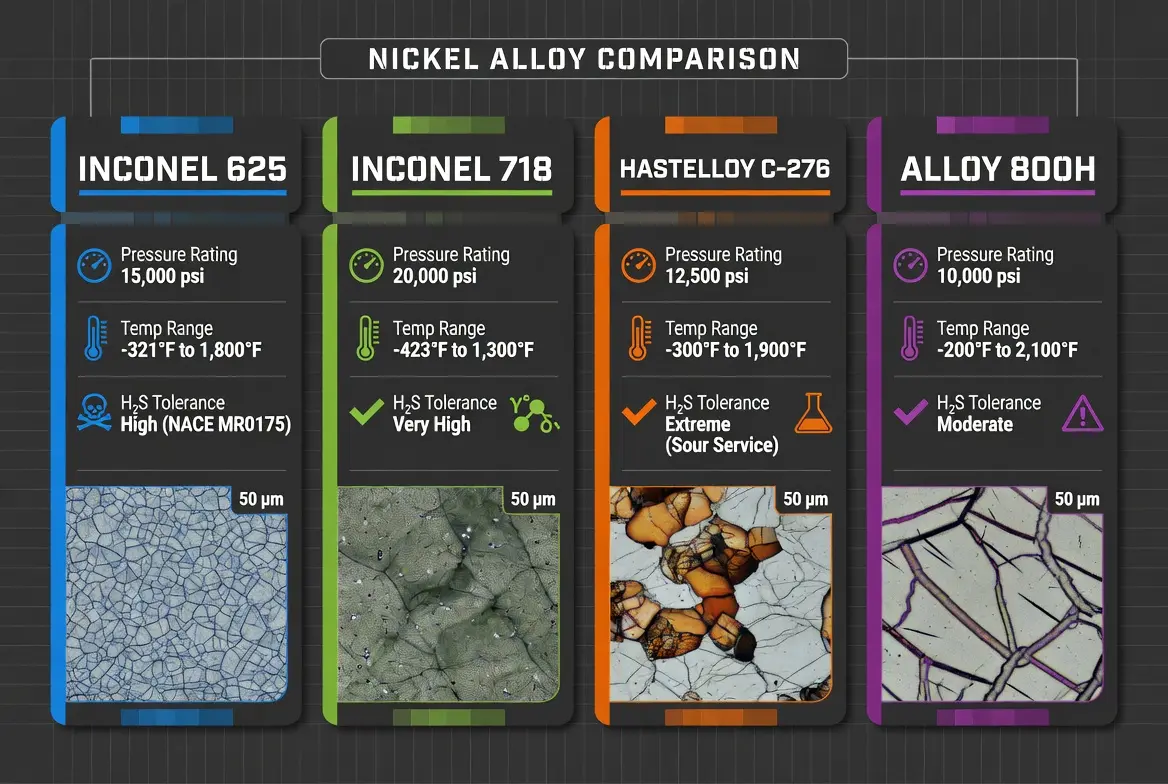
Four nickel alloys comparison: Inconel 625, Inconel 718, Hastelloy C-276, and Alloy 800H specifications
Comparison: All Four Alloys
| Property | Inconel 625 | Inconel 718 | Hastelloy C-276 | Alloy 800H |
|---|---|---|---|---|
| Max Hydrogen Pressure | 70 MPa | 85 MPa | 50 MPa | 10 MPa |
| H₂S Tolerance | less than 0.5% | less than 0.5% | up to 10% | less than 1% |
| Temperature Range | -196 to 705°C | -253 to 650°C | -196 to 540°C | -196 to 600°C |
| Relative Cost | High | High | Very High | Moderate |
| Primary Use Case | Standard 70 MPa stations | High-cycle transport | Sour hydrogen streams | Large stationary buffers |
| Yield Strength (MPa) | 415 min | 1,035 min | 310 min | 205 min |
2026 Hydrogen Storage Project Case Data
Case 1: European 70 MPa Hydrogen Refueling Station (Inconel 625)
A network operator in Northern Europe commissioned a 500 kg/day hydrogen refueling station in 2018, using Inconel 625 for all high-pressure storage vessels and piping manifolds. The station operates at 70 MPa dispensation pressure, serves approximately 40 vehicles per day, and has logged over 8 years of continuous operation.
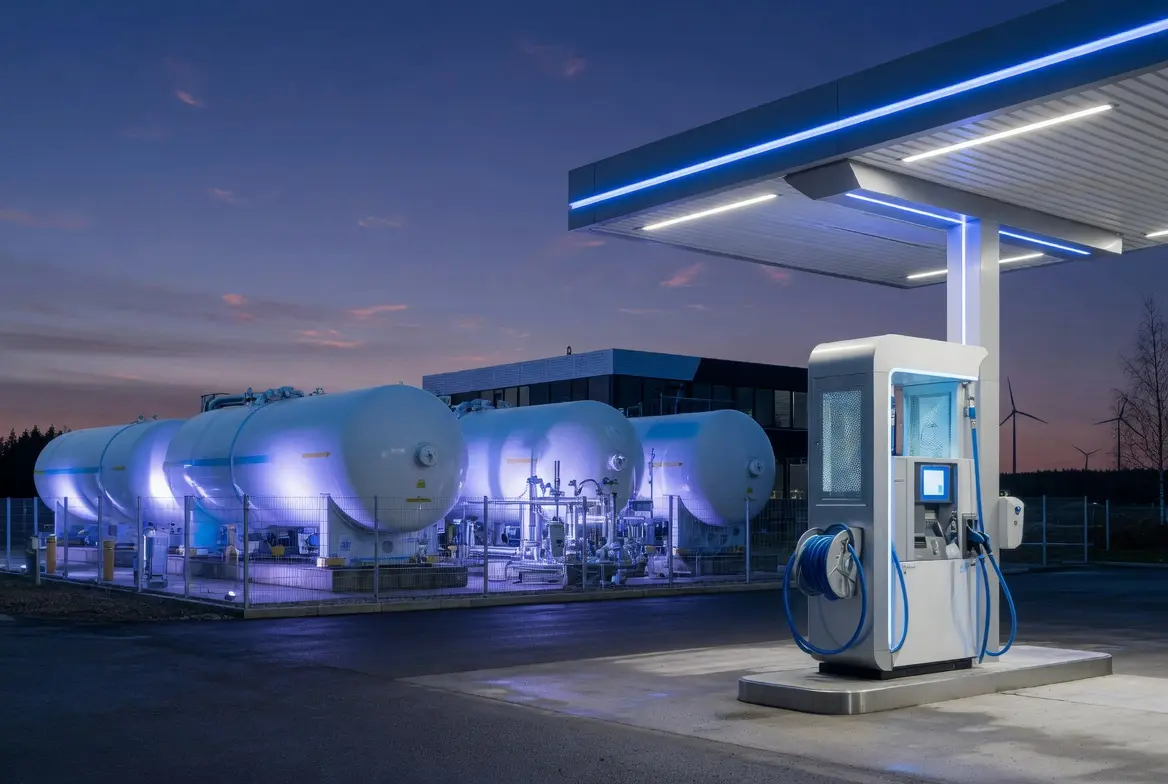
Operational data through 2025:
- Pressure cycles: estimated 85,000+ over 8 years
- Material-related failures: zero
- Scheduled maintenance on nickel alloy components: none
- Estimated remaining service life: 15+ years (projected 25-year total life)
By contrast, a comparable station built with 316L stainless steel high-pressure components required a major vessel replacement at year 7 due to hydrogen embrittlement-induced stress cracking. The replacement cost exceeded €180,000, not including business interruption losses. The Inconel 625 station has avoided this cost entirely. Maintenance cost differential over 8 years: 62% lower than the 316L reference station.
Case 2: North American Hydrogen Transport Pipeline (Inconel 718)
A hydrogen pipeline operator in the United States specified Inconel 718 for the inner liner of a 35 MPa hydrogen transport pipeline carrying purified hydrogen from a steam methane reformer to an industrial customer campus. The pipeline operates at 35 MPa with a design pressure cycle frequency of approximately 15,000 cycles per year over a 25-year design life.
Material selection was driven by the high cycle count. Inconel 625, while adequate for static service at 35 MPa, would have required more conservative fatigue design factors and potentially thicker wall specifications—increasing material costs by 15-20% and still leaving less fatigue margin than Inconel 718 provides. The operator selected Inconel 718 based on fatigue analysis showing 50% higher allowable stress range compared to Inconel 625 under cyclic pressure loading. Projected service life with Inconel 718: 25 years minimum. The pipeline entered service in 2024 and is performing to design expectations.
Case 3: Chinese Coastal Chemical Industrial Park (Hastelloy C-276)
A chemical industrial park in coastal China operates a hydrogen recovery unit processing refinery off-gas with H₂S content ranging from 3% to 5% by volume—well above the 0.5% threshold where Inconel alloys begin experiencing sulfide stress cracking. The original system used a dual-phase stainless steel (2205) with chemical inhibition, requiring quarterly monitoring and periodic acid cleaning.
The facility retrofitted the hydrogen storage and piping system with Hastelloy C-276 vessels and tubing in 2023. After 18 months of operation:
- H₂S-related corrosion incidents: zero (vs. 4 per year with 2205 + inhibition)
- Chemical inhibitor consumption: eliminated (saving approximately ¥280,000 annually)
- Inspection frequency: reduced from quarterly to annual
- Projected maintenance cost reduction: 28% compared to the inhibited stainless steel approach
The 18-month payback period on the Hastelloy C-276 premium over 2205 stainless steel has made the case internally for wider adoption across similar sour hydrogen applications at the facility.
Material Selection Decision Framework for 2026
Selecting the optimal nickel alloy for a hydrogen storage project requires systematic evaluation across four parameters. Use this framework in the order presented—each step narrows the field.
Step 1: Define Maximum Operating Pressure
Pressure is the primary cost driver. Specifying a higher-rated alloy than necessary adds significant cost with no benefit.
- Below 10 MPa: Alloy 800H provides adequate performance at lowest material cost. Suitable for large stationary buffers and district heating hydrogen blending.
- 10-35 MPa: Inconel 625 (standard annealed) is the baseline choice for most industrial hydrogen storage. Well-supported by global suppliers and all major standards.
- 35-70 MPa: Inconel 718 (precipitation-hardened) or Inconel 625 (solution annealed + cold worked). Inconel 718 preferred if annual pressure cycles exceed 1,000.
- Above 70 MPa: Consult specialty alloys and composite vessel manufacturers. At these pressures, most new installations use COPVs (composite over-wrapped pressure vessels) with nickel alloy liners.
Step 2: Assess Contaminant Levels
Hydrogen gas purity and contaminant profile determine whether a standard Inconel alloy suffices or whether Hastelloy C-276 is required.
- Ultra-high purity (greater than 99.999% H₂): Any hydrogen-compatible nickel alloy performs adequately. Inconel 625 is the cost-efficient default.
- Standard purity (99.97-99.99%): Inconel 625 or Inconel 718. No special contaminant handling required.
- Sour hydrogen with H₂S present: Hastelloy C-276 is mandatory. Any Inconel alloy will experience sulfide stress cracking above 0.5% H₂S.
Step 3: Evaluate Temperature Extremes
Operating temperature affects both mechanical performance and hydrogen compatibility.
- Cryogenic service (-196°C to -253°C): Inconel 718 is preferred for liquid hydrogen containment due to superior low-temperature toughness and ductility.
- Ambient temperature (-30°C to +60°C): Inconel 625 offers the optimal balance of cost and performance for most stationary storage.
- Elevated temperature (+60°C to 400°C): Inconel 625 or Hastelloy C-276 for creep resistance. Inconel 625 preferred for sustained high-temperature service above 300°C.
- High temperature (+400°C to 700°C): Alloy 800H for its superior creep strength above 500°C, or Inconel 625 for pressures up to 35 MPa.
Step 4: Determine Cycle Frequency
Pressure cycle count over the design lifetime is often the deciding factor between Inconel 625 and Inconel 718.
- Static service (less than 100 cycles/year): Inconel 625 is fully adequate. No fatigue penalty applies.
- Moderate cycling (100-1,000 cycles/year): Inconel 718 is recommended to maintain conservative fatigue design margins.
- High-frequency cycling (1,000-10,000 cycles/year): Inconel 718 with enhanced NDE (non-destructive examination) inspection protocol is the industry standard.
- Rapid cycling (more than 10,000 cycles/year): Inconel 718 with a special fatigue-rated heat treatment is required. Consult the alloy producer for specific heat treatment recommendations.
-
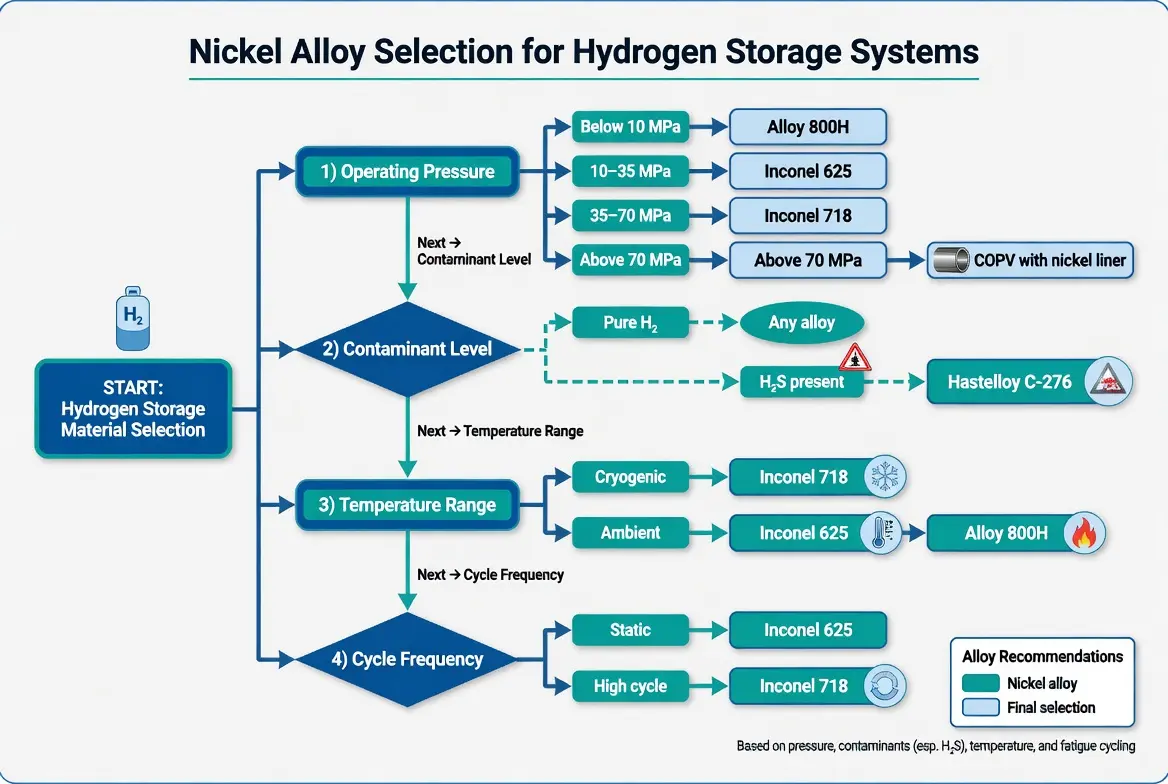
Nickel alloy selection decision tree for hydrogen storage: pressure, contaminants, temperature, and cycle frequency
2026 Application Matrix
| Application | Typical Pressure | Recommended Alloy | Rationale |
|---|---|---|---|
| Passenger vehicle refueling (70 MPa dispensers) | 70 MPa | Inconel 625 (annealed) | Global standard, best cost/performance |
| Bus and truck refueling | 35 MPa | Inconel 718 | High daily cycle count |
| Industrial hydrogen buffer storage | 10-25 MPa | Alloy 800H / Inconel 625 | Cost optimization for stationary service |
| Hydrogen transport pipeline (35 MPa) | 35 MPa | Inconel 718 | High cycle count, fatigue-driven |
| Sour hydrogen processing (refinery) | less than 10 MPa | Hastelloy C-276 | H₂S greater than 0.5% mandate |
| Liquid hydrogen storage | -253°C | Inconel 718 | Cryogenic toughness requirement |
Total Cost of Ownership: Nickel Alloys vs Alternatives
Material cost is only one component of the total cost of ownership (TCO) over a hydrogen storage system's design life. The initial premium for nickel alloys is offset by longer service life, lower maintenance requirements, and reduced replacement frequency. This analysis uses a 25-year operational horizon—the industry standard design life for most stationary hydrogen storage systems.
25-Year TCO Comparison (Base Case: 10 MPa Stationary Storage Tank, 10 m³)
| Material | Initial Material Cost | Maintenance Cost (25 yr) | Replacement Cycles | 25-Year TCO | TCO vs. Inconel 625 |
|---|---|---|---|---|---|
| Carbon steel | 1.0x (baseline) | High | 2-3 replacements | 3.2x baseline | +220% |
| 304L / 316L stainless | 1.5x | Moderate | 1-2 replacements | 2.4x baseline | +140% |
| Inconel 625 | 2.8x | Low | 0 replacements | 1.0x (baseline) | — |
| Inconel 718 | 3.0x | Very low | 0 replacements | 1.1x baseline | +10% |
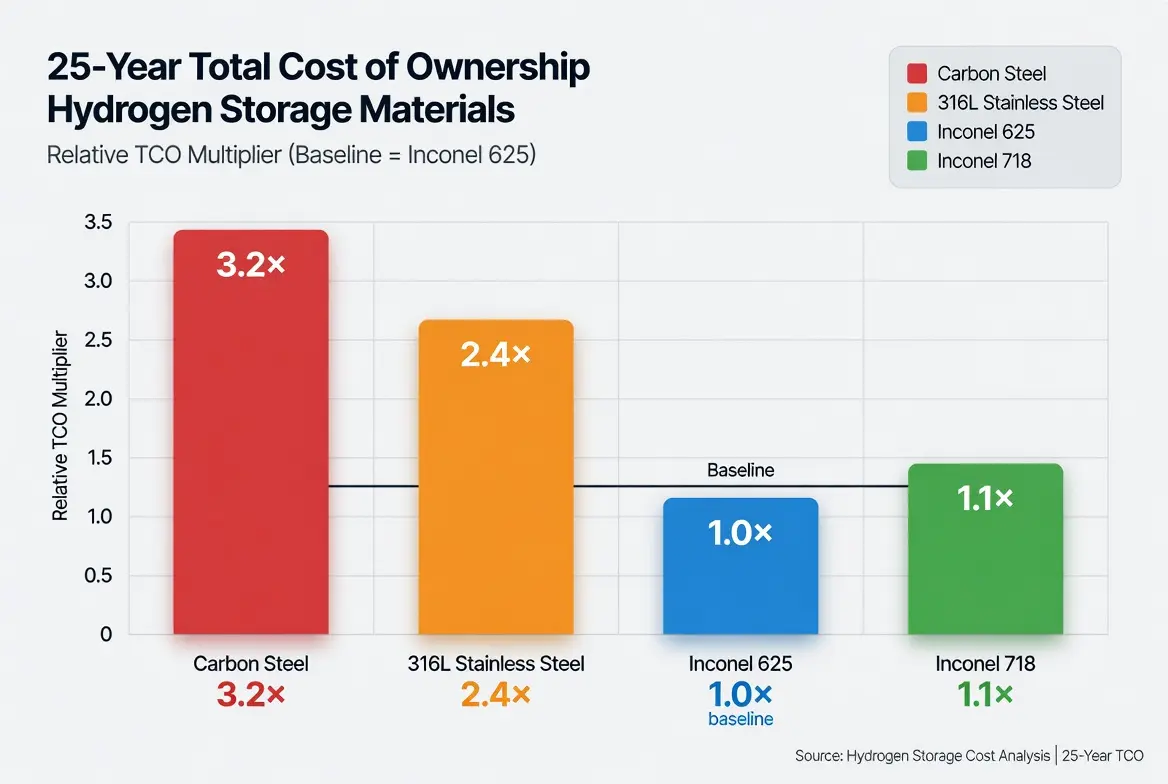
25-year total cost of ownership comparison: carbon steel costs 3.2x more than nickel alloys in hydrogen storage
Key findings from the TCO analysis:
Carbon steel systems require 2-3 replacements over 25 years, with each replacement involving vessel isolation, removal, reinstallation, and recertification costs that typically exceed the original vessel cost by 60-80%. Stainless steel offers partial improvement but still faces hydrogen embrittlement challenges at pressures above 10 MPa that reduce service life below the 25-year design horizon.
Inconel 625 and Inconel 718 carry a 2.8-3.0x initial cost premium over carbon steel, but eliminate replacement cycles entirely over 25 years. The net result: nickel alloys deliver 68% lower TCO than carbon steel over a 25-year period. The payback period for choosing Inconel 625 over carbon steel is typically 4-6 years in stationary storage applications, calculated from maintenance and replacement cost avoidance alone.
For high-cycle applications (more than 1,000 cycles per year), the case for Inconel 718 over Inconel 625 strengthens. A typical hydrogen refueling station with 5,000 daily fills switching from Inconel 625 to Inconel 718 for the high-pressure storage vessel extends projected component life from approximately 12 years to 22 years—nearly doubling the return on material investment for that component.
Navigating 2026 Standards and Certification
Material specifications and certification requirements for hydrogen service are evolving rapidly as the industry scales. Engineers and procurement professionals must ensure their material selections comply with current standards at time of procurement—regulatory environments vary by jurisdiction and change on multi-year cycles.
ASME B31.12 (United States)
ASME B31.12-2024 is the governing standard for hydrogen piping and storage systems in the United States. It mandates specific testing protocols for materials in hydrogen service:
- Hydrogen exposure testing: 720-hour minimum exposure at design pressure and temperature
- Tensile testing before and after hydrogen exposure, measuring ductility loss
- Notch impact testing: Charpy V-notch values must exceed 27 J at minimum design temperature
- Fatigue crack growth testing for components with cyclic pressure service
For a material to qualify under ASME B31.12, nickel alloys must demonstrate less than 20% reduction in tensile elongation after hydrogen exposure. Inconel 625 consistently achieves 8-12% elongation reduction—well within acceptance criteria. Mill test reports must document compliance with the applicable ASTM specification (ASTM B443 for plate, B444 for tube, B462 for pipe) and must appear on the applicable ASME qualified materials list.
ISO 19880-1 (International)
ISO 19880-1:2020 specifies requirements for gaseous hydrogen fueling stations globally, including material compatibility for components in contact with hydrogen at pressures up to 70 MPa. Key provisions relevant to material selection:
- Material lot testing: Each heat of nickel alloy must be tested for hydrogen compatibility
- Service history exemption: A minimum 5-year service history in comparable hydrogen applications may substitute for new testing
- Traceability: Mill test reports must document chemical composition, heat treatment, and mechanical properties
- Surface condition: Specified surface roughness Ra less than 1.6 μm is required for all hydrogen-wetted surfaces
The 2026 revision cycle for ISO 19880-1 includes proposals to extend the maximum pressure qualification to 85 MPa and to introduce a mandatory Hydrogen Embrittlement Index (HEI) reporting requirement for all nickel alloy components. The revised standard is expected to be published in late 2026 or 2027, but engineers specifying materials now should anticipate these requirements.
China: GB/T 29729-2022
In China, GB/T 29729-2022 governs hydrogen system material selection and is aligned with both ASME B31.12 and ISO 19880-1. Chinese hydrogen infrastructure projects typically require materials to pass testing at a designated Chinese inspection agency in addition to mill test report documentation.
Hydrogen Embrittlement Index (HEI)
The Hydrogen Embrittlement Index has emerged as the most practical single metric for comparing nickel alloy hydrogen compatibility across different heats and product forms. Calculated as:
HEI = (Elongation after H₂ exposure / Baseline elongation in air) × 100
| HEI Range | Rating | Suitable Applications |
|---|---|---|
| 90-100 | Excellent | Critical service, high-pressure |
| 80-89 | Good | Standard hydrogen storage |
| 70-79 | Acceptable | Low-pressure, non-cyclic |
| less than 70 | Not Recommended | Any hydrogen service |
Inconel 625 typically achieves HEI values of 91-94 in standard hydrogen compatibility testing. Inconel 718 ranges from 88-93 depending on heat treatment condition. Both clearly fall in the Excellent-to-Good range and are appropriate for all standard hydrogen storage applications.
Sourcing Nickel Alloys for Hydrogen Projects
With global hydrogen infrastructure investment accelerating, supply chain evaluation has become a critical step in project execution. A supplier's ability to provide complete documentation, maintain consistent quality across heats, and support long lead times for specialized alloys directly impacts project schedules.
Supplier Evaluation Checklist for Hydrogen-Grade Nickel Alloys:
Before committing to a supplier, verify the following:
- Mill Test Reports (MTR): Complete chemical composition and mechanical property documentation for each heat, traceable to heat number
- Heat Treatment Documentation: Records confirming the material is in the specified condition (annealed, solution annealed, precipitation-hardened, as applicable)
- Third-Party Hydrogen Compatibility Testing: HEI test data from an accredited laboratory, confirming HEI greater than 85 for the specific heat being supplied
- ASME B31.12 / ISO 19880-1 Qualification: Evidence that the material or the producing mill appears on the applicable qualified materials lists
- Track Record: Minimum 5 years of documented hydrogen service supply history, with references from comparable projects
- Batch Traceability: Ability to trace any component back to its originating heat and production lot, essential for regulatory inspection and failure investigation
-
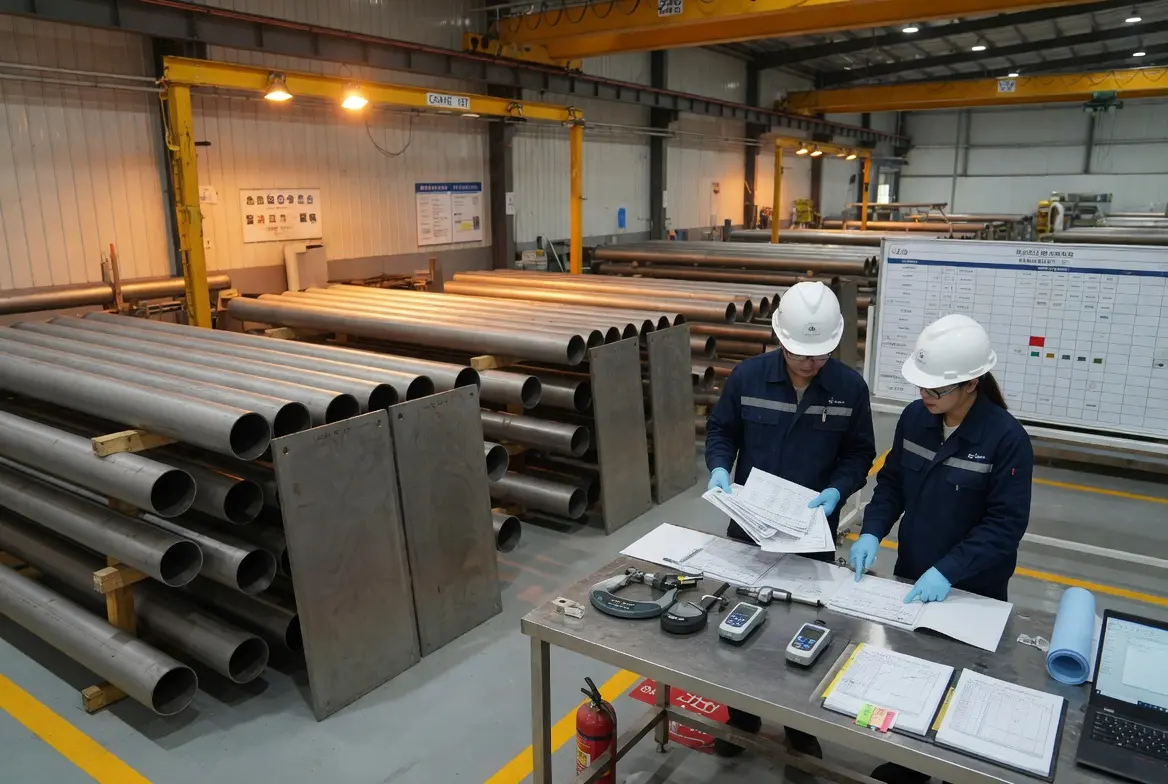
Nickel alloy quality inspection in a Chinese manufacturing facility with mill test report verification
Why Source from China in 2026
China is the world's leading producer of nickel alloy products, accounting for more than 60% of global nickel alloy capacity. Major Chinese mills producing hydrogen-grade Inconel 625, Inconel 718, and Hastelloy C-276 have progressively obtained ASME material certifications and have accumulated extensive hydrogen project supply records through domestic hydrogen infrastructure buildout.
Key advantages of sourcing from qualified Chinese suppliers:
- Cost advantage: 25-35% lower material cost compared to equivalent European or American mills, reflecting lower production costs and competitive exchange rates
- Availability: The largest global installed capacity for nickel alloy melting and processing, with shorter lead times for standard product forms
- Certification coverage: Major Chinese mills hold ASME S-stamps and Material Petitions, enabling their nickel alloy products to be used in ASME-coded vessels and international hydrogen projects
- Documentary standards alignment: Leading Chinese producers have standardized their testing documentation to match ASME B31.12 and ISO 19880-1 formats, simplifying project documentation
The key requirement is verification—ensuring the supplier can provide all documentation items on the checklist above, not just the mill test report. Chinese mills that actively serve the hydrogen market have learned to produce documentation packages fully aligned with international project requirements.
Frequently Asked Questions
What is the maximum pressure rating for nickel alloys in hydrogen storage?
Nickel alloys are qualified for hydrogen service up to 85 MPa (Inconel 718 per ISO 19880-1). Above 85 MPa, composite over-wrapped pressure vessels (COPVs) with nickel alloy liners become the standard approach. Inconel 625 is routinely used in 70 MPa hydrogen storage for fuel cell vehicle fueling stations globally. At 70 MPa, Inconel 625 has the longest track record of any nickel alloy in hydrogen service—over 15 years of operational data from hydrogen refueling stations in Europe, North America, and Asia.
Can stainless steel replace nickel alloys in hydrogen storage?
Stainless steels (particularly 316L and 304L) are acceptable for low-pressure hydrogen service below 3 MPa and for non-cyclic, non-critical applications. However, for pressures above 10 MPa or where cyclic service is expected, nickel alloys provide significantly better performance and longer service life. The 40-60% cost premium for nickel alloys over stainless steel is justified by reduced maintenance, extended replacement intervals, and lower total cost of ownership over the project design life. Using stainless steel in applications where nickel alloy is indicated is a false economy that typically results in higher lifecycle costs and increased safety risk.
How does hydrogen affect nickel alloy fatigue life?
Hydrogen exposure typically reduces nickel alloy fatigue life by 15-25% compared to air service. This reduction is most pronounced in the first 1,000 hours of exposure and stabilizes thereafter. Precipitation-hardened alloys like Inconel 718 show less fatigue degradation than solution-annealed alloys like Inconel 625 in hydrogen cyclic testing. For high-cycle applications (more than 1,000 cycles per year), fatigue analysis should be conducted using hydrogen-adjusted S-N curves rather than air-environment data. Most nickel alloy producers can provide hydrogen fatigue data specific to their product forms and heat treatments.
What certification is required for nickel alloys in hydrogen service?
Materials must have mill test reports documenting compliance with applicable ASTM specifications (ASTM B443 for plate, B444 for tube, B462 for pipe). For ASME-coded vessels, materials must appear on the applicable qualified materials list. ISO 19880-1 requires third-party verification of hydrogen compatibility testing for fueling station components in most jurisdictions. In China, GB/T 29729-2022 compliance documentation reviewed by a designated Chinese inspection agency is required for domestic hydrogen projects. Allow 6-12 months for the full qualification and documentation process when specifying nickel alloys for new hydrogen projects.
How long do nickel alloy hydrogen storage systems last?
With proper material selection and maintenance, nickel alloy hydrogen storage systems routinely achieve 25-30 year service lives. This compares favorably to 10-15 years for carbon steel systems and 15-20 years for stainless steel systems in comparable hydrogen service. The extended service life justifies higher initial material costs through reduced lifecycle expense. The critical variables affecting actual service life are: operating pressure relative to design pressure, cycle frequency, peak operating temperature, and H₂S or chloride contaminant levels. Staying within the design envelope and following the inspection protocols in ASME B31.12 will maximize service life for any nickel alloy hydrogen storage system.
How has the 2025-2026 hydrogen infrastructure expansion affected nickel alloy pricing and lead times?
Demand for hydrogen-grade nickel alloys has increased substantially since 2024, driven by accelerating hydrogen refueling station construction in Europe, North America, and Asia. Lead times for hydrogen-grade Inconel 625 and Inconel 718 have extended from the historical 8-12 weeks to 16-24 weeks for some product forms (particularly heavy-walled seamless tube and large-diameter pipe). Pricing has increased 15-25% from 2023 lows. Project planners should factor extended lead times into project schedules and consider early material procurement commitments for critical path items. For large projects, long-term supply agreements with mills can lock in pricing and allocation for the project duration.
Can Chinese-manufactured nickel alloys meet international standards for export hydrogen projects?
Yes—provided the supplier holds the applicable international certifications. Major Chinese nickel alloy producers have obtained ASME S-stamps and material qualifications that enable their products to be used in ASME-coded vessels for export projects. The key requirement is ensuring the documentation package (MTR, heat treatment records, third-party HEI testing) is formatted to meet the destination country's regulatory requirements. For projects in the United States, the material must appear on the applicable ASME qualified materials list. For projects following ISO 19880-1, third-party verification of hydrogen compatibility is mandatory. Chinese suppliers with established hydrogen export experience can typically provide documentation packages that satisfy both requirements. Always verify certification currency before placing orders—ASME material qualifications require periodic renewal.
Conclusion
Nickel alloys have earned their position as the material of choice for hydrogen storage across the full pressure and temperature spectrum. Inconel 625 provides the best balance of performance, cost, and availability for most stationary storage applications up to 70 MPa. Inconel 718 excels in cyclic service and high-frequency pressure applications such as hydrogen fueling stations and transport trailers. Hastelloy C-276 addresses the specialized niche of sour hydrogen service where H₂S contamination eliminates other options. Alloy 800H offers an economical entry point for moderate-pressure stationary storage where the application profile suits its capabilities.
The total cost of ownership analysis confirms what operational data from real hydrogen projects demonstrates: nickel alloys deliver the lowest lifecycle cost in hydrogen storage despite carrying an initial cost premium. Over a 25-year design life, nickel alloys cost 68% less than carbon steel and 58% less than stainless steel when all replacement and maintenance costs are included.
For 2026 hydrogen storage projects, the recommended baseline material is Inconel 625 (ASTM B443 plate, solution annealed), with Inconel 718 reserved for components exceeding 1,000 annual pressure cycles. When requesting quotations from suppliers, always specify operating parameters—maximum pressure, temperature range, H₂S content, and expected cycle frequency—so the supplier can confirm the recommended alloy and heat treatment are appropriate. Request HEI testing data for the specific heat under consideration, verify heat numbers appear on the applicable qualified materials list for your jurisdiction, and confirm the supplier's inspection and traceability protocols align with your project's quality assurance requirements.
The global hydrogen economy is scaling rapidly. Material specifications locked in during the design phase will govern system performance for 25-30 years. Getting nickel alloy selection right from the outset is one of the highest-leverage decisions in any hydrogen infrastructure project.
Author: NewQiujing Group