Stainless Steel Bending Radius Chart: Guidelines by Grade & Thickness
Bending stainless steel is not the same as bending mild steel. The material’s higher yield strength, work-hardening rate, and springback behavior mean that using generic sheet metal guidelines leads to cracked parts, out-of-tolerance angles, and surface defects. This guide provides the specific bending radius data, K-factor values, and springback compensation numbers that fabrication engineers and press brake operators need — organized by stainless steel grade and thickness, from a material supplier’s practical perspective.
Why Stainless Steel Bending Radius Matters
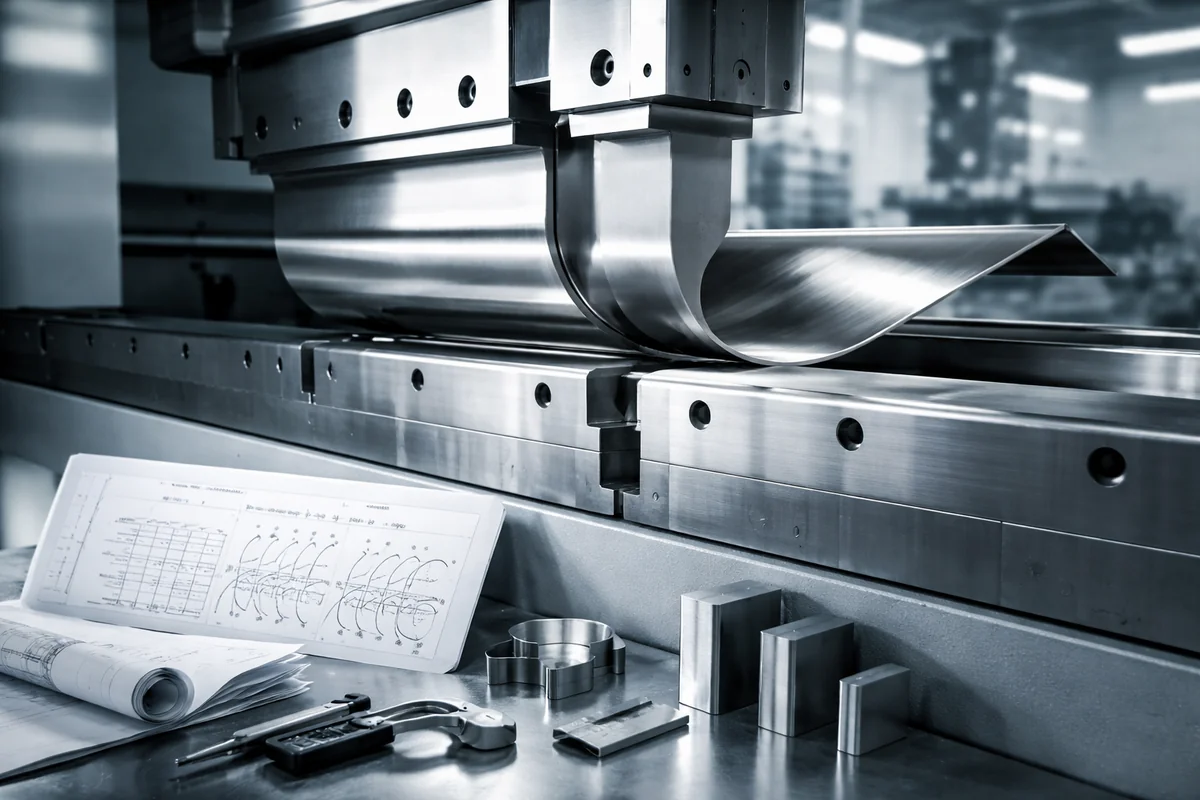
The minimum bend radius is the smallest radius you can form at the inside of a bend without cracking the material or creating micro-fractures that compromise structural integrity. For stainless steel, this value depends on three factors:
- Grade composition — Austenitic grades (304, 316) are more formable than ferritic (430) or duplex (2205) grades
- Temper condition — Annealed material bends much more easily than cold-worked (hard) temper
- Sheet thickness — Thicker material requires a larger minimum radius
Getting the bend radius wrong has real consequences. Too tight a radius on 304L causes work-hardening cracks along the bend line. Too large a radius on 430 ferritic stainless results in excessive springback and parts that don’t meet angular tolerance. For a material supplier like NewQiujing Steel, we see these issues regularly when clients bring in parts that were designed with carbon steel assumptions.
Key rule of thumb: Stainless steel generally requires a minimum bend radius 1.5 to 2 times larger than the equivalent carbon steel specification for the same thickness.
Minimum Bend Radius by Stainless Steel Grade
The tables below show minimum inside bend radii for common stainless steel grades at various thicknesses. All values assume annealed temper and a 90-degree bend using a standard V-die.
Austenitic Stainless Steel (304, 304L, 316, 316L)
Austenitic grades offer the best formability among stainless steels. The low yield strength and high elongation of annealed 304/316 allow tighter bend radii.
| Thickness (mm) | 304 / 304L Min Radius | 316 / 316L Min Radius | Notes |
|---|---|---|---|
| 0.5 | 0.5t | 0.5t | Easily formed, no cracking risk |
| 0.8 | 0.5t | 0.5t | Standard sheet metal thickness |
| 1.0 | 0.5t | 0.5t | Common for enclosures and panels |
| 1.2 | 0.5t | 1.0t | 316 slightly less formable due to Mo content |
| 1.5 | 1.0t | 1.0t | Minimum radius increases at this thickness |
| 2.0 | 1.0t | 1.0t | Press brake with appropriate die opening |
| 2.5 | 1.5t | 1.5t | Consider air bending for tighter radii |
| 3.0 | 1.5t | 2.0t | 316L requires slightly larger radius |
| 4.0 | 2.0t | 2.0t | Coined bending may be needed |
| 5.0 | 2.5t | 2.5t | Bottom bending recommended |
t = material thickness
Ferritic Stainless Steel (430, 409)
Ferritic grades have lower ductility than austenitic grades and are more prone to cracking at tight radii. They also exhibit less springback, which can be an advantage for angle accuracy.
| Thickness (mm) | 430 Min Radius | 409 Min Radius | Notes |
|---|---|---|---|
| 0.5 | 1.0t | 1.0t | More brittle than austenitic |
| 0.8 | 1.0t | 1.0t | Grain direction matters more |
| 1.0 | 1.5t | 1.0t | Bend perpendicular to rolling direction |
| 1.2 | 1.5t | 1.5t | Risk of edge cracking |
| 1.5 | 2.0t | 1.5t | Pre-heating helps for 430 |
| 2.0 | 2.5t | 2.0t | 409 is more formable than 430 |
| 3.0 | 3.0t | 2.5t | Consider roll forming instead |
Duplex Stainless Steel (2205, 2507)
Duplex grades have approximately twice the yield strength of austenitic grades, which means significantly larger minimum bend radii and much more springback.
| Thickness (mm) | 2205 Min Radius | 2507 Min Radius | Notes |
|---|---|---|---|
| 0.5 | 1.5t | 2.0t | High strength = limited formability |
| 0.8 | 2.0t | 2.5t | Springback is significant |
| 1.0 | 2.0t | 3.0t | 2507 is the most difficult to bend |
| 1.5 | 3.0t | 3.5t | Consider heat treatment if possible |
| 2.0 | 3.5t | 4.0t | Air bending preferred |
| 3.0 | 4.0t | 5.0t | Limited forming capability |
High-Temperature Grades (309S, 310S)
These grades are designed for elevated temperature service and have higher chromium-nickel content, which reduces room-temperature formability.
| Thickness (mm) | 309S Min Radius | 310S Min Radius | Notes |
|---|---|---|---|
| 1.0 | 1.5t | 2.0t | Similar to duplex in difficulty |
| 1.5 | 2.0t | 2.5t | Work hardens quickly |
| 2.0 | 2.5t | 3.0t | Multiple bend passes may be needed |
| 3.0 | 3.0t | 3.5t | Pre-heating to 200°C helps |
K-Factor and Bend Allowance for Stainless Steel
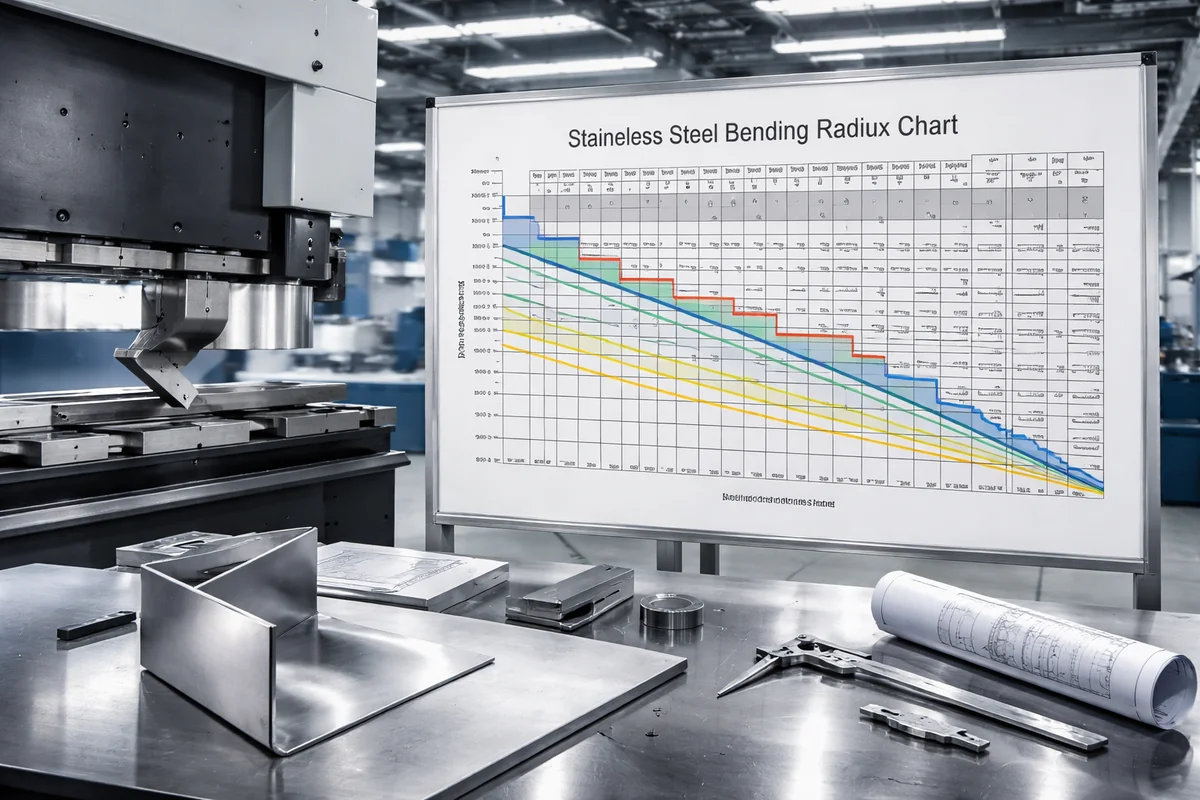
The K-factor determines where the neutral axis shifts during bending and is critical for accurate flat pattern calculations. For stainless steel, the neutral axis shifts more toward the inside of the bend compared to carbon steel due to higher work hardening.
K-Factor Values by Grade and Thickness
| Ratio (R/T) | 304/316 K-Factor | 430 K-Factor | 2205 K-Factor | Carbon Steel Reference |
|---|---|---|---|---|
| 0.5 (tight) | 0.33 | 0.35 | 0.30 | 0.33 |
| 1.0 | 0.35 | 0.38 | 0.33 | 0.38 |
| 2.0 | 0.38 | 0.40 | 0.35 | 0.42 |
| 3.0 | 0.40 | 0.42 | 0.38 | 0.44 |
| 4.0+ (large) | 0.42 | 0.44 | 0.40 | 0.45 |
Practical note: For most stainless steel press brake work with R/T ratios between 1 and 3, use K = 0.38 for 304/316 and K = 0.35 for duplex grades as starting values, then adjust based on actual part measurements.
Bend Allowance Formula
Bend Allowance (BA) = π × (R + K × T) × θ / 180Where:
- R = inside bend radius (mm)
- K = K-factor from table above
- T = material thickness (mm)
- θ = bend angle (degrees)
Example: 2mm 304L, 90° bend, R = 2mm (1.0t)
BA = π × (2 + 0.38 × 2) × 90 / 180
BA = 3.1416 × 2.76 × 0.5
BA = 4.34mm
Springback Compensation by Grade
Springback is the elastic recovery that occurs after the bending force is released. Stainless steel exhibits significantly more springback than carbon steel, and the amount varies by grade.
Springback Multiplier by Grade
To achieve your target angle, you must over-bend by the following factors:
| Grade | Over-Bend Factor (90° target) | Actual Bend Angle | Notes |
|---|---|---|---|
| 304 Annealed | 2-3° | 87-88° | Moderate springback |
| 304 1/4 Hard | 5-7° | 83-85° | Significant springback |
| 316 Annealed | 3-4° | 86-87° | Slightly more than 304 |
| 316L Annealed | 3-4° | 86-87° | Similar to 316 |
| 430 Annealed | 1-2° | 88-89° | Low springback — advantage |
| 2205 Duplex | 8-12° | 78-82° | Extreme springback |
| 2507 Super Duplex | 12-15° | 75-78° | Most difficult to control |
| 310S Annealed | 5-8° | 82-85° | High springback |
Practical Springback Tips
- Increase bend angle gradually — Start with 3° over-bend on 304, measure, adjust
- Use coining — Coining (bottoming) the bend significantly reduces springback by plastically deforming the bend radius
- Account for thickness variation — Stainless steel sheet thickness can vary ±0.1mm, which affects springback consistency
- Temperature matters — Warmer material (20-30°C) has slightly less springback than cold material (5-10°C)
- For duplex grades — Consider air bending with CNC angle compensation rather than trying to achieve the angle in a single hit
V-Die Selection and Tooling Guidelines
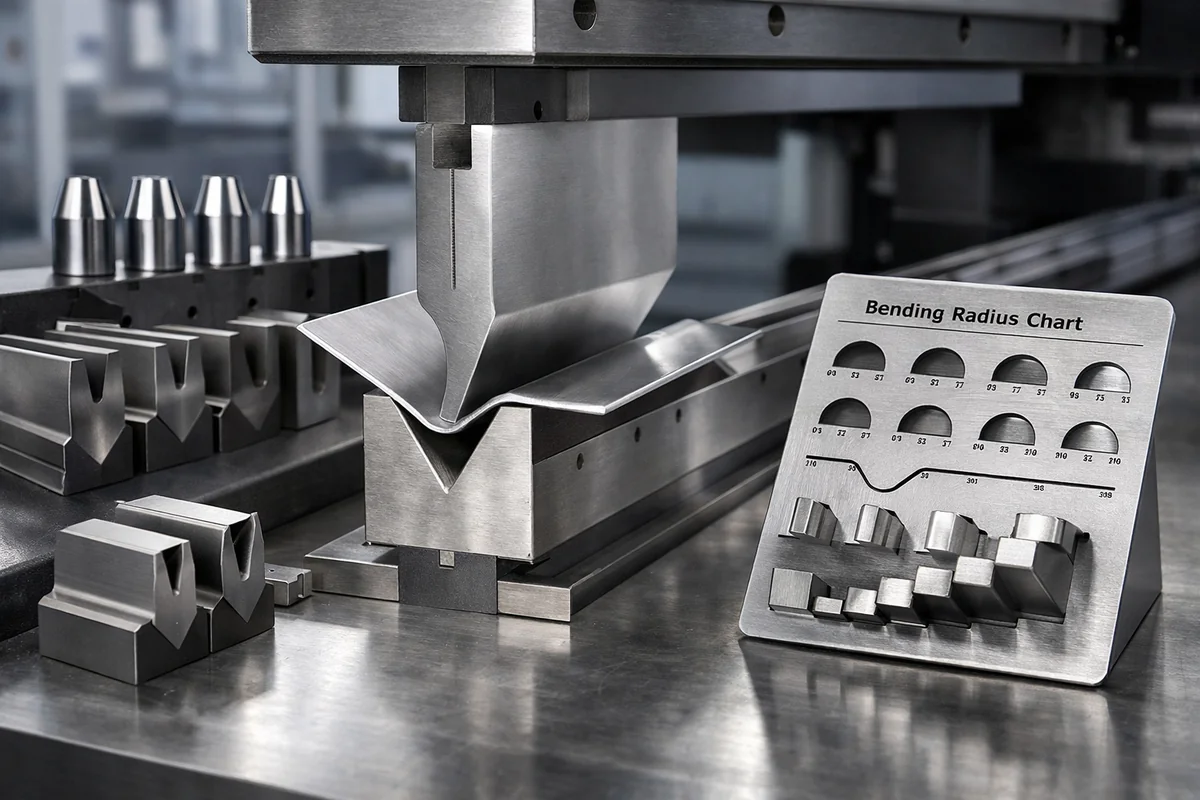
The V-die opening directly affects the minimum achievable bend radius and the bending force required. For stainless steel, the standard V-die opening calculations differ from carbon steel.
V-Die Opening Formula
V-die opening = (R + 1.5T) × 2For stainless steel, multiply the carbon steel V-die opening by 1.15 to 1.25 to account for higher springback and forming force.
Recommended V-Die Openings by Thickness
| Material Thickness | Carbon Steel V | Stainless 304/316 V | Duplex 2205 V |
|---|---|---|---|
| 0.8mm | 6mm | 7mm | 8mm |
| 1.0mm | 8mm | 9mm | 10mm |
| 1.2mm | 9mm | 11mm | 12mm |
| 1.5mm | 11mm | 13mm | 14mm |
| 2.0mm | 14mm | 16mm | 18mm |
| 2.5mm | 18mm | 20mm | 22mm |
| 3.0mm | 20mm | 23mm | 25mm |
Bending Force Calculation
Bending Force (kN) = (1.33 × σ_UTS × T² × L) / VWhere:
- σ_UTS = Ultimate tensile strength (MPa)
- T = Material thickness (mm)
- L = Bend length (mm)
- V = V-die opening (mm)
Typical UTS values for calculation:
- 304/316 Annealed: 520 MPa
- 430 Annealed: 450 MPa
- 2205 Duplex: 620 MPa
- 310S Annealed: 520 MPa
Example: 2mm 304L, 1000mm bend length, V = 16mm
Force = (1.33 × 520 × 4 × 1000) / 16
Force = 173,560 N ≈ 174 kN (≈ 18 tons)
Common Bending Defects and Material-Related Fixes
Cracking at the Bend Line
Cause: Bend radius below minimum for the grade, or material in hard temper.
Fixes:
- Increase inside bend radius to meet the grade-specific minimum (see tables above)
- Use annealed temper material for tight bends
- For 430 ferritic — bend perpendicular to the rolling direction
- For duplex — consider pre-heating to 150-200°C before bending
Excessive Springback
Cause: High yield strength material (especially duplex), large bend radius, or thin material.
Fixes:
- Over-bend by the grade-specific compensation angle (see Springback section)
- Use coining/bottoming instead of air bending
- Reduce V-die opening to increase forming pressure
- For 2205/2507 — use CNC-controlled over-bend with in-process measurement
Surface Scratching
Cause: Tooling contact, inadequate lubrication, or material surface contamination.
Fixes:
- Use urethane or nylon-die tooling for polished surfaces (BA, #4, #8 mirror)
- Apply stainless steel-specific bending lubricant (no chlorinated compounds)
- Clean the sheet surface before bending — fingerprints cause etching marks during forming
- Protect film-coated sheets — bend with film on, remove after forming
Orange Peel Effect
Cause: Large grain size in the material, common in annealed austenitic grades.
Fixes:
- Specify fine-grain material (grain size No. 6-8 per ASTM E112)
- Light cold-rolling pass before forming
- Reduce bend radius to increase plastic deformation (counter-intuitive but effective for surface quality)
Dimensional Inaccuracy
Cause: Inconsistent springback, material thickness variation, or incorrect K-factor in flat pattern.
Fixes:
- Measure first article and adjust over-bend angle
- Use material from the same heat/lot for a production run
- Update K-factor based on actual measurements (don’t rely on theoretical values)
- For precision parts — consider finish machining after bending
Practical Recommendations from NewQiujing Steel
After supplying stainless steel to fabrication shops for over 25 years, here are the recommendations that prevent the most common problems:
- Always request mill certificates — Know the exact yield strength and elongation of your specific heat. Nominal values in standards have wide ranges.
- Test bend first — For any new grade or thickness combination, make a test bend with the actual material before running production.
- Specify temper carefully — The difference between annealed and 1/4 hard 304 is dramatic for bending. Annealed 304 at 1.0mm can achieve 0.5t radius; 1/4 hard needs 2.0t minimum.
- Account for grain direction — Bend perpendicular to the rolling direction whenever possible. This is especially critical for ferritic (430) and duplex (2205) grades.
- Consider the full process — If your part needs both bending and welding, bend first. Welding heat affects the microstructure and can make subsequent bending more difficult, especially for duplex grades where the heat-affected zone loses corrosion resistance.
- Work with your material supplier — At NewQiujing Steel, we can advise on the optimal grade selection when bending requirements are a design constraint. Sometimes switching from 316 to 316L (lower carbon) improves formability without sacrificing corrosion performance.
Frequently Asked Questions
What is the minimum bend radius for 304 stainless steel?
For annealed 304 stainless steel at common sheet thicknesses (0.5-2.0mm), the minimum inside bend radius is 0.5t to 1.0t (where t = material thickness). At 3mm and above, increase to 1.5t-2.0t. Cold-worked (hard temper) 304 requires 2.0t to 3.0t minimum.
Can you bend 430 stainless steel without cracking?
Yes, but with caution. Use a minimum radius of 1.5t to 2.0t for 430, always bend perpendicular to the rolling direction, and avoid tight radii below 1.0t. For thicknesses above 2mm, consider pre-heating to 150-200°C.
How much springback does 2205 duplex stainless steel have?
Duplex 2205 has 8-12° of springback for a 90° target bend, significantly more than austenitic grades (2-4°). You must over-bend to approximately 78-82° to achieve a final 90° angle. Super duplex 2507 has even more springback (12-15°).
What V-die opening should I use for stainless steel bending?
Use the formula V = (R + 1.5T) × 2, then multiply by 1.15-1.25 for stainless steel. For example, 2mm 304 with a 2mm inside radius: V = (2 + 3) × 2 = 10mm, adjusted to 12-13mm for stainless.
Does stainless steel need lubrication when bending?
For standard grades (304, 316) with mill finish, lubrication is optional but recommended. For polished surfaces (BA, #4, #8 mirror), always use stainless steel-specific lubricant to prevent die marks. Never use chlorinated cutting oils — they cause stress corrosion cracking.
This bending radius guide is based on practical fabrication experience and material data from NewQiujing Steel’s 25+ years of stainless steel supply. For specific applications with unusual grade, thickness, or radius combinations, contact our technical team for material-specific recommendations.
Related Guides: Laser Cutting Parameters | Coil vs Sheet Comparison
Related material guides
Author: NewQiujing Group