304 vs 316 Stainless Steel: 4 Cases Where You Must Upgrade
Here is an uncomfortable truth that most stainless steel comparison articles won’t tell you: 304 stainless steel is good enough for about 90% of applications. The remaining 10%? Choosing 304 in those scenarios doesn’t just mean you overspent on a “good enough” material — it means your equipment fails, your project gets delayed, and you end up spending twice to replace what should have been right the first time.
I have seen procurement engineers save $0.50 per kilogram by specifying 304 instead of 316, only to replace entire piping systems 18 months later because chloride-induced pitting ate through the walls. That $0.50 per kilogram decision turned into a $40,000 replacement project.
This guide is not another generic comparison table. It is a decision framework — four specific scenarios where 316 is not optional, plus a clear process for making the call on everything else.
The One Difference That Matters: Molybdenum
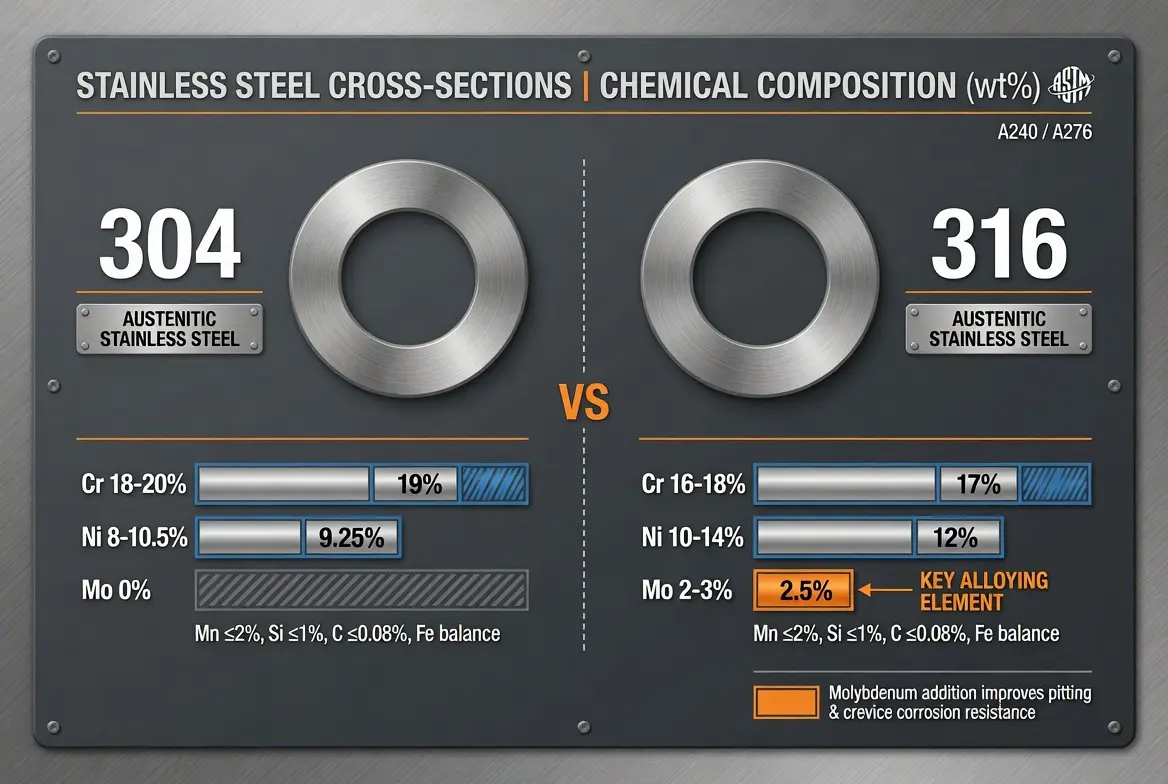
Side by side comparison of 304 and 316 stainless steel chemical composition showing chromium nickel and molybdenum content percentages
Before we get into the decision scenarios, you need to understand why this choice exists at all. Both 304 and 316 are austenitic stainless steels with similar base compositions:
| Element | 304 | 316 |
|---|---|---|
| Chromium | 18.0–20.0% | 16.0–18.0% |
| Nickel | 8.0–10.5% | 10.0–14.0% |
| Molybdenum | — | 2.0–3.0% |
| Carbon | ≤0.08% | ≤0.08% |
| Manganese | ≤2.00% | ≤2.00% |
That 2-3% molybdenum is the entire story. Molybdenum dramatically improves resistance to pitting corrosion and crevice corrosion, especially in chloride-rich environments. Pitting is the nasty kind of corrosion — tiny holes that penetrate deep into the metal, often invisible from the surface until a leak or structural failure occurs.
Think of it this way: chromium gives stainless steel its basic corrosion resistance (the passive oxide layer). Molybdenum reinforces that layer specifically against chloride attacks. Without it, the passive layer breaks down locally in salty or acidic conditions, and you get pits.
304 has no molybdenum. 316 has 2-3%. That is the difference between a pipe that lasts 20 years and one that fails in 3.
Scenario 1: Chloride Exposure — The #1 Reason to Upgrade
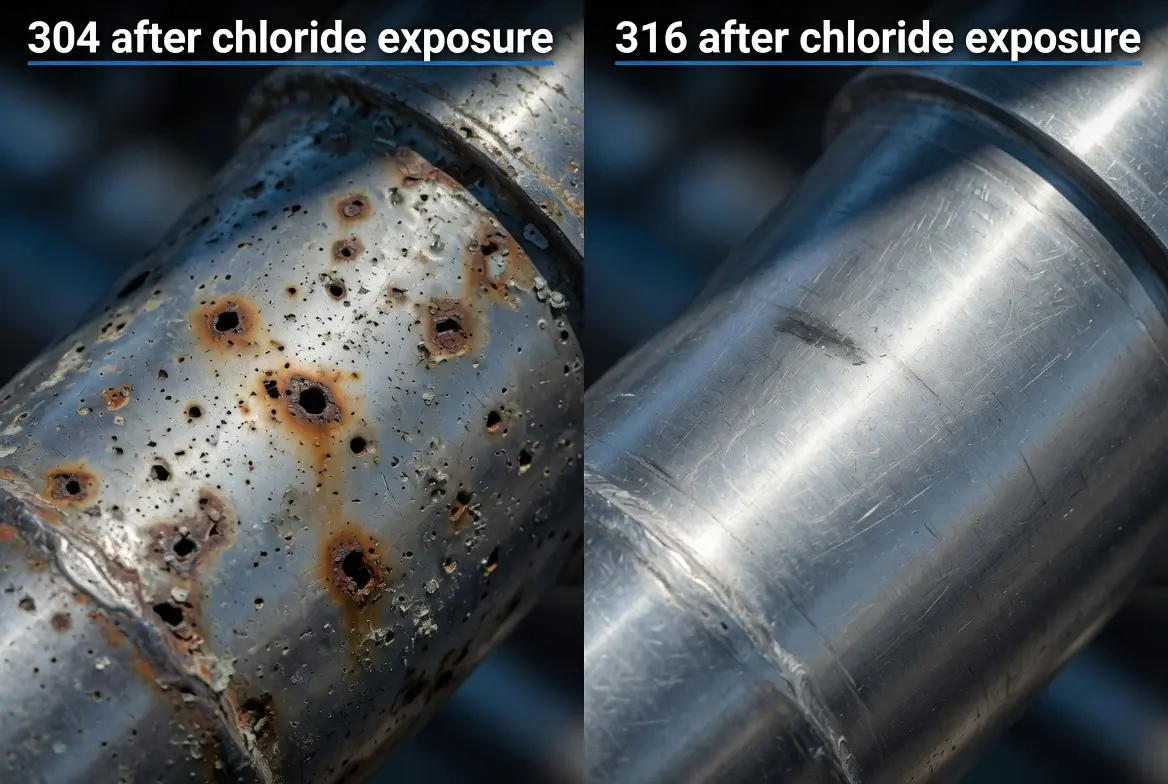
Comparison of pitting corrosion damage on 304 stainless steel versus intact 316 stainless steel surface after chloride exposure
Chloride is stainless steel’s worst enemy, and it shows up in more places than you think. If your application involves any of the following, 316 is not a nice-to-have — it is the minimum acceptable grade:
- Seawater and marine environments — Seawater contains roughly 35,000 ppm chlorides. 304 will pit within months of continuous immersion. Offshore platforms, desalination plants, and marine hardware all require 316 or higher.
- Coastal outdoor installations — Even without direct seawater contact, salt spray in coastal areas (within 5-10 km of the shoreline) deposits chlorides on metal surfaces. Rain washes some away, but not all. Over time, the accumulation causes pitting on 304.
- Chlorinated water systems — Municipal water treatment uses chlorine or chloramine. Swimming pool equipment, water treatment plants, and cooling towers all expose stainless steel to chlorides at levels that attack 304.
- Chemical processing with chloride-containing solutions — Hydrochloric acid, sodium chloride brines, and many cleaning solutions used in food and pharmaceutical processing contain chlorides at concentrations well above what 304 can handle.
The test: If the environment contains more than 200 ppm of chlorides in solution, or if the equipment is exposed to salt spray, 316 is the correct choice. Below 200 ppm in a controlled indoor environment, 304 is usually adequate.
Scenario 2: High-Temperature Service
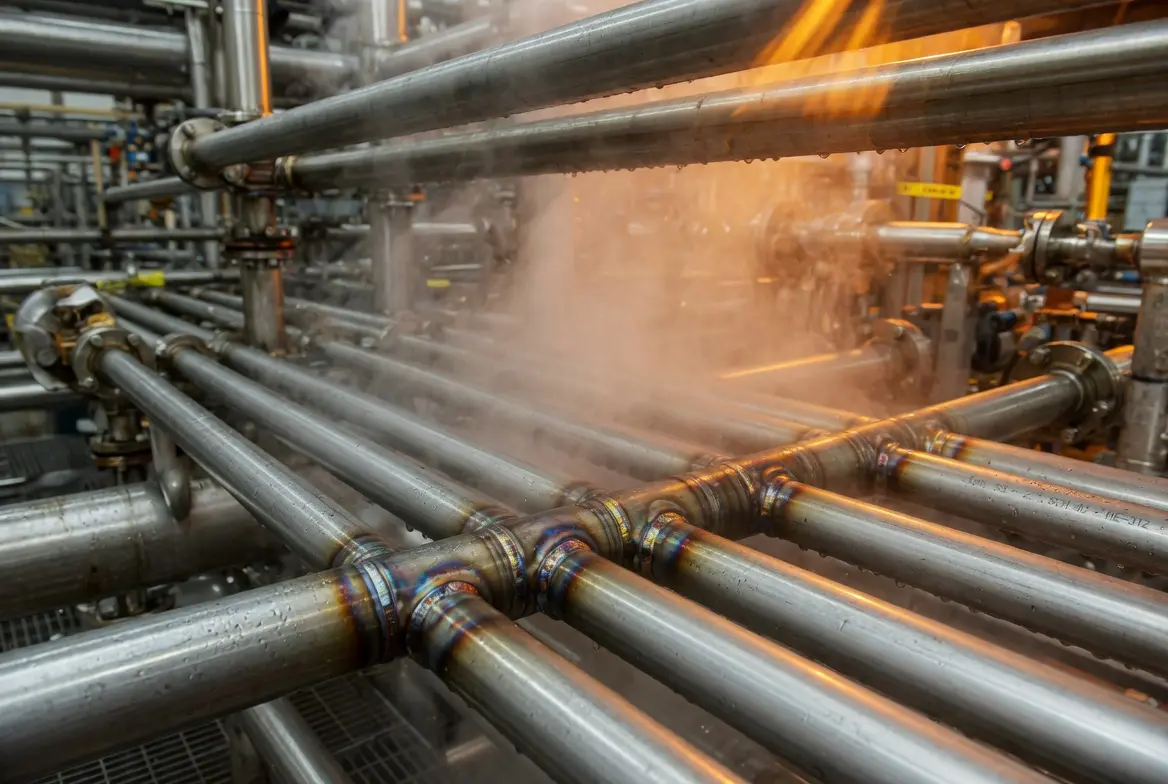
Industrial heat exchanger tubes made of 316 stainless steel operating at high temperature in a chemical processing plant
Temperature changes the corrosion equation. At elevated temperatures, the passive oxide layer on stainless steel becomes less stable, and the rate of corrosion accelerates. Here is where the grades diverge significantly:
- 304 performs well up to about 870°C (1600°F) for intermittent service and 925°C (1700°F) for continuous service in non-corrosive atmospheres. But in the presence of corrosive agents at high temperature, its limit drops considerably.
- 316 maintains strength and corrosion resistance up to about 982°C (1800°F) in many environments. The molybdenum stabilizes the alloy against sensitization — the precipitation of chromium carbides at grain boundaries that makes the steel vulnerable to intergranular corrosion.
Where this matters in practice:
- Heat exchangers — Process fluids at elevated temperatures, especially if they contain any chlorides, will degrade 304 tubes much faster than 316.
- Furnace components and exhaust systems — High-temperature oxidation combined with any corrosive flue gas components demands 316 or higher.
- Steam systems and boilers — Even treated boiler water contains some chlorides. At operating temperatures, 304 is more susceptible to stress corrosion cracking (SCC) in the presence of chlorides.
Rule of thumb: If operating temperatures regularly exceed 200°C (400°F) and the environment contains any chlorides or acidic compounds, specify 316. The cost difference is trivial compared to a unplanned shutdown for tube replacement.
Scenario 3: Pharmaceutical and Food Processing with Aggressive CIP
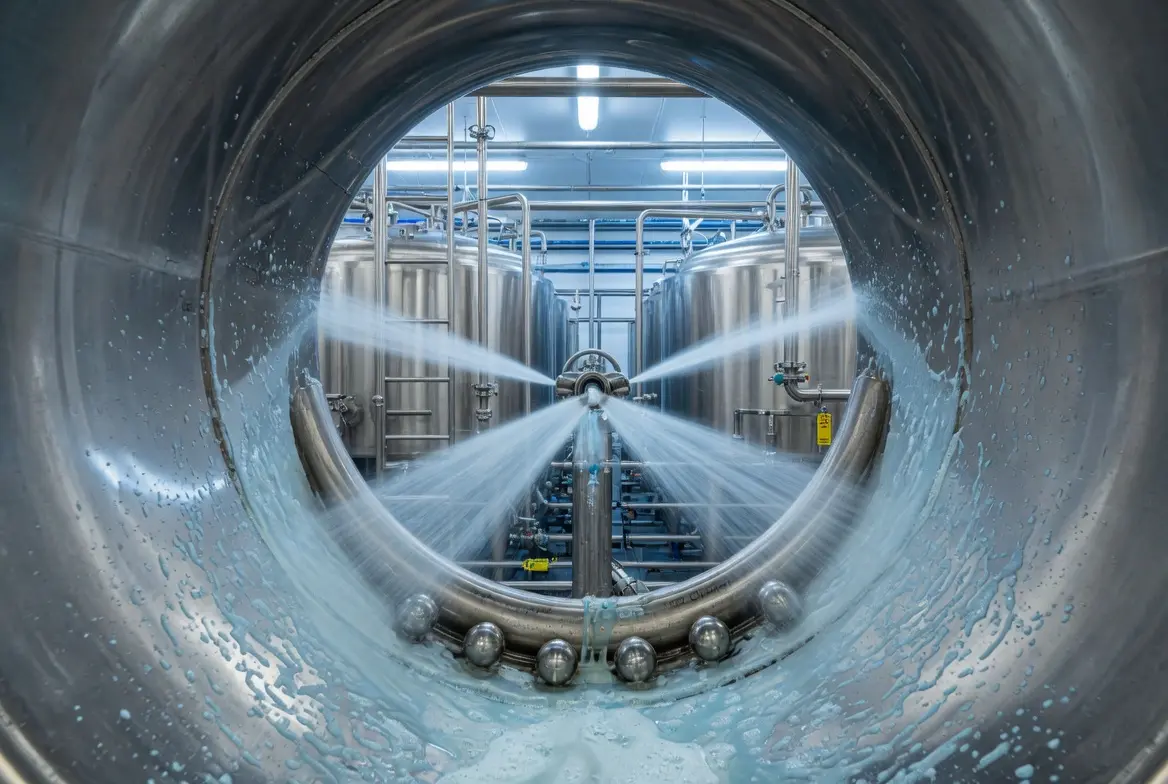
Stainless steel food processing equipment during clean-in-place CIP cycle with cleaning solution spray inside sanitary piping
This one surprises people. They assume 304 is the default for food and pharmaceutical applications — and for many products, it is. But the cleaning protocols used in these industries can be more corrosive than the products themselves.
Clean-in-Place (CIP) systems use concentrated cleaning agents that cycle between caustic (sodium hydroxide) and acid (nitric acid or phosphoric acid) phases at elevated temperatures. Some facilities also use chlorine-based sanitizers between production runs. The combination of high-temperature caustic, acid, and chloride exposure is brutal on stainless steel.
304 handles standard CIP cycles reasonably well. But when facilities run aggressive protocols — higher temperatures (above 80°C), higher concentrations, or chlorine-based sanitizers — 304 develops crevice corrosion under gaskets, in dead legs, and at weld joints. These are exactly the locations where bacterial contamination hides, which is the opposite of what food and pharma equipment should allow.
316’s molybdenum content provides a meaningful safety margin against CIP-induced corrosion. More importantly, it resists the localized breakdown of the passive layer that leads to crevice corrosion — the kind that creates hidden contamination traps.
When to upgrade: If your CIP protocol includes chlorine-based sanitizers, operates above 80°C, or if the equipment contacts salty, acidic, or high-chloride products (seafood, cheese brine, pickled foods, pharmaceutical APIs with chloride salts), use 316 for all wetted surfaces.
Scenario 4: Structural Applications Where Failure Is Not an Option
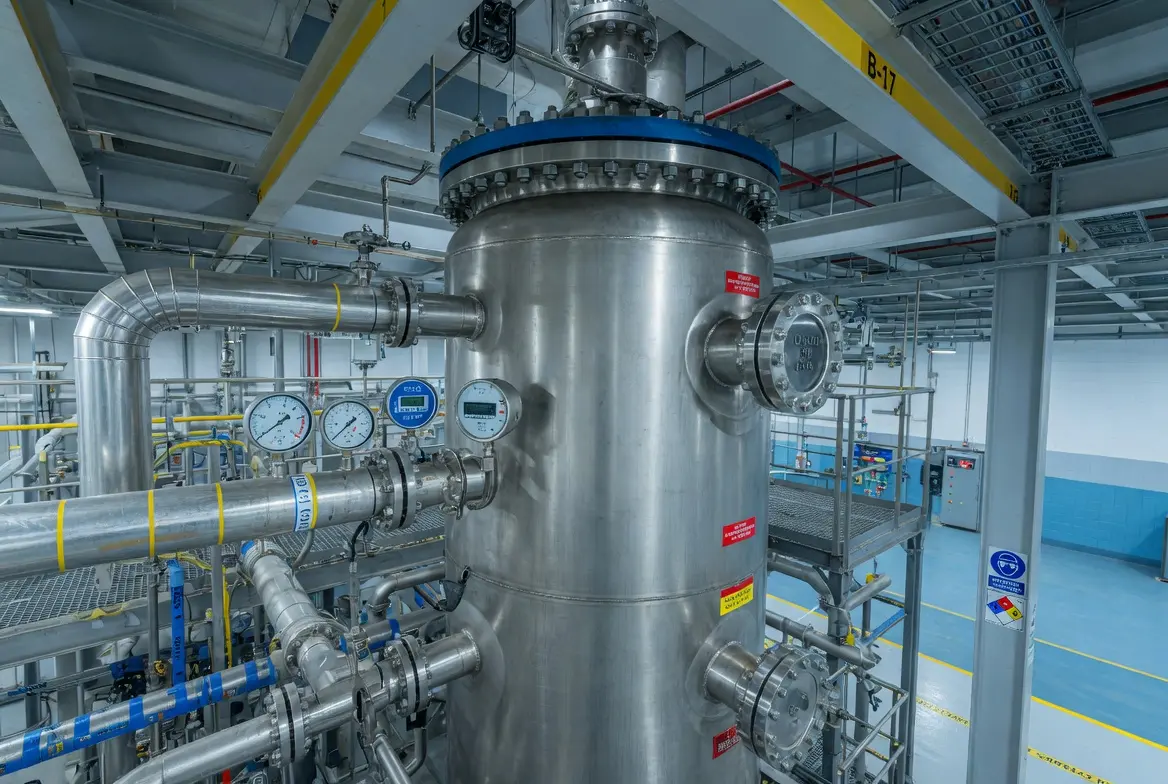
Large stainless steel 316 pressure vessel in an industrial chemical processing facility with piping connections
Not all corrosion failures are equal. A corroded kitchen sink is an aesthetic problem. A corroded structural support in a chemical plant is a safety hazard. In applications where mechanical failure has serious consequences — injury, environmental release, or costly unplanned shutdown — the extra cost of 316 is insurance, not an expense.
Critical applications include:
- Pressure vessels and piping — ASME pressure vessel codes consider material grade in design calculations. 316’s higher allowable stress values and better corrosion resistance can result in thinner walls (lower material cost) while maintaining safety margins.
- Structural supports in corrosive environments — Walkways, handrails, and structural frames in chemical plants, wastewater treatment facilities, and coastal structures.
- Storage tanks for corrosive media — Even if the stored product is mildly corrosive, the combination of liquid contact, vapor space, and temperature cycling creates conditions that accelerate corrosion at the liquid-vapor interface.
- Fasteners and connections — Bolts, flanges, and fittings are often the first components to fail because they experience crevice conditions (under bolt heads, in thread roots) and stress concentrations.
The cost calculation: A 316 pressure vessel might cost 20% more than an identical 304 vessel. But if the 304 vessel requires replacement after 8 years instead of 20, the annualized cost of the 316 vessel is actually lower. Factor in the cost of downtime, environmental compliance, and potential safety incidents, and the business case for 316 in critical applications is straightforward.
The Decision Tree: When 304 Is Good Enough
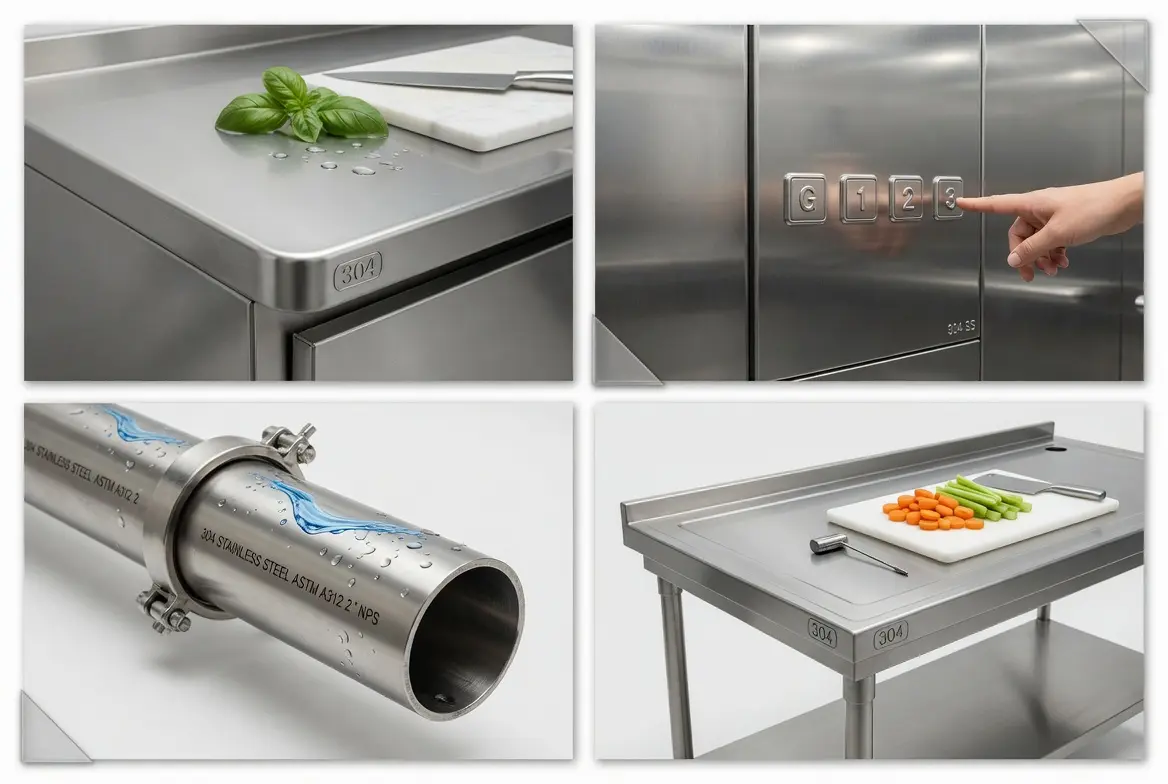
Common applications for 304 stainless steel including kitchen equipment architectural panels and indoor piping
Now that you know when 316 is mandatory, here is the other 90% — applications where 304 is the smart, cost-effective choice:
- Indoor architectural and decorative applications — Elevator panels, handrails in commercial buildings, kitchen countertops, and interior trim. No chloride exposure, no extreme temperatures.
- General-purpose food equipment (non-aggressive CIP) — Sinks, work tables, standard dairy processing (non-brine), bakery equipment. Standard cleaning protocols with mild detergents.
- Water supply piping (non-chlorinated or low-chloride) — Domestic water supply in areas with low-chloride water. Check your local water report for chloride levels — if below 200 ppm, 304 is fine.
- Automotive exhaust (non-marine) — Standard automotive exhaust systems in non-coastal areas. The exhaust gas temperature is within 304’s range, and chloride exposure is minimal.
- General industrial equipment — Storage bins, conveyor components, machine guards, and non-critical process equipment in dry or low-humidity environments.
For these applications, 304 delivers the corrosion resistance, formability, and weldability you need at a lower price point. Spending more for 316 here is not wrong — it is just unnecessary.
Cost Analysis: Price Per Kilo vs. Cost Per Year
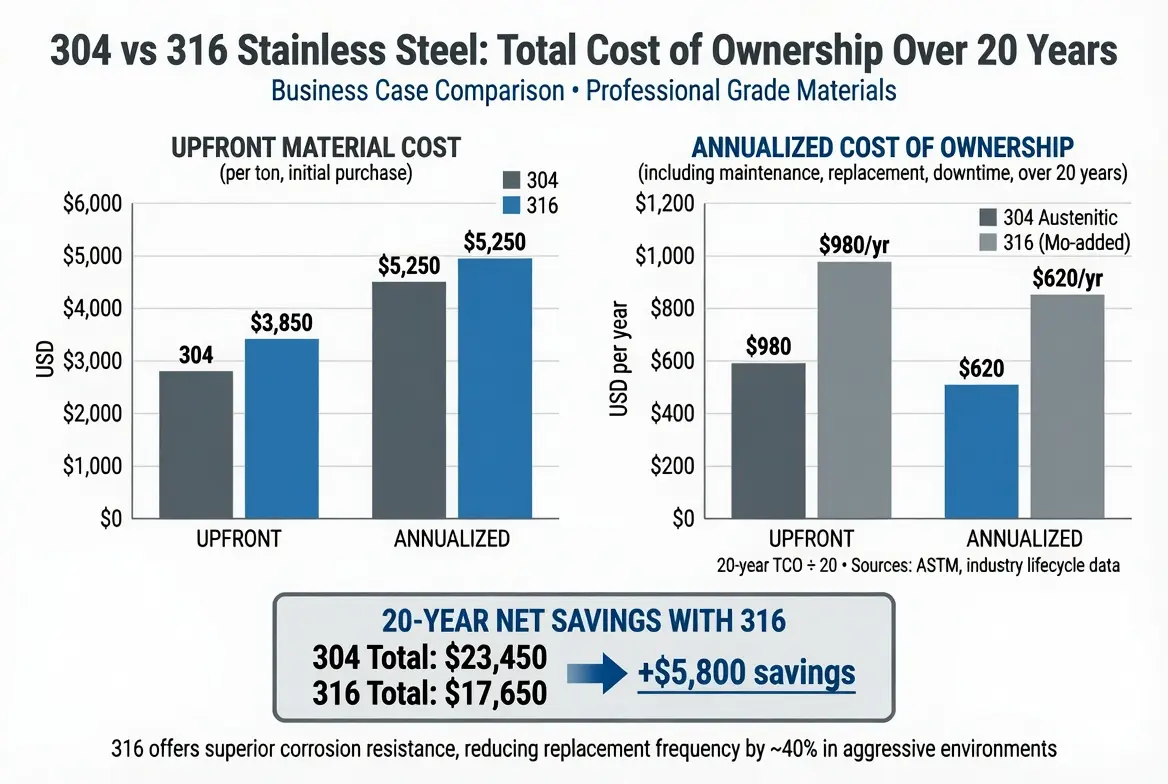
Chart comparing total cost of ownership between 304 and 316 stainless steel piping over 20 year service life
Procurement teams often compare stainless steel grades on a price-per-kilogram basis. This is the wrong metric. The right metric is total cost of ownership per year of service life.
Here is a simplified comparison for a typical industrial piping project:
| Factor | 304 Piping | 316 Piping |
|---|---|---|
| Material cost per meter (DN100 Sch10) | ~$45 | ~$58 |
| Expected service life (chloride environment) | 8–12 years | 20–30 years |
| Annualized material cost | $4.50/m/year | $2.32/m/year |
| Downtime risk (replacement shutdown) | High after year 8 | Low |
| Environmental compliance risk | Higher (leak potential) | Lower |
In a chloride-containing environment, the 316 piping system costs less per year of service — even though the upfront material cost is 29% higher. The break-even point comes around year 10, after which 316 continues performing while 304 needs replacement.
This analysis reverses in benign environments. If there are no chlorides and no extreme temperatures, 304’s lower upfront cost translates directly to lower total cost of ownership because both grades will last decades.
How to Specify the Right Grade on Your Purchase Order
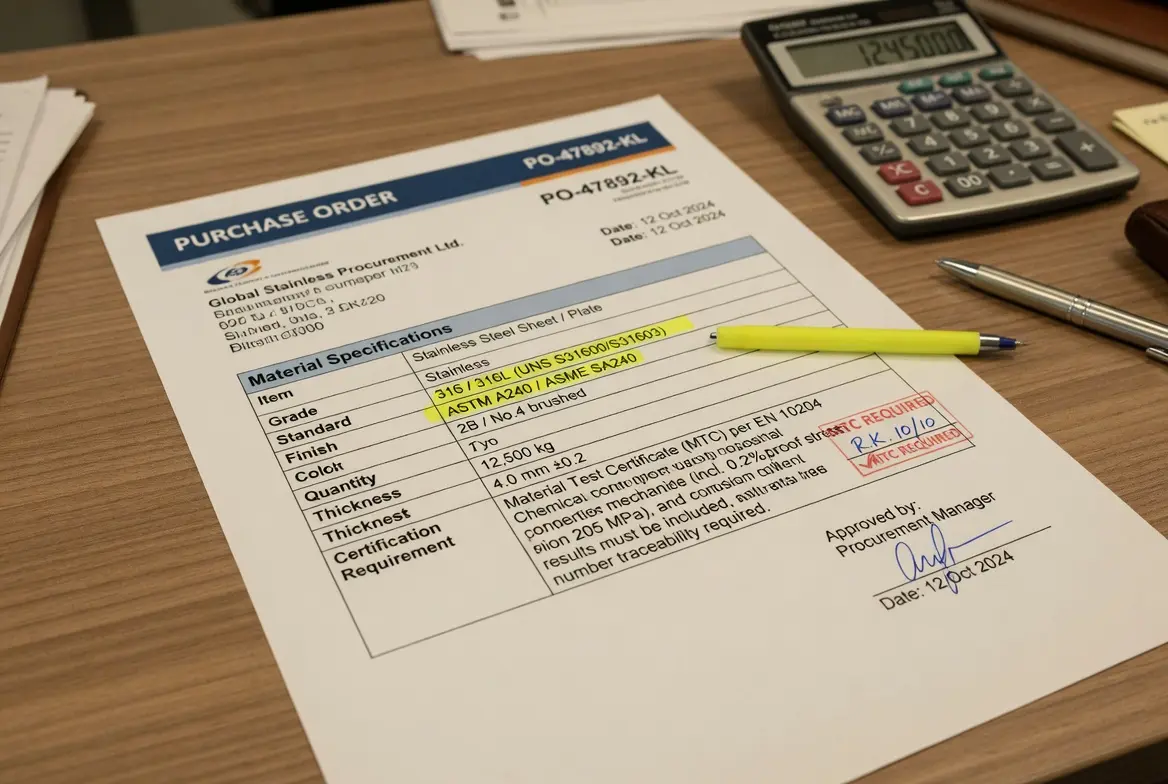
Sample purchase order document showing stainless steel grade specification with ASTM standards and material certification requirements
When you are ready to order, specifying the grade correctly prevents costly mistakes. Here is what a clear material specification looks like:
- Grade and standard — Always reference the ASTM specification. For plates and sheets: ASTM A240 Type 304 or ASTM A240 Type 316. For pipe: ASTM A312 TP304 or TP316. For bar: ASTM A276 Type 304 or 316.
- Product form — Specify whether you need plate, sheet, coil, pipe, tube, bar, or wire. Each form has different dimensional standards and tolerances.
- Surface finish — 2B (mill finish), No. 4 (brushed), or No. 8 (mirror) are the most common. The finish affects both appearance and corrosion resistance — a rougher finish traps more contaminants and can accelerate pitting.
- Dimensional tolerances — Thickness, width, length, and straightness tolerances should reference the applicable ASTM or EN standard. If you have tight tolerances, state them explicitly.
- Certification — Request a Mill Test Certificate (MTC) or EN 10204 3.1 certificate that confirms chemical composition and mechanical properties for each heat. This is your proof that the material is what you ordered.
A reliable supplier will confirm all of these details before production. If a supplier pushes back on providing certification or cannot confirm the exact grade and standard, that is a red flag.
Quick Reference: The 30-Second Decision
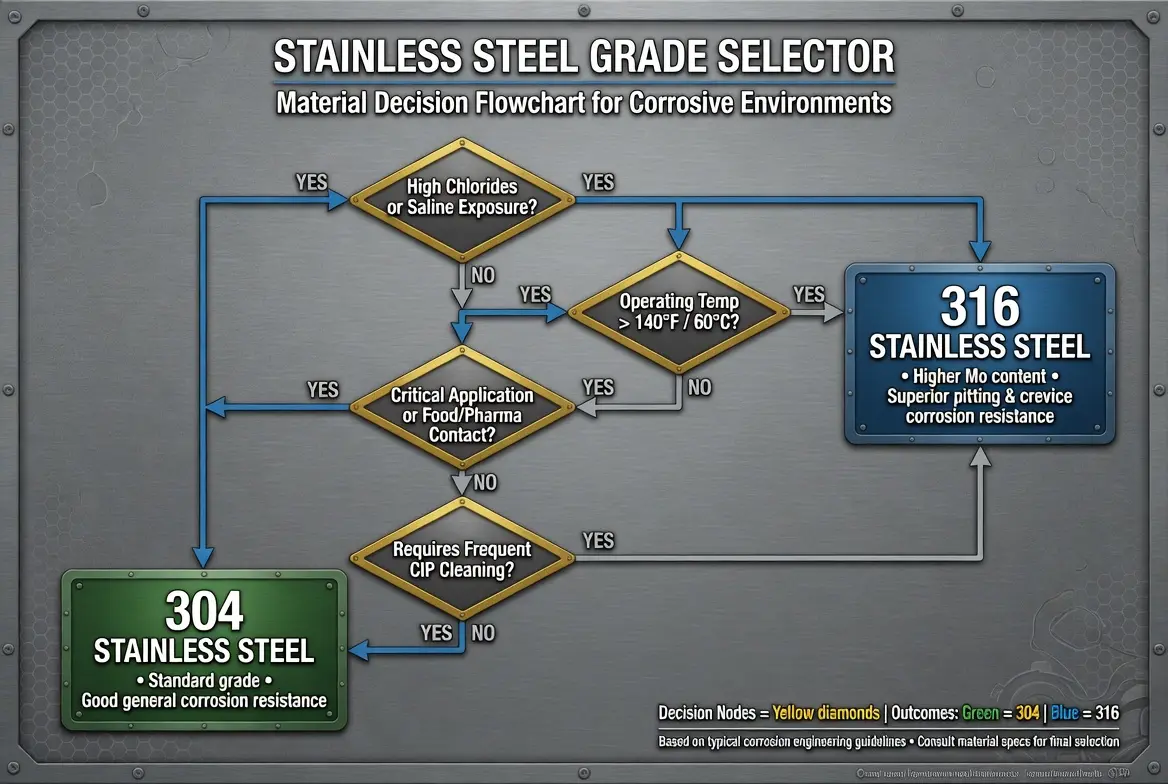
Decision flowchart for choosing between 304 and 316 stainless steel based on chloride exposure, temperature, and application criticality
For those who need a fast answer, here is the simplified decision process:
- Does the application involve chlorides (seawater, salt spray, chlorine-treated water, chloride-containing chemicals)? If yes → 316.
- Does it operate above 200°C (400°F) in a potentially corrosive atmosphere? If yes → 316.
- Is it a critical structural or pressure-containing component where failure has safety or environmental consequences? If yes → 316.
- Does the CIP or cleaning protocol include chlorine-based sanitizers or operate above 80°C? If yes → 316.
- If none of the above apply → 304 is the right choice. Save your budget for where it matters.
This is not about one grade being universally “better” than the other. It is about matching the material to the environment. 304 is an excellent stainless steel. 316 is an excellent stainless steel with a specific superpower (chloride resistance) that you pay extra for. Use that superpower when you need it, and don’t pay for it when you don’t.
If you need help selecting the right grade for your specific application, or if you want to discuss material specifications with engineers who handle these decisions every day, contact our team. We stock the full range of 304 and 316 products — plates, sheets, pipes, bars, and coils — in all common specifications, with material certification included.
Related material guides
Author: NewQiujing Group