Every brewery starts with the same assumption: “We need 316L for everything.” Then they get the quote, see the price tag, and start cutting corners — usually by downgrading fermentation tanks to 304. That’s exactly backwards.
I’ve spent 15 years specifying stainless steel for food and beverage plants. The breweries that get it right select grades equipment by equipment, matching the corrosion threat each piece actually faces. The ones that get it wrong either overpay for 316L they don’t need or under-specify 304 and pay for it later in tank replacements and contamination events.
This guide walks through every major piece of brewery equipment and tells you exactly what grade to specify, why, and where the money is best spent.
Why Grade Selection Matters More in Brewing Than You Think
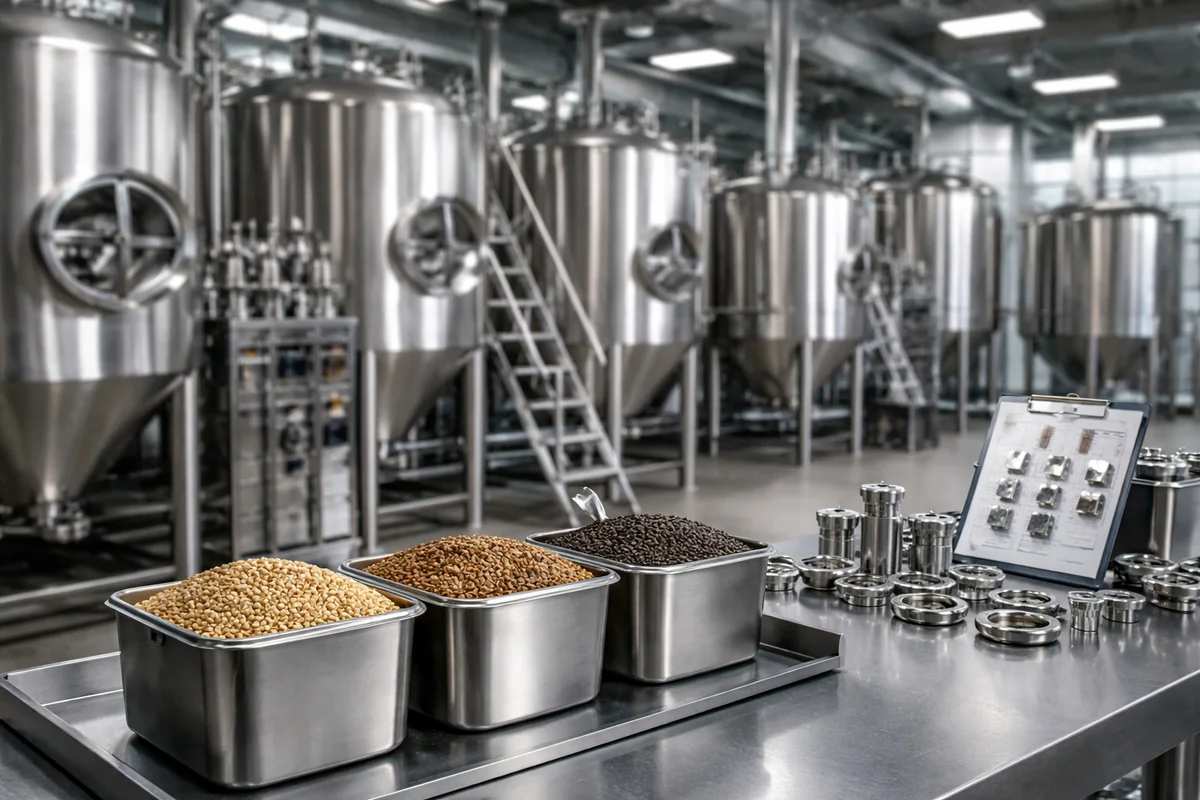
Brewing is not a generic “food contact” application. The food-grade stainless steel compliance requirements that apply to dry food handling don’t capture what happens inside a brewery tank.
A brewery vessel simultaneously faces three aggressive environments:
- **Acidic wort** at pH 4.0–4.5 during fermentation, dropping to 3.8–4.2 in sour beer production
- **Alkaline CIP solutions** — sodium hydroxide (NaOH) at 2–5% concentration, cycled at 70–80°C
- **Chlorinated sanitizers** — sodium hypochlorite at 100–200 ppm, applied after every CIP cycle
This combination is significantly more aggressive than standard food processing. A tank that handles only neutral-pH products can run 304 for decades. A fermentation tank cycling through acid wort, hot caustic, and chlorine sanitizer is a different beast entirely.
The cost of getting this wrong isn’t just a replacement tank. It’s the lost batch when a pitting failure is discovered mid-fermentation, the production downtime while a new tank is fabricated and installed, and — worst case — the product recall when corrosion products contaminate the beer.
The Three Corrosion Threats in Every Brewery
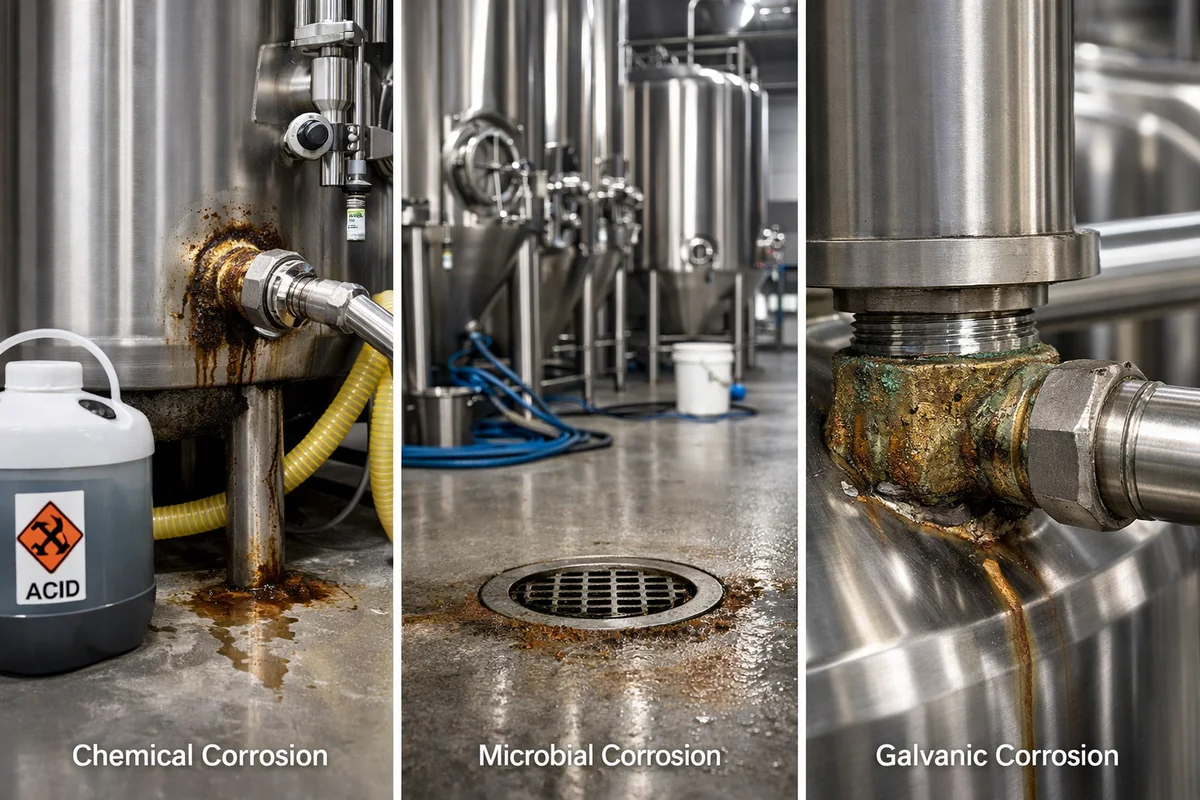
Before picking grades, understand what you’re fighting. Every brewery environment presents three distinct corrosion mechanisms, and each attacks a different part of your equipment.
Pitting Corrosion: The Chloride Problem
Chloride ions from sanitizers are the number one enemy of stainless steel in breweries. They penetrate the passive chromium oxide layer at weak points — scratches, weld heat tint, surface inclusions — and create deep, narrow pits that can perforate a tank wall.
The duplex stainless steel dual-phase microstructure resists pitting far better than standard austenitic grades. The practical measure is the Pitting Resistance Equivalent Number (PREN):
| Grade | PREN Value | Chloride Tolerance |
|——-|———–|——————-|
| 304/304L | 18–20 | Low — pitting risk above 50 ppm Cl⁻ |
| 316/316L | 24–26 | Moderate — tolerates 200+ ppm Cl⁻ |
| Duplex 2205 | 34–36 | High — handles 1000+ ppm Cl⁻ |
| 904L | 42–45 | Very high — for extreme chloride environments |
For standard brewery sanitizer concentrations (100–200 ppm), 316L provides adequate pitting resistance. 304 will pit over time in this environment — the question isn’t if, but when.
Crevice Corrosion: The Gasket and Weld Problem
Where pitting attacks open surfaces, crevice corrosion attacks confined spaces — under gaskets, behind bolt heads, at weld toes, and in tight radii. The chemistry inside a crevice becomes more acidic and more concentrated than the bulk solution, accelerating attack.
This is why tank design matters as much as grade selection. Sharp internal corners, poorly welded joints, and gasketed connections are all crevice corrosion initiation sites regardless of grade. But 316L buys you significantly more time before crevice corrosion initiates compared to 304.
Stress Corrosion Cracking: The Heat Problem
Stainless steel under tensile stress in hot chloride environments can crack — suddenly and without warning. This affects heated equipment: boil kettle supports, heat exchanger frames, and any component experiencing thermal cycling while exposed to chloride-containing cleaning solutions.
Neither 304 nor 316L is immune to stress corrosion cracking (SCC) above ~60°C in chloride environments. Duplex 2205 has dramatically better SCC resistance due to its dual-phase microstructure, which forces cracks to change direction at phase boundaries.
Grade Selection by Equipment Type
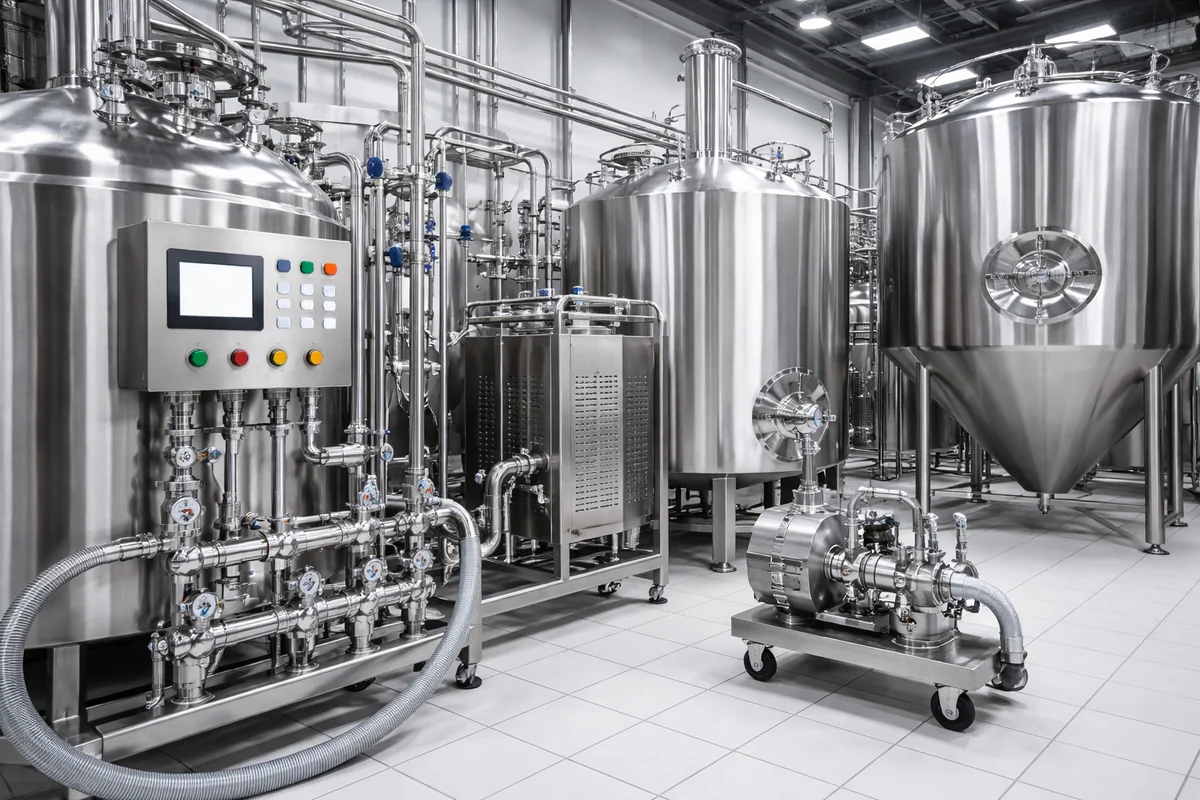
Here’s where the practical decisions happen. I’ve organized this by the equipment you’ll find in a typical brewery, with specific grade recommendations based on the actual corrosion environment each piece faces.
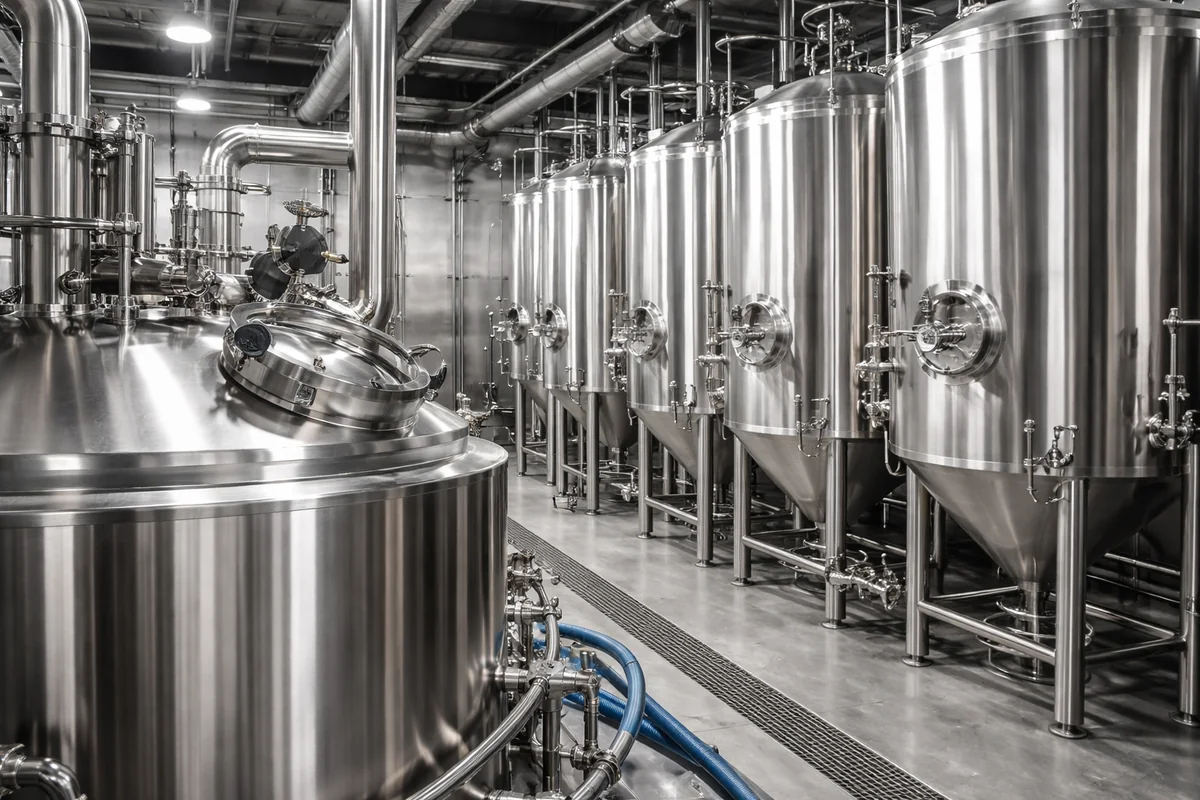
Fermentation Tanks and Brite Tanks — 316L Mandatory
This is non-negotiable. Fermentation tanks cycle through every aggressive environment in the brewery: acidic wort, CO₂-saturated beer, hot caustic CIP, and chlorine sanitizer. Brite tanks see the same CIP regimen plus the additional stress of carbonation pressures (typically 10–15 psi).
Specify: 316L, minimum 2.0mm wall thickness for standard atmospheric and low-pressure fermentation (up to 15 psi). For unitanks rated to 30 psi, increase to 2.5–3.0mm.
Why 316L specifically (not 316): The “L” designation means carbon content below 0.03%, which prevents sensitization (chromium carbide precipitation at grain boundaries during welding). Sensitized stainless steel is vulnerable to intergranular corrosion — exactly the kind of attack that develops slowly in CIP-cycled tanks and shows up as pitting along weld lines 3–5 years into service.
Mash Tuns and Lauter Tuns — 304L Is Sufficient
Mash tuns handle hot water (62–72°C) and grain at pH 5.0–5.5. This is a relatively benign environment for stainless steel. The main concern is abrasion from grain husks, not chemical attack.
Specify: 304L, 2.0mm wall thickness. Spend the savings on a better surface finish instead.
Exception: If your process includes an acid rest step (mashing at pH 4.0–4.5 to activate phytase), or if you’re brewing sour beers with kettle souring in the mash tun, upgrade to 316L. The lower pH combined with elevated temperature pushes the corrosion risk into 316L territory.
The stainless steel for dairy processing grade selection guide covers similar low-acid applications where surface finish quality matters more than alloy selection.
Boil Kettles and Hot Liquor Tanks — 304L with 316L Weld Zones
Boil kettles operate at 100°C with wort at near-neutral pH (5.0–5.5). The main corrosion risk isn’t the wort — it’s the heat-affected zone (HAZ) adjacent to welds, where sensitization can occur despite using low-carbon 304L base material.
Specify: 304L for the shell and dished ends, but insist on 316L filler rod (ER316L) for all welds. This creates a slightly more corrosion-resistant weld deposit that compensates for the chromium depletion in the HAZ.
For steam-jacketed kettles: The jacket itself sees boiler water, which may contain chlorides depending on your water source. If your boiler feed water has >100 ppm chloride, specify 316L for the jacket.
Hot liquor tanks follow the same logic — 304L shell, 316L weld filler. The water temperature (75–85°C) is high enough to accelerate corrosion but the near-neutral pH keeps the risk manageable for 304L.
Piping and Valves — 316L for Product Contact, 304 for Utility
Product transfer lines — from mash tun to boil kettle, from fermenter to brite tank, from brite tank to bright beer tank — see constant CIP cycling and direct beer contact. These should be 316L.
Utility piping — glycol loops, water supply, compressed air — can be 304. Glycol is actually somewhat inhibitive to stainless steel corrosion, and utility water typically doesn’t carry sanitizer chemicals.
Valve specifics: Pay attention to the wetted parts, not just the body. A valve with a 304 body but 316L trim (seat, stem, ball) is acceptable for product service. A valve with all-304 wetted parts is not.
The stainless steel bending radius chart provides bend radius specifications for both 304 and 316L tubing, which matters when designing pipe runs with tight radii.
Heat Exchangers — Split-Grade Approach
Plate heat exchangers in breweries handle two different fluids on opposite sides of each plate. The wort side sees acidic, high-velocity fluid. The coolant side (glycol or city water) sees a closed loop with low chloride.
Specify: 316L plates for wort-side contact. If the unit uses a frame and compression system, the frame can be 304 or even carbon steel with epoxy coating.
For shell-and-tube heat exchangers, specify 316L tubes (the high-velocity, high-corrosion side) and 304L tubesheet and shell (the lower-risk side).
Storage Tanks — 316L Interior, 304L Exterior
Finished beer storage tanks see the same product contact and CIP exposure as brite tanks — 316L interior is mandatory. But the exterior shell only faces atmospheric conditions. A 304L exterior shell welded to a 316L interior liner is a cost-effective approach for large storage vessels.
The structural supports, legs, and access platforms can be 304 or even painted carbon steel, depending on the brewery’s aesthetic and budget.
Surface Finish Requirements That Actually Matter
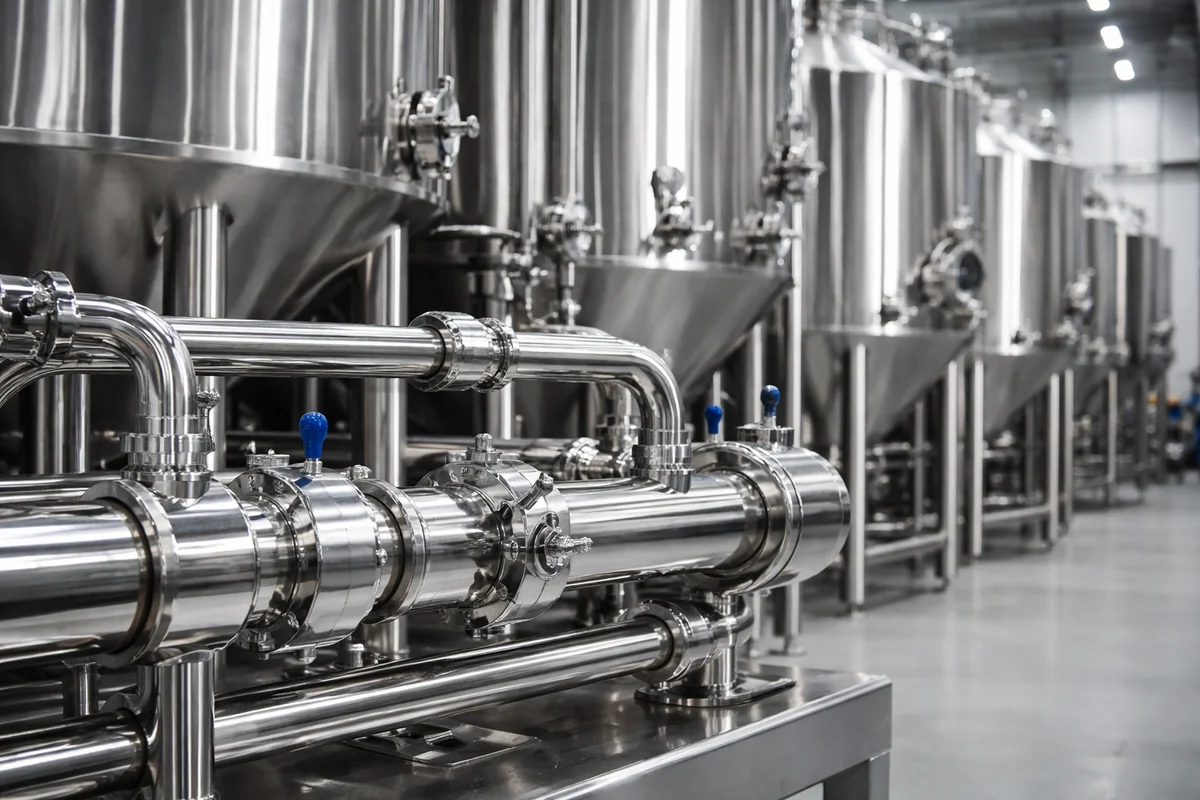
Grade selection is only half the equation. Surface finish determines how well that grade performs in practice. A rough 316L surface will harbor bacteria and corrode faster than a properly finished 304L surface.
| Equipment | Minimum Ra (μm) | Recommended Finish | Why |
|———–|—————-|——————-|—–|
| Fermentation tanks | ≤ 0.8 | Electropolished or #4 brushed | Prevents yeast/bacteria harboring |
| Brite tanks | ≤ 0.5 | Electropolished | Crystal-clear product contact |
| Mash tuns | ≤ 1.6 | #4 brushed or BA | Grain abrasion will roughen anyway |
| Boil kettles | ≤ 1.2 | BA or #4 brushed | High temp + cleaning access |
| Product piping | ≤ 0.8 | Electropolished | CIP effectiveness depends on smoothness |
| Utility piping | ≤ 3.2 | Mill finish (2B) | No product contact |
Electropolishing removes 10–25 μm of surface material, eliminating micro-peaks where bacteria hide. It also enriches the surface chromium content, improving corrosion resistance. For fermentation and brite tanks, it’s worth the 15–20% cost premium over mechanical polishing.
BA (bright annealed) finish, produced by annealing in an inert atmosphere, achieves Ra ~0.4 μm without the cost of electropolishing. It’s an excellent middle ground for equipment that needs good hygiene but doesn’t justify full electropolish.
Weld Quality — The Hidden Failure Point
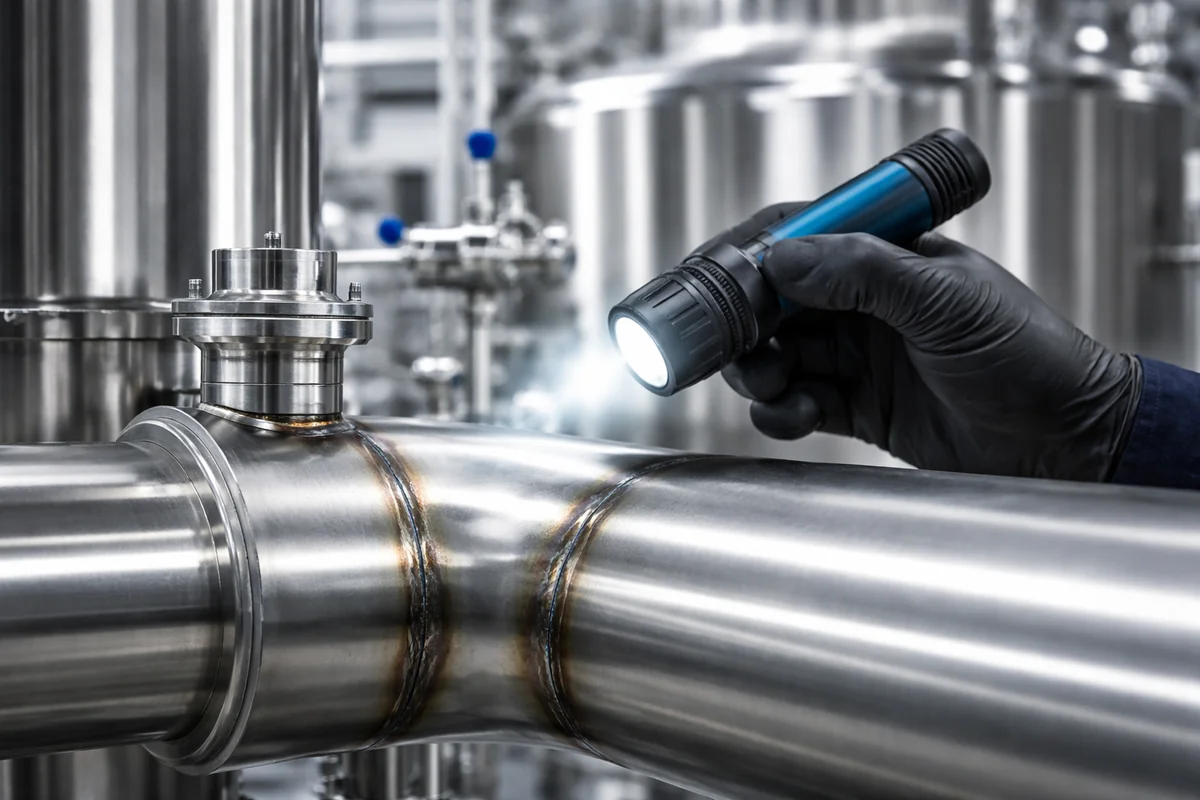
In my experience, 80% of premature stainless steel failures in breweries start at a weld. Not because the weld is structurally weak — it’s because the welding process creates a zone of reduced corrosion resistance right where the CIP chemicals concentrate.
Why Weld Zones Corrode First
Welding heats the stainless steel to 1,500°C+ and the adjacent base metal to 600–800°C. In that heat-affected zone (HAZ), chromium carbides precipitate at grain boundaries, depleting the surrounding chromium below the 10.5% minimum needed for passivation. This is called sensitization.
Even with low-carbon “L” grades (carbon < 0.03%), some sensitization occurs. The result is a narrow band of reduced corrosion resistance running along every weld — exactly where CIP solutions drain and pool.
Heat Tint: The Visible Warning
After welding, a heat tint (temper color) appears on the stainless surface adjacent to the weld. This tint is an enriched iron oxide layer that sits on top of the chromium oxide passive layer. It looks cosmetic, but it’s actually a corrosion risk: the tint is less corrosion-resistant than the underlying stainless, and chloride-containing solutions preferentially attack through it.
Remove heat tint on all product-contact welds. Two methods:
- **Chemical passivation** — citric acid (4–10% concentration, 20–60 minutes at 20–50°C) removes heat tint and restores the passive layer. This is the preferred method for brewery tanks.
- **Mechanical removal** — grinding and polishing. Acceptable for external welds, but creates surface roughness that may need further finishing for product contact.
- **316L where it matters**: Fermentation tanks, brite tanks, product piping (~60% of stainless by weight)
- **304L where it’s sufficient**: Mash tun, boil kettle, HLT, utility piping (~40% of stainless)
- **Savings vs all-316L**: 15–20%, roughly $3,000–6,000 on a $40,000–60,000 equipment budget
- **316L where it matters**: All product-contact vessels, piping, valve wetted parts, CIP skid (~70% of stainless)
- **304L where it’s sufficient**: Structural frames, access platforms, utility piping, glycol headers (~30%)
- **Savings vs all-316L**: 10–15%, roughly $8,000–15,000 on a $100,000–150,000 equipment budget
- **316L premium per tank**: $2,000–5,000 depending on size and pressure rating
- **High-chloride water supply**: If your municipal water or well water contains >200 ppm chloride, every piece of equipment that contacts raw water — including CIP supply tanks, water treatment systems, and utility piping — faces elevated pitting risk. Duplex 2205 with PREN 35+ handles this confidently.
- **Coastal breweries**: Salt air infiltration into ventilation systems deposits chlorides on external surfaces. Coastal breweries that specify 304 for external cladding and structural steel often see atmospheric pitting within 5 years. Duplex 2205 eliminates this.
- **Recycled water systems**: Breweries using greywater recycling or water reclamation may have elevated and variable chloride levels. Duplex 2205 provides a safety margin that 316L cannot.
- Mill Test Report (MTR) per EN 10204 Type 3.1 for every heat of stainless steel
- Chemical composition and mechanical properties verified against ASTM A240 (plate/sheet) or A276 (bar)
- Heat number traceability from MTR to finished equipment
- Ra value measured by profilometer at 3 random locations per vessel
- Ra ≤ 0.8 μm for fermentation and brite tanks
- Ra ≤ 0.5 μm for electropolished surfaces
- Visual inspection for scratches, embedded iron contamination, and heat tint
- Visual inspection of 100% of product-contact welds
- Dye penetrant (PT) testing on all nozzle-to-shell and shell-to-head welds
- No heat tint visible on product-contact surfaces after passivation
- Filler rod grade documented on weld map
- Citric acid passivation per ASTM A967 on all product-contact surfaces
- Water spray test: sheet of water, no beading within 30 seconds
- Ferroxyl test (optional but recommended): no blue spots indicating free iron
- Grade, product form, and standard for each component (e.g., “316L plate per ASTM A240, 2.0mm, 2B finish”)
- Surface finish Ra values by component
- Welding procedure qualification requirements (ASME IX or ISO 15614)
- NDE requirements by weld class
- Passivation method and verification
- Documentation package: MTR, weld map, dimensional report, passivation certificate
Filler Rod Selection
| Base Metal | Filler Rod | Why |
|———–|———–|—–|
| 304L | ER308L | Matches base composition, slight over-alloying with Cr/Ni for crack resistance |
| 316L | ER316L | Matches molybdenum content for consistent corrosion resistance |
| 304L (high-corrosion zone) | ER316L | Over-alloying the weld for extra corrosion protection |
Never use carbon steel filler on stainless base metal. Never use 308L filler on 316L base metal — you lose the molybdenum in the weld deposit, creating a preferential corrosion path.
The ASTM A240 vs A276 stainless steel standards explain how these specifications cover different product forms and what chemical composition limits apply to each grade.
Cost Analysis: 304L vs 316L by Brewery Scale
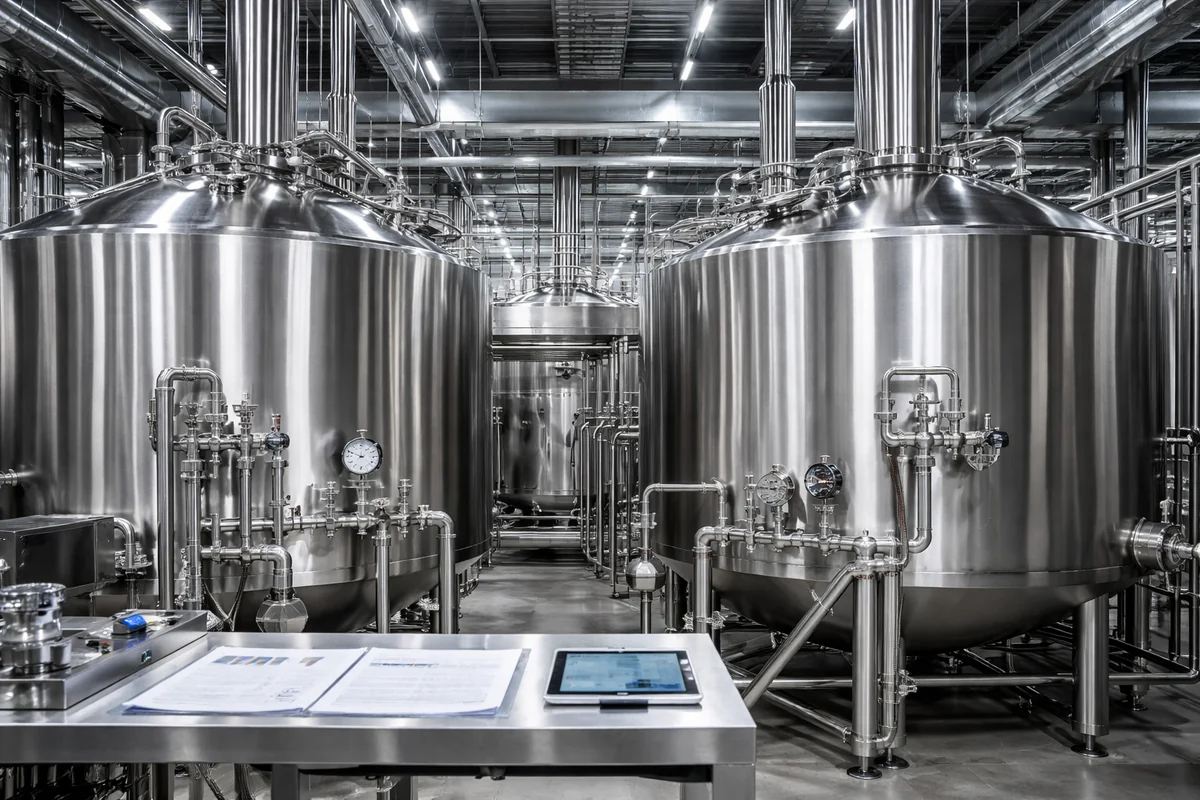
The 316L premium over 304L typically runs 20–30% for raw material, translating to 15–25% higher fabricated cost depending on the equipment. Here’s how that breaks down by brewery size.
Microbrewery (10–50 HL)
For a 10 HL brewhouse with 4 fermenters and 2 brite tanks:
At this scale, the $3,000–6,000 saved on material can be redirected to better surface finishes — specifically electropolishing the fermentation tanks instead of accepting a mechanical polish. That trade-off (lower grade where it doesn’t matter, better finish where it does) consistently produces better long-term outcomes than upgrading the grade everywhere but accepting a rougher surface.
Regional Brewery (50–500 HL)
For a 50 HL brewhouse with 12 fermenters, 4 brite tanks, and a centrifuge:
Regional breweries also benefit from specifying 316L for the CIP skid itself — the hot caustic and chlorine circuits corrode 304 faster than most buyers realize, and a CIP skid failure takes the entire cleaning system offline.
Large-Scale Brewery (500+ HL)
At this scale, the 316L premium becomes a smaller percentage of total project cost, and the operational risk of any corrosion failure is amplified by production volume. I recommend 316L for all wetted surfaces, with 304L only for structural and non-contact components.
The incremental cost is typically 8–12% of equipment budget, but the insurance against a single batch contamination event (which could cost $50,000–200,000 in lost product) makes it a clear ROI.
Here’s the full picture:
| Brewery Scale | Equipment Budget | 316L Premium | Annual Production | Cost per HL of Insurance |
|————–|—————–|————-|——————-|————————-|
| Micro (10–50 HL) | $40K–60K | $3K–6K | 500–2,500 HL | $1.20–12.00/HL |
| Regional (50–500 HL) | $100K–150K | $8K–15K | 5,000–25,000 HL | $0.32–3.00/HL |
| Large (500+ HL) | $300K–500K | $25K–50K | 50,000+ HL | $0.50–1.00/HL |
The cost per hectoliter of “insurance” drops dramatically with scale, which is why I’m more aggressive about recommending 316L everywhere for large breweries.
When to Consider Duplex 2205 for Brewery Applications
Most breweries don’t need duplex stainless steel. But three situations justify the 40–50% material premium over 316L:
The PREN 40 vs PREN 25 comparison in our duplex guide shows the quantitative difference in pitting resistance.
One caveat: duplex welding requires more skill and tighter parameter control than austenitic welding. Verify that your fabrication shop has qualified welders for duplex 2205 before committing.
Procurement Checklist for Brewery Stainless Steel
When you’re ready to order, specify these requirements in your RFQ to get exactly what you need:
Material Certification:
Surface Finish:
Weld Quality:
Passivation Verification:
What to Specify in Your RFQ:
Getting grade selection right isn’t about spending the most money — it’s about spending it on the right equipment. A well-specified brewery with 304L and 316L in the right places will outlast an over-specified all-316L brewery that cut corners on surface finish and weld quality to afford the premium grade.
The right grade depends on what each piece of equipment is actually fighting — and now you know exactly what that is.
Author: NewQiujing Group