Duplex 2205 vs 316L Stainless Steel: Key Differences and Best Uses
Duplex 2205 is usually the better choice for high-chloride and high-strength applications,
while 316L is often the better choice for easier fabrication, broader general-purpose use,
and some higher-temperature service conditions.The right grade depends on corrosion risk, strength requirements, fabrication limits,
and total project cost—not just raw material price.
Key Takeaways
- Duplex 2205 typically offers much higher yield strength than 316L.
- Duplex 2205 has better resistance to pitting, crevice corrosion, and chloride stress corrosion cracking.
- 316L is easier to form, machine, and fabricate in many standard industrial applications.
- 316L remains a strong commercial choice for general-purpose corrosive service.
- Duplex 2205 can reduce total project cost when higher strength allows thinner sections.
What Is Duplex 2205 and What Is 316L?
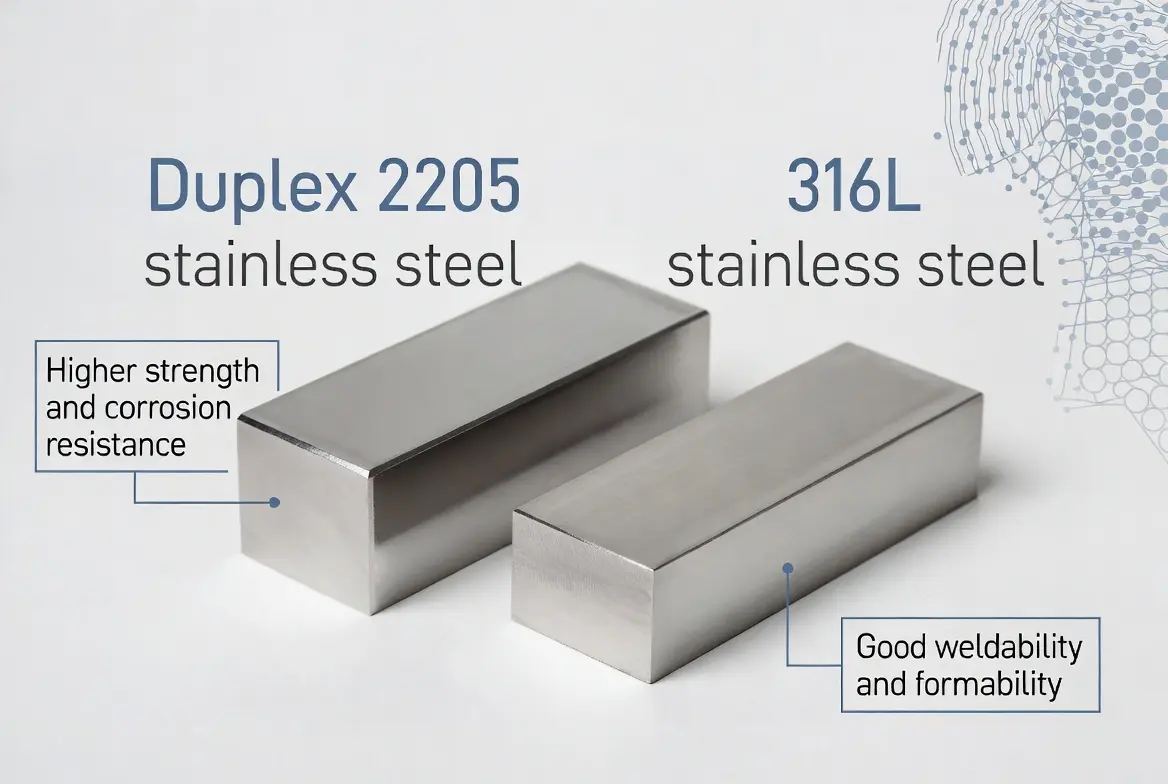
Introduction to Duplex 2205 and 316L stainless steel grades
Duplex 2205 is a duplex stainless steel with a mixed ferritic-austenitic microstructure.
This structure gives it a combination of higher mechanical strength and stronger resistance
to chloride stress corrosion cracking than common austenitic grades.
316L is a low-carbon austenitic stainless steel widely used in tanks, pipelines, fittings,
heat exchangers, food equipment, and general industrial fabrication. It is popular because
it offers a reliable balance of corrosion resistance, weldability, availability, and fabrication ease.
In simple terms, the comparison between duplex stainless steel vs austenitic stainless steel
is often a choice between higher performance and easier fabrication.
Duplex 2205 vs 316L Stainless Steel: Quick Comparison
| Property | Duplex 2205 | 316L |
|---|---|---|
| Microstructure | Duplex | Austenitic |
| Typical PRE | 35 | 24 |
| Minimum Yield Strength | 500 MPa | 240 MPa |
| Typical Cr | 22.4% | 17.2% |
| Typical Ni | 5.7% | 10.1% |
| Typical Mo | 3.1% | 2.1% |
| Typical N | 0.17% | — |
| Best For | Chlorides, higher strength, marine and process service | General corrosive service, easier forming and fabrication |
Chemical Composition Differences
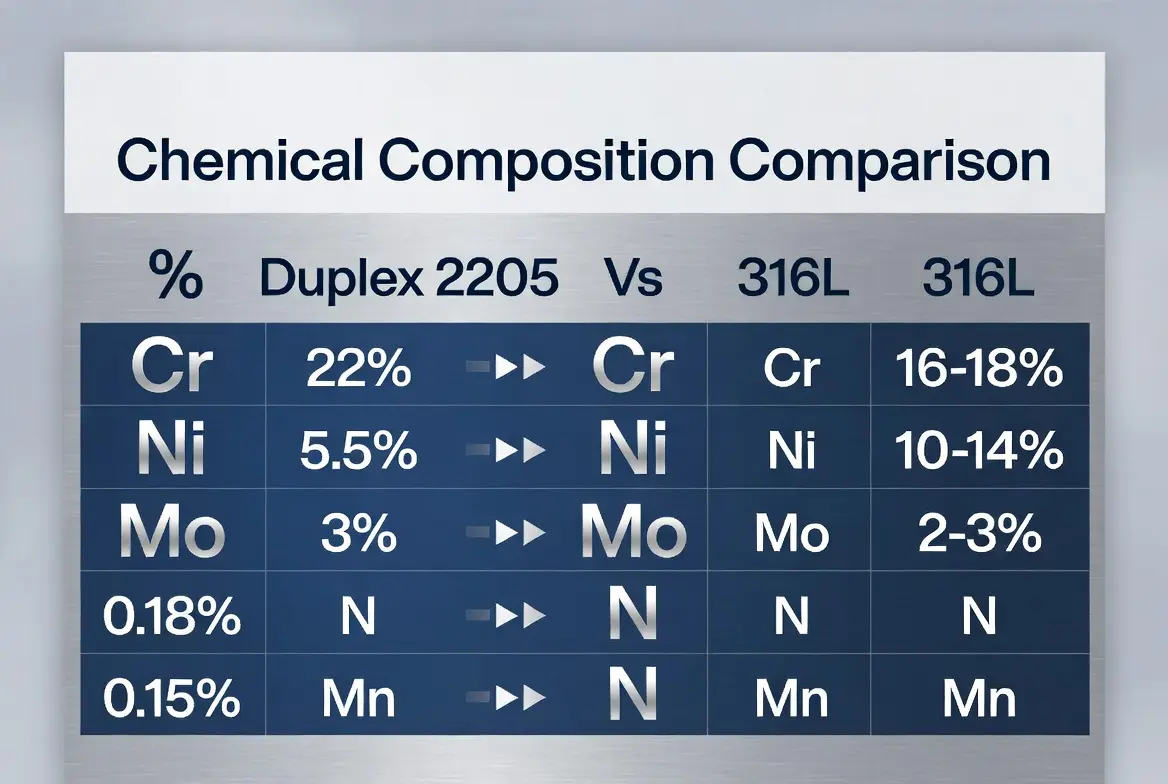
Chemical composition differences between Duplex 2205 and 316L stainless steel
The chemistry gap between Duplex 2205 and 316L is one of the main reasons for their different performance profiles.
Duplex 2205 typically contains more chromium, molybdenum, and nitrogen, while 316L contains more nickel.
This chemistry helps Duplex 2205 achieve higher resistance to localized corrosion in chloride-bearing environments.
In contrast, 316L keeps its value through good formability, stable fabrication performance, and broad application range.
For buyers comparing Duplex 2205 vs 316L stainless steel, chemistry should not be viewed in isolation.
It directly affects corrosion resistance, welding behavior, and long-term service reliability.
Strength and Mechanical Properties
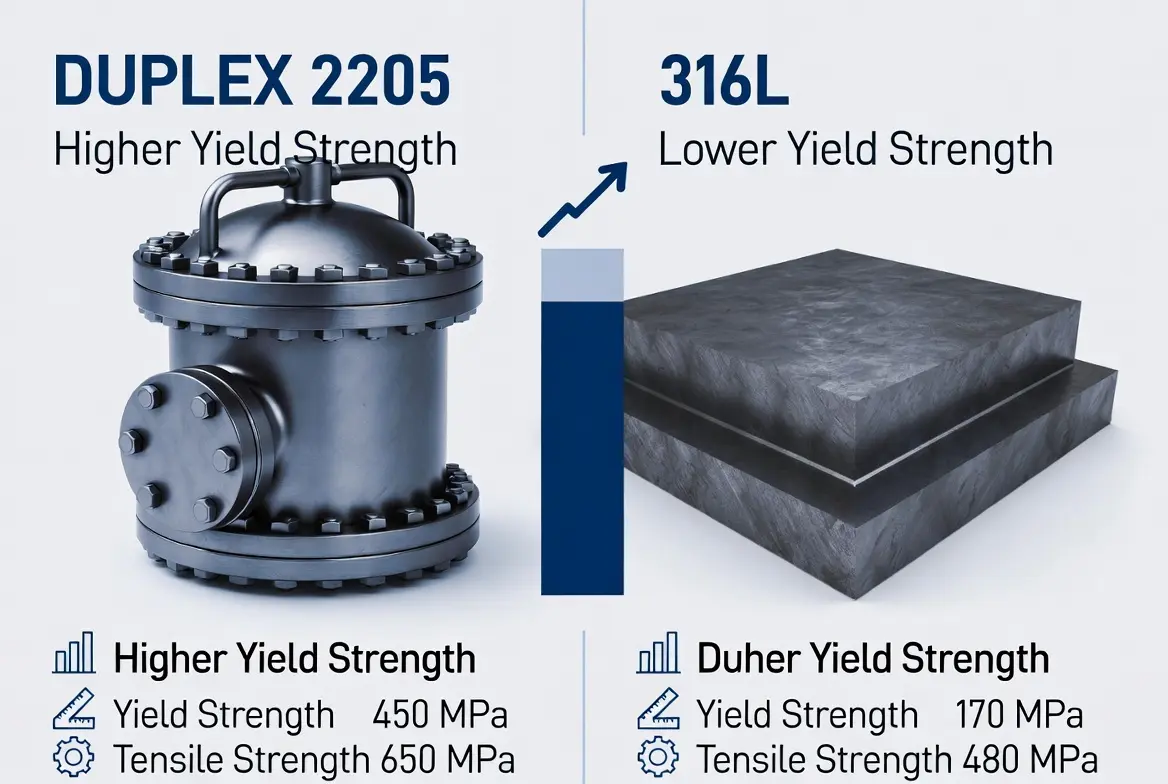
Strength and mechanical properties of Duplex 2205 vs 316L stainless steel
Duplex 2205 is significantly stronger than 316L. This is one of the most important differences in industrial design.
In many published datasheets, Duplex 2205 shows about double the yield strength of 316L.
This higher strength can allow thinner wall sections, lower structural weight, and improved load capacity in pressure vessels,
storage tanks, pipelines, and process systems. That advantage becomes even more important when both strength and corrosion resistance matter.
316L, however, still has advantages in ductility and easier forming. If the project involves complex fabrication,
deep drawing, or standard shop processing, 316L may remain the more practical option.
Corrosion Resistance in Chloride Environments
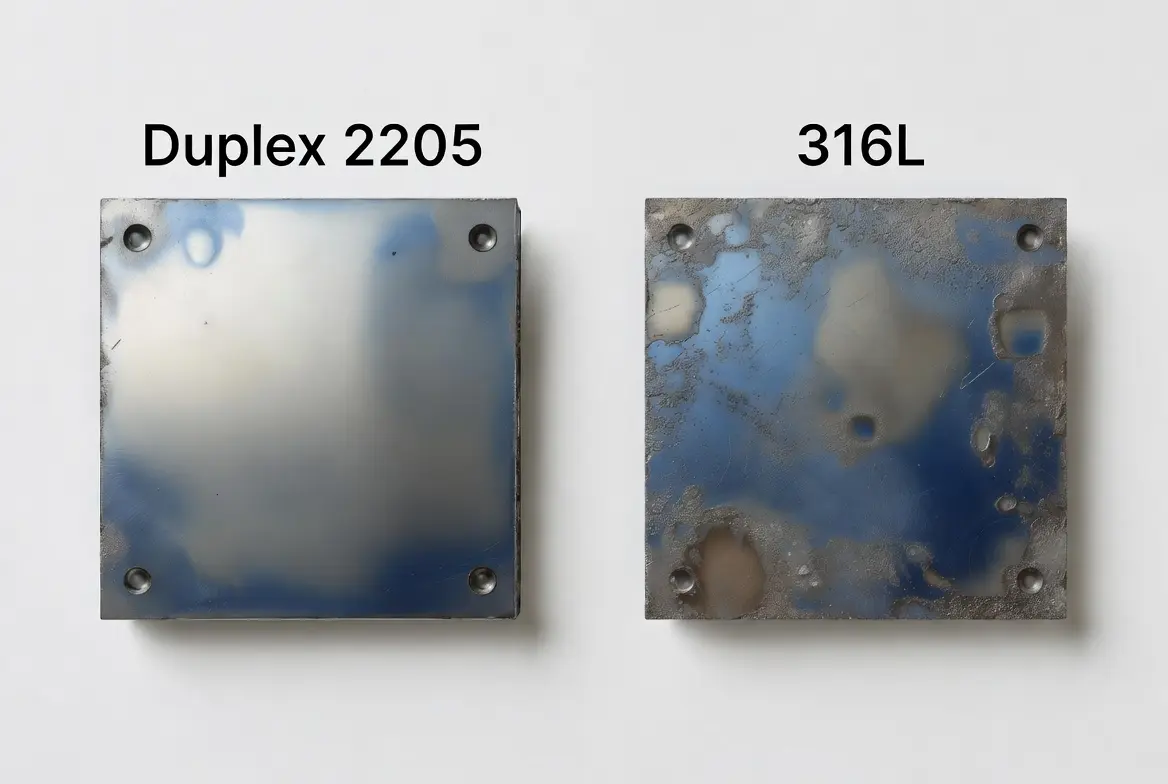
Corrosion resistance comparison of Duplex 2205 and 316L in chloride environments
Corrosion resistance is often the deciding factor in the 2205 vs 316L corrosion resistance discussion.
Duplex 2205 is generally preferred for environments where pitting, crevice corrosion, and chloride stress corrosion cracking are serious risks.
This includes seawater systems, coastal installations, offshore platforms, desalination units, chemical process equipment,
and heat exchangers working with chloride-containing media. In these conditions, the higher PRE of Duplex 2205 is a major advantage.
316L is still suitable for many mild to moderate corrosive environments. It performs well in a wide range of industrial applications,
but its operating window becomes narrower as chloride concentration, temperature, and stress levels increase.
Welding, Forming, and Machining
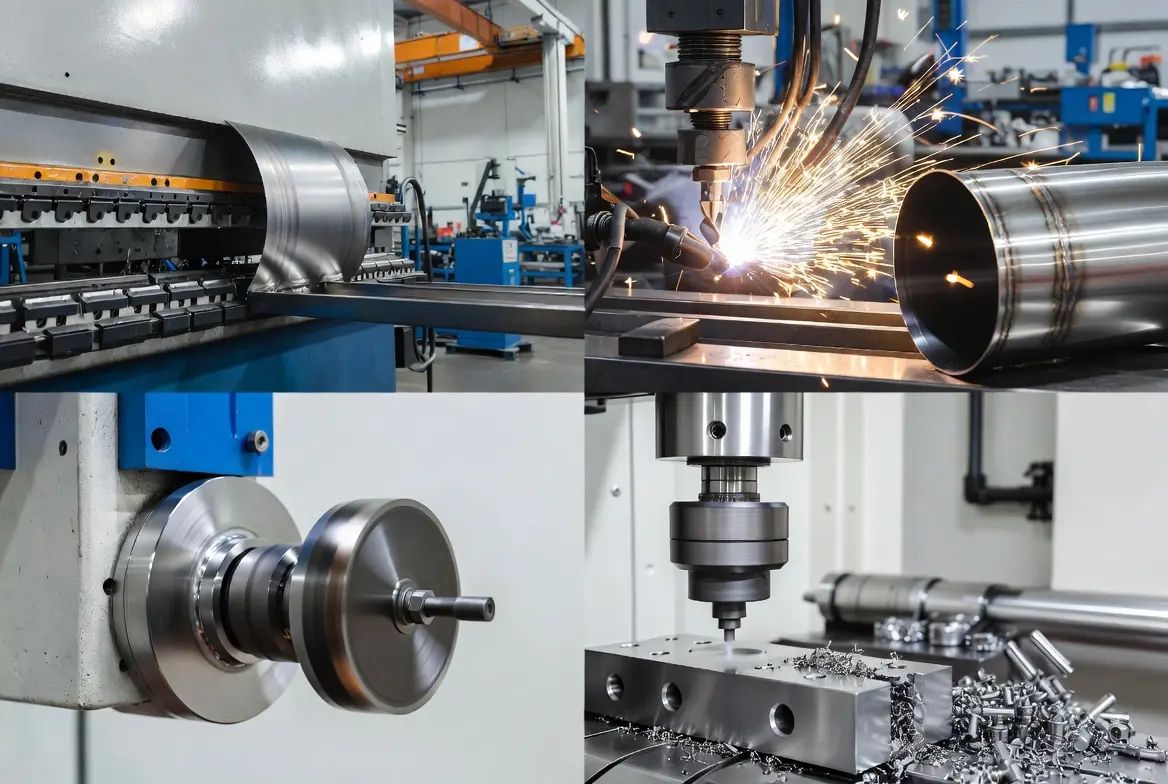
Welding forming and machining differences between Duplex 2205 and 316L stainless steel
316L remains one of the easiest stainless steel grades to fabricate in many workshops.
It is familiar to fabricators, widely available, and commonly chosen for general-purpose industrial production.
Duplex 2205 is weldable, but it requires tighter process control. Heat input, interpass temperature,
and filler selection matter more than they do with standard austenitic stainless steels.
In forming and machining, Duplex 2205 usually requires higher force and more planning because of its higher strength.
That is why Duplex 2205 should not be treated as a direct replacement for 316L in every application.
Temperature Limits and Service Conditions
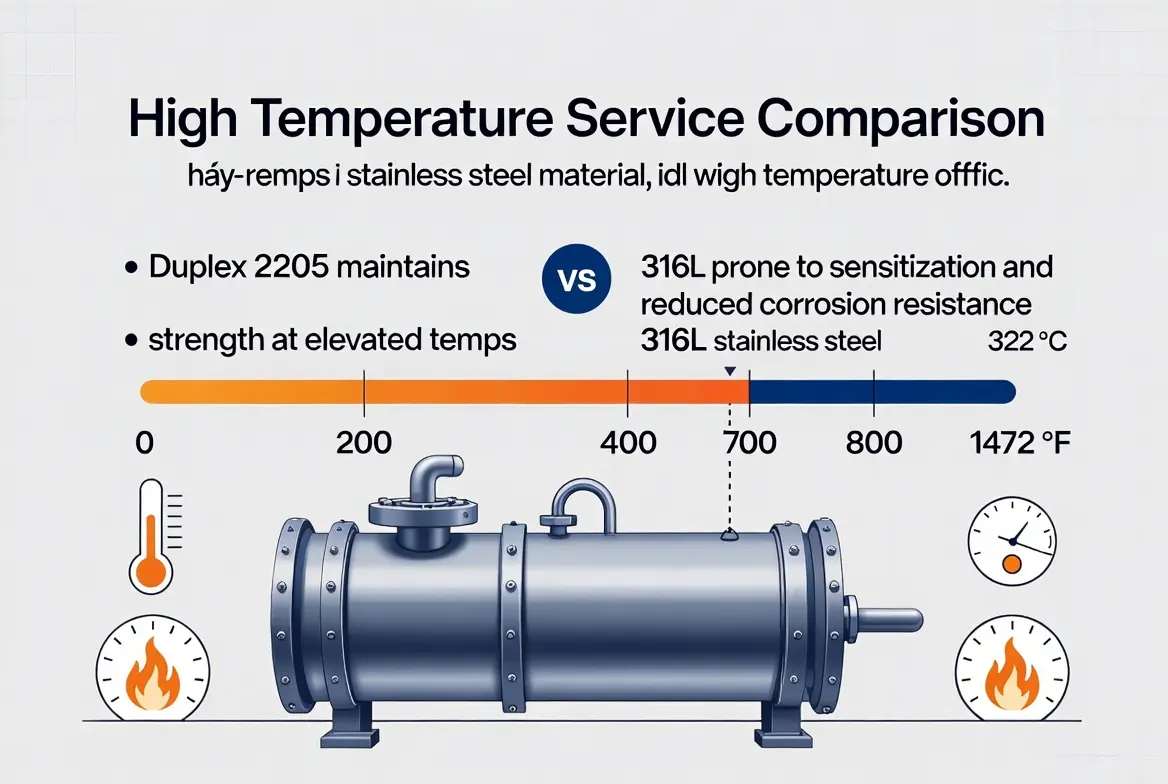
Temperature limits and service conditions for Duplex 2205 and 316L stainless steel
One common mistake is to assume that Duplex 2205 is better than 316L in every operating condition.
In reality, service temperature can change the material decision.
Duplex 2205 performs very well in many chloride-rich environments, but prolonged exposure to elevated temperatures
can affect its structure and impact performance. In some applications, this makes 316L the more suitable material.
316L is often the better option when a project demands standard corrosion resistance together with more forgiving
high-temperature service behavior and easier fabrication.
Cost and Total Value
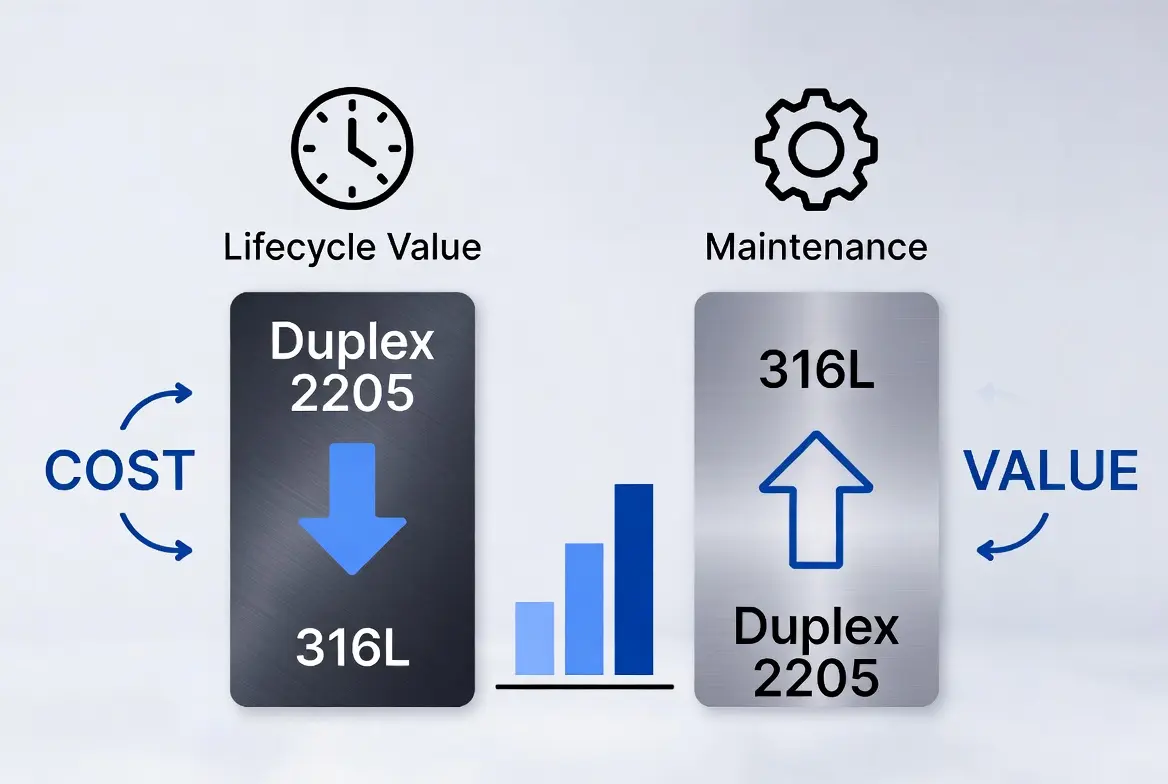
Cost and total value comparison of Duplex 2205 vs 316L stainless steel
Material selection should not be based only on price per ton. The better question is which grade reduces total project risk.
Duplex 2205 may cost more upfront in some specifications, but its higher strength can reduce wall thickness,
structural weight, and sometimes welding volume. In aggressive environments, it can also reduce the risk of early failure and replacement.
316L still offers strong total value in standard industrial applications where fabrication simplicity,
supply chain familiarity, and general corrosion resistance are the main priorities.
When to Choose Duplex 2205 or 316L
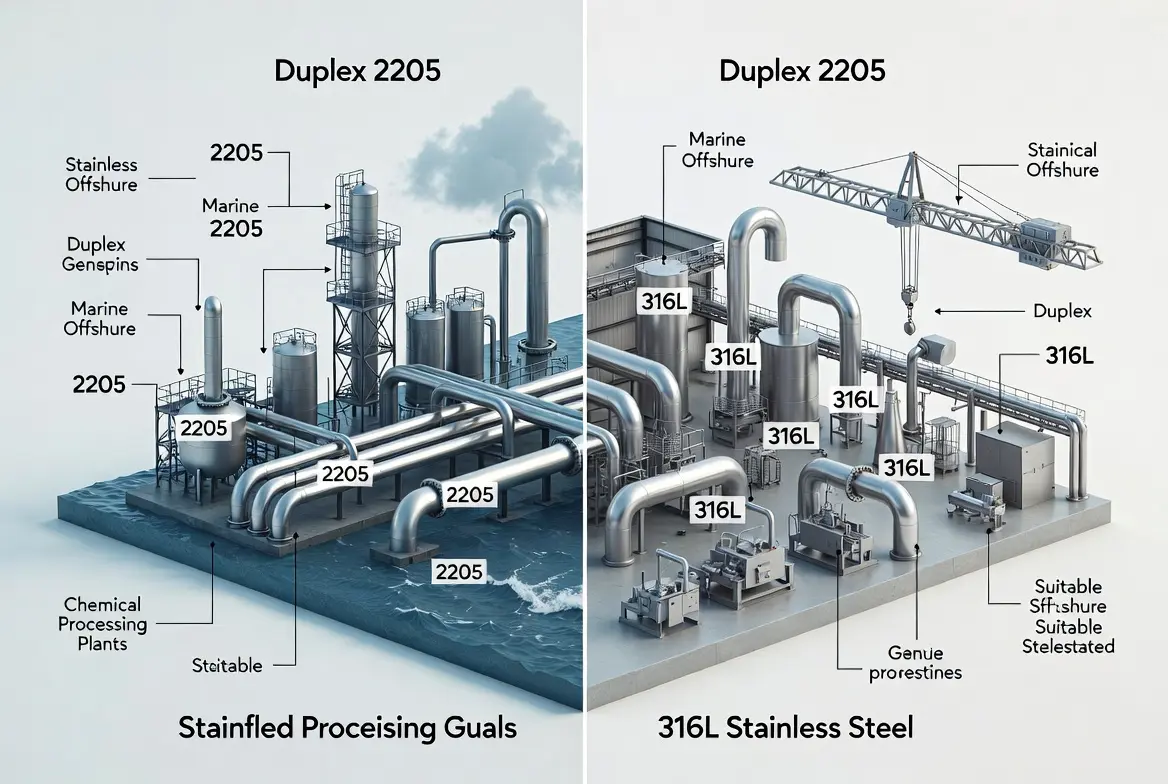
When to choose Duplex 2205 or 316L stainless steel for industrial applications
Choose Duplex 2205 When:
- Chloride levels are high.
- Pitting and crevice corrosion are major concerns.
- Stress corrosion cracking risk must be reduced.
- Higher yield strength can improve design efficiency.
- The application is marine, offshore, desalination, or aggressive chemical processing.
Choose 316L When:
- The corrosive environment is moderate rather than severe.
- Fabrication ease is more important than maximum strength.
- Broad availability and standard workshop familiarity matter.
- The service condition favors a conventional austenitic grade.
- The application is general-purpose industrial equipment.
Frequently Asked Questions
What is the main difference between Duplex 2205 and 316L stainless steel?
The main difference is that Duplex 2205 combines higher strength with stronger resistance
to chloride pitting, crevice corrosion, and stress corrosion cracking, while 316L is easier
to fabricate and is widely used for general corrosive service.
Is Duplex 2205 stronger than 316L?
Yes. Duplex 2205 commonly offers much higher yield strength than 316L, which can help reduce
wall thickness and improve structural efficiency in suitable designs.
Is Duplex 2205 more corrosion resistant than 316L?
In many chloride-containing environments, yes. Duplex 2205 is generally more resistant
to localized corrosion and chloride stress corrosion cracking than standard 316L stainless steel.
When should I choose Duplex 2205 instead of 316L?
Choose Duplex 2205 for seawater, offshore, desalination, chemical processing, and other chloride-rich
environments where corrosion resistance and strength are critical.
Is 316L still a good choice for industrial equipment?
Yes. 316L is still an excellent choice for many tanks, pipelines, fittings, and fabricated components
because it offers dependable corrosion resistance, good weldability, and broad global availability.
Final Thoughts
Duplex 2205 vs 316L stainless steel is not a simple good-versus-bad comparison.
It is a decision between two proven grades built for different priorities.
Duplex 2205 is the stronger option for high-chloride, higher-strength, and more demanding corrosive environments.
316L remains the better fit for many general industrial applications where fabrication ease and supply convenience matter more.
If you need help choosing the right grade for sheets, plates, coils, pipes, or custom processing parts,
you can learn more about our company on About Us
or contact us directly through New QiuJing.
Related Guides: 2507 Super Duplex Stainless Steel | 304 vs 316 for Food Processing
Related material guides
Author: NewQiujing Group