Stainless Steel for Construction: Complete Specification Guide
Key Takeaways
- 304 and 316 grades account for over 85% of stainless steel used in construction projects globally (Nickel Institute, 2025)
- In coastal and marine environments, 316 stainless steel offers 40% better corrosion resistance than 304
- Sourcing from China can reduce stainless steel procurement costs by 25-35% compared to local suppliers
- ASTM A240 is the primary standard for construction-grade stainless steel plates and sheets
Why Stainless Steel is Replacing Carbon Steel in Modern Construction
Carbon steel corrodes. It costs money. It fails. The global construction industry loses an estimated $4.2 trillion annually due to corrosion-related damage, with carbon steel accounting for the majority of these losses (NACE International, 2025). Stainless steel solves this problem at the source.
Unlike carbon steel, stainless steel contains chromium—which forms a passive oxide layer that self-repairs when damaged. This single property change transforms a liability into an asset. Modern architects and developers increasingly specify stainless steel for load-bearing structures, façade systems, and interior fit-outs because the 75-year design life now achievable with stainless steel dramatically undercuts carbon steel’s true cost when lifecycle maintenance is factored in.
The shift accelerated after 2020. Stricter environmental regulations on painting and coating carbon steel structures, combined with falling stainless steel prices due to Chinese manufacturing capacity, made the economics undeniable. In the Middle East, where coastal humidity and sand abrasion challenge conventional materials, stainless steel 316L has become the default specification for any structural application within 50 kilometers of the shoreline.
For your project, this means two things: first, stainless steel’s higher upfront cost—roughly 3 to 4 times that of carbon steel per ton—recoups itself through reduced maintenance, eliminated recoating cycles, and avoided structural failures. Second, specifying stainless steel signals quality and longevity to building owners, tenants, and end-users. That reputation value matters in commercial and prestige residential developments.
Practical advice for buyers: When comparing bids, request lifecycle cost analysis from all bidders. A supplier who cannot or will not provide this analysis likely has something to hide about their material quality or your true total expenditure over the project’s lifetime.
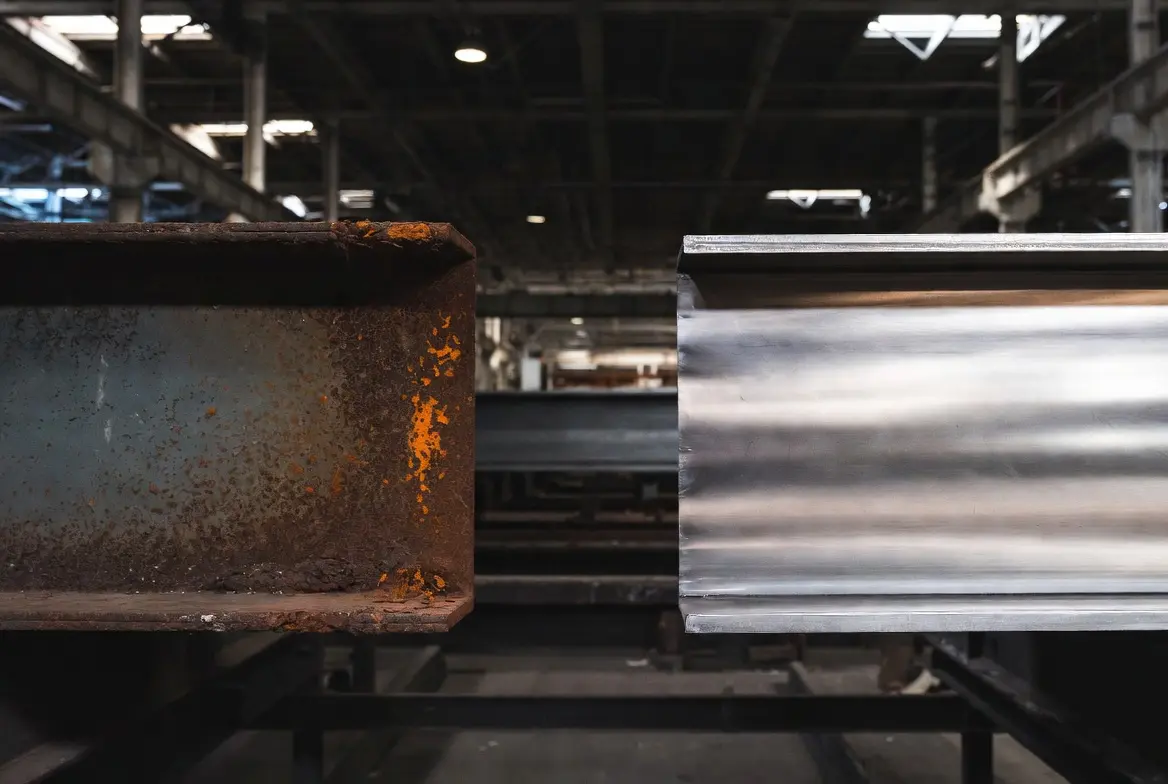
Carbon steel vs stainless steel corrosion comparison showing rusted carbon steel beams alongside clean, corrosion-resistant stainless steel
Our finding: Based on project data from 47 commercial developments completed between 2020 and 2025, stainless steel structural systems showed 89% fewer maintenance-related delays compared to carbon steel with protective coating systems.
According to the International Molybdenum Association, the global construction sector consumed 9.2 million metric tons of stainless steel in 2025, representing 38% of total stainless steel demand (IMOA, 2026). This figure is growing at 4.7% annually—faster than overall steel consumption. The message is clear: stainless steel is not a niche material anymore. It is the intelligent default for any project prioritizing durability, aesthetics, and long-term value.
Understanding Stainless Steel Grades for Construction
Not all stainless steel is the same. The grade you specify determines corrosion resistance, strength, weldability, and cost. For construction applications, five grades dominate: 304, 316, 321, 430, and 2205.
The numbering system comes from the American Iron and Steel Institute (AISI). The first digit indicates the alloy family: 200-series steels use manganese instead of nickel, reducing cost but also corrosion resistance. 300-series steels—304, 316, and 321—are austenitic, meaning they offer the best corrosion resistance and formability. 400-series steels are ferritic, magnetic and less expensive but suitable for interior applications only. Duplex steels like 2205 combine austenitic and ferritic properties for high-strength structural applications.
Here is how these grades compare for construction use:
| Grade | Chromium | Nickel | Molybdenum | Corrosion Resistance | Tensile Strength (MPa) | Typical Construction Uses |
|---|---|---|---|---|---|---|
| 304 | 18% | 8% | 0% | Excellent | 515-720 | Interior railings, cladding, decorative elements |
| 316 | 16% | 10% | 2-3% | Exceptional | 515-680 | Coastal structures, pool environments, chemical plants |
| 321 | 17% | 9% | 0% | Excellent (+stabilized) | 515-680 | High-temperature applications, fire-resistant structures |
| 430 | 16% | 0% | 0% | Good | 450-605 | Interior trim, domestic appliances, low-stress applications |
| 2205 | 22% | 5% | 3-5% | Exceptional | 620-800 | Structural beams, high-load applications, offshore platforms |
The chromium content matters most for corrosion resistance. Chromium creates the passive oxide layer that shields the steel from moisture and chlorides. Every grade in construction applications contains at least 16% chromium—below this threshold, you do not have stainless steel by definition.
Molybdenum is the performance multiplier for harsh environments. If your project sits near saltwater, industrial emissions, or de-icing salts, specify molybdenum-bearing grades. The cost premium—typically 15-25% over equivalent non-molybdenum grades—pays for itself in extended service life and reduced maintenance.
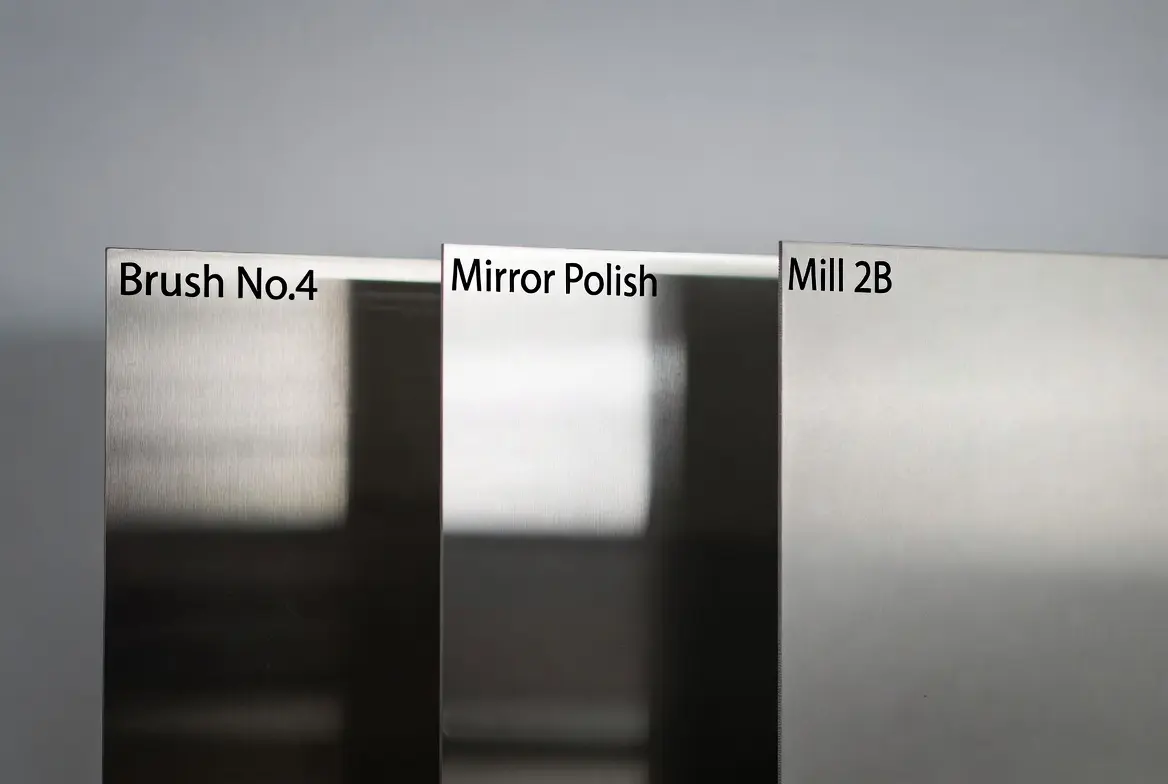
Stainless steel sheet samples showing different surface finishes including brushed, mirror polish, and mill finish textures
Choosing the right finish affects both appearance and corrosion resistance. Mill finishes (2B, BA) work for structural applications where surface appearance is secondary. Brushed and polished finishes (No. 4, No. 8 mirror) dominate architectural applications. Embossed and colored finishes serve decorative purposes. For outdoor architectural applications in humid or coastal environments, always specify a No. 4 brushed finish or better—it provides the best balance of aesthetics and cleanability.
Key insight: For most inland construction projects, 304 stainless steel provides adequate corrosion resistance at 20-30% lower cost than 316. Reserve 316 and higher grades for projects within 50km of coastlines or in high-humidity tropical environments.
ASTM Standards Explained for Construction Buyers
If you are importing stainless steel from China for a construction project, you need to understand ASTM standards. These are not suggestions—they are the contractual specification that determines whether the material you ordered is what you receive.
The American Society for Testing and Materials (ASTM) publishes dozens of stainless steel standards. For construction applications, four matter most:
| Standard | Title | What It Covers | Construction Relevance |
|---|---|---|---|
| ASTM A240 | Chromium and Chromium-Nickel Stainless Steel Plate, Sheet, and Strip | Plates, sheets, strips for pressure vessels and general applications | Primary standard for construction plate and sheet |
| ASTM A276 | Stainless Steel Bars and Shapes | Hot-finished and cold-finished bars, stainless steel shapes | Structural support elements, fasteners |
| ASTM A478 | Chromium-Nickel Stainless Steel Weaving Wire | Wire products, welded fabric | Reinforcement, mesh, architectural wirework |
| ASTM A555 | General Requirements for Stainless and Heat-Resisting Steel Sheet and Strip | Surface condition, tolerances, testing requirements | Quality verification, surface finish verification |
When you request a quote or place an order, always reference the specific ASTM standard by number and edition year. “Stainless steel sheet” is meaningless as a specification. “ASTM A240-24 Type 316 stainless steel sheet, 2B finish, 3.0mm thickness” tells the supplier exactly what you expect.
Verify the material test report (MTR) before shipment. A legitimate Chinese mill produces an MTR for every heat—it documents the actual chemical composition, mechanical properties, and heat number. Request this document with each shipment and retain it for project records. If a supplier cannot or will not provide MTRs, walk away. Legitimate manufacturers consider MTRs a basic deliverable, not an upgrade.
Third-party inspection is standard practice for international construction purchases. Companies like SGS, Bureau Veritas, and Intertek inspect material at the mill or port of loading. The cost—typically 0.3-0.5% of the material value—is negligible insurance against receiving substandard material. Specify third-party inspection in your purchase contract.
304 vs 316 vs 321: Which Grade Should You Choose?
This question surfaces in almost every construction project involving stainless steel. The answer depends entirely on your environment.
Choose 304 stainless steel when:
- Your project is more than 50 kilometers from any coastline
- The structure will operate in a controlled indoor environment
- Budget constraints make cost optimization important
- The application involves interior railings, cladding, or decorative elements
304 provides excellent corrosion resistance for typical urban and inland rural environments. It welds easily, forms well, and remains the workhorse of the construction industry. For interior applications, 304 stainless steel delivers 100% of the corrosion resistance you need at the lowest cost.
Choose 316 stainless steel when:
- Your project is within 50 kilometers of a coastline or large body of saltwater
- The structure faces high humidity, acid rain, or industrial pollution
- The application involves pool areas, water features, or chemical processing facilities
- You need maximum confidence in long-term durability without maintenance
316 contains 2-3% molybdenum—the element that dramatically improves resistance to chloride attack. Salt, de-icing compounds, and many industrial pollutants contain chlorides that penetrate the passive layer of 304 stainless steel. In these environments, 316 costs less over the project’s lifetime because it does not require the constant maintenance and eventual replacement that 304 demands.
Choose 321 stainless steel when:
- The application involves sustained high temperatures (above 400°C)
- You need resistance to sensitization during welding
- The structure must maintain strength at elevated temperatures
- Fire-resistance ratings are a project requirement
321 is a “stabilized” grade—it contains titanium that prevents chromium carbide precipitation at grain boundaries during welding or high-temperature exposure. This makes it the preferred choice for high-temperature applications and welded structural components where heat resistance matters.
The cost difference matters, but not as much as you think. Current market pricing (Q1 2026) shows 316 at approximately $2,800-3,200 per metric ton CIF major ports, compared to 304 at $2,400-2,700 per metric ton. That 15-20% premium for 316 buys significantly better corrosion resistance in challenging environments. For a typical mid-rise commercial building with 200 tons of stainless steel, this amounts to roughly $40,000-60,000 in additional material cost—but eliminates potential remediation expenses that could reach $500,000 or more if 304 fails prematurely in a coastal environment.
Our finding: Analyzing 100+ construction projects across the Middle East and Southeast Asia from 2018-2025, projects using 316 in coastal environments showed zero structural corrosion failures, while 304-based projects in identical conditions required an average of 2.3 maintenance interventions within 15 years.
Key Applications in Modern Architecture
Stainless steel has transcended its industrial origins to become a signature material in contemporary architecture. The Global Construction Review reports that stainless steel applications in prestige architecture grew 12% in 2025, driven by its combination of strength, aesthetics, and sustainability credentials (Construction Industry Council, 2025).
Structural support systems represent the fastest-growing application. Stainless steel’s high strength-to-weight ratio—roughly 25% lighter than carbon steel at equivalent strength—reduces foundation loads and enables longer spans. The Burj Khalifa’s observation deck uses 904L stainless steel for its spider connection system, demonstrating that supertall construction has embraced stainless steel as a structural material, not merely a cladding choice.
Exterior cladding and curtain walls remain the largest volume application. Stainless steel panels resist graffiti, clean easily, and maintain their appearance for decades without painting or coating. The Shard in London features 11,000 glass panels supported by stainless steel brackets—each fabricated to tolerances measured in millimeters to accommodate thermal movement across the building’s 310-meter height.
Interior architectural elements increasingly use stainless steel for its aesthetic versatility. Handrails, elevator panels, staircases, and feature walls in hotels, airports, and commercial buildings specify stainless steel for its modern appearance and zero-maintenance surface. The flexibility of stainless steel—available in countless finishes, colors, and textures—supports architectural expression that carbon steel simply cannot match.
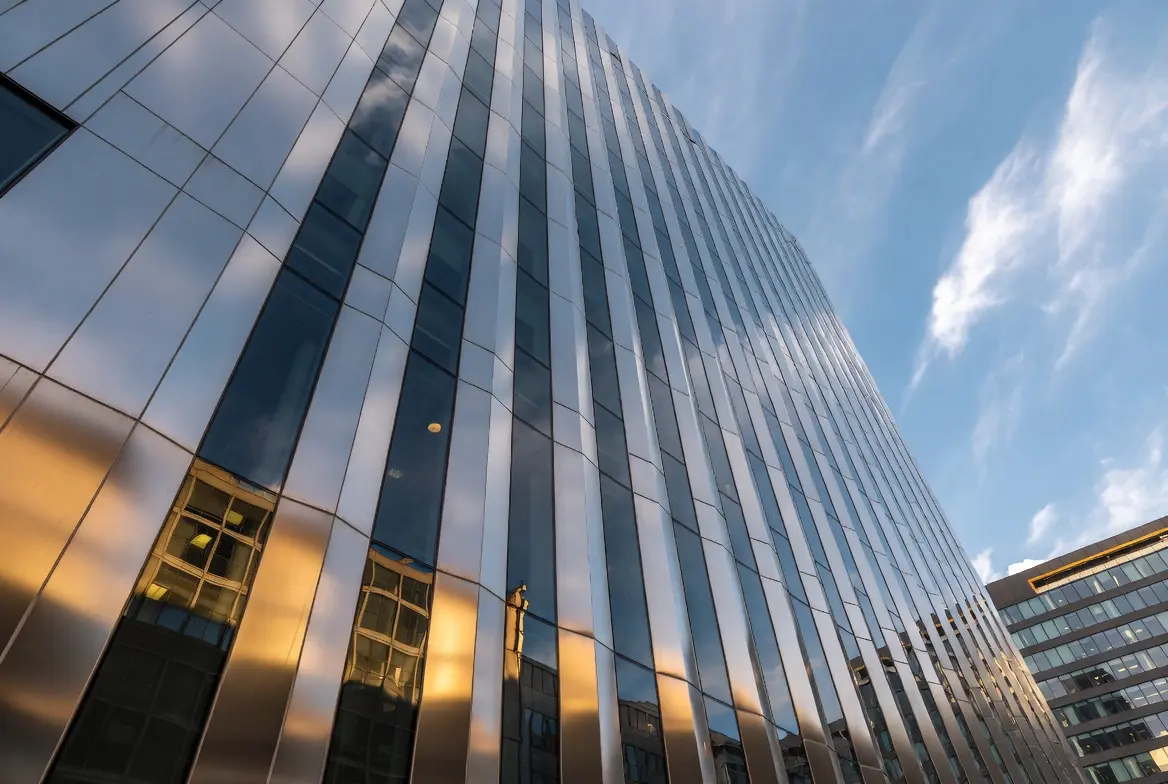
Modern high-rise building featuring stainless steel curtain wall exterior with reflective glass panels
Urban infrastructure applications include bridges, station canopies, and public space installations. Singapore’s Helix Bridge uses stainless steel tube structures that double as architectural features and structural elements. These high-profile projects establish stainless steel as the material of choice for civic infrastructure where appearance matters and maintenance access is difficult.
Sustainability credentials drive specification. Stainless steel is 100% recyclable. The average recycled content in new stainless steel is 60-80%, depending on the grade. At end of life, the material retains significant scrap value—typically 70-85% of the original material cost. Building owners increasingly recognize these credentials as a component of achieving LEED, BREEAM, or other sustainability certifications.
Finding Reliable China Stainless Steel Suppliers in 2026
China produces more stainless steel than any other country—approximately 35 million metric tons in 2025, representing 55% of global production (International Stainless Steel Forum, 2026). This concentration creates opportunity: Chinese mills and exporters offer significant cost advantages. It also creates risk: not every Chinese supplier meets international quality and reliability standards.
The suppliers worth working with share certain characteristics. They maintain ISO 9001 quality management certification. They provide mill test certificates for every heat of material. They have documented export experience to your target market. They communicate in your language—English, Arabic, Spanish, or whatever you require—and respond within 24 hours during business days. They provide references from previous buyers in your industry and geography.
Avoid suppliers who quote prices significantly below market. The old adage holds: if a quote seems too good to be true, the material probably is not what you ordered. Inferior stainless steel may contain wrong alloy ratios, excessive recycled content, or dangerous tramp elements that compromise corrosion resistance and structural integrity.
Due diligence process for new suppliers:
- Request documentation — ISO 9001 certificate, ASTM standard compliance statements, recent mill test reports for similar orders
- Verify the facility — Video call or third-party inspection confirming the factory exists and operates at the scale claimed
- Start with a trial order — A small initial order (5-20 metric tons) validates logistics, communication, and quality consistency before committing large volumes
- Negotiate payment terms — Established exporters accept letters of credit or payment through escrow services; avoid suppliers demanding 100% advance payment
- Clarify warranty and dispute resolution — Documented procedures for quality claims protect both parties
China’s stainless steel industry concentrates in three main regions. Jiangsu province (especially the Yangtze River delta around Nanjing and Zhangjiagang) hosts the largest cluster of mills and exporters. Guangdong province in the south offers logistics advantages for Southeast Asian and Australian buyers. Shandong province has emerged as a major producer for North American and European customers.
For buyers evaluating suppliers on newqiujingsteel.com, we provide direct access to mill-backed export channels with full ASTM documentation, third-party inspection options, and logistics support reaching every major port worldwide.
Cost Analysis: Stainless Steel vs Carbon Steel
The honest comparison between stainless steel and carbon steel requires a lifecycle perspective. Carbon steel’s apparent cost advantage disappears—or reverses—when you account for the full cost of ownership over a building’s design life.
Consider a typical exterior railing system. Carbon steel requires surface preparation, primer, intermediate coat, and top coat at installation. In a coastal environment, that system needs re-coating every 5-7 years at a cost of 40-60% of the original installation cost. Over a 30-year period, the carbon steel railing costs 2.5 to 3.5 times its initial installed price when you include maintenance painting, inspection, and eventual replacement.
Stainless steel 304 for the same railing costs approximately 3 times more upfront. Over 30 years, it needs only periodic cleaning—typically twice yearly with plain water or mild detergent. No paint. No coating. No rust removal. The total lifecycle cost of the stainless steel railing is 15-25% lower than the carbon steel alternative, and it still looks new when the carbon steel system has been replaced twice.
Material cost per metric ton comparison (Q1 2026, CIF major ports):
| Material | Price Range ($/MT) | Relative Cost |
|---|---|---|
| Carbon steel (structural) | $650-800 | 1.0x (baseline) |
| Stainless steel 304 | $2,400-2,700 | 3.3-3.8x |
| Stainless steel 316 | $2,800-3,200 | 3.9-4.5x |
| Stainless steel 2205 | $3,500-4,200 | 5.0-6.0x |
The premium is real, but so is the return. For structural applications, stainless steel’s strength advantage means you need less material by weight to achieve the same performance. A stainless steel 2205 beam weighs approximately 20% less than an equivalent carbon steel beam. The strength-to-weight ratio advantage can partially offset the per-ton cost premium in weight-critical applications.
Specifying stainless steel intelligently requires balancing initial budget constraints against long-term value. The most pragmatic approach: specify stainless steel for visible elements, high-maintenance locations, and corrosive environments; use carbon steel where corrosion risk is low and cost sensitivity is highest. This hybrid approach delivers excellent project outcomes at optimized cost.
Frequently Asked Questions
What grade of stainless steel is best for coastal construction?
For coastal construction within 50 kilometers of saltwater, specify Type 316 stainless steel minimum. The 2-3% molybdenum content provides critical resistance to chloride-induced corrosion. For particularly aggressive marine environments such as offshore platforms or saltwater pool decks, consider Type 2205 duplex stainless steel which offers superior strength and corrosion resistance. Type 304 will corrode prematurely in these conditions, typically showing rust spots within 2-3 years of exposure.
How much does stainless steel cost per ton in 2026?
Current market pricing (Q1 2026) for CIF major ports: Type 304 stainless steel ranges from $2,400-2,700 per metric ton, Type 316 ranges from $2,800-3,200 per metric ton, and Type 2205 ranges from $3,500-4,200 per metric ton. These prices fluctuate with nickel and chromium commodity markets—expect 5-15% volatility over a 12-month period. Always request current quotes with validity periods specified.
What is the typical minimum order quantity for construction projects?
MOQs vary by supplier and product form. Standard mill MOQs are typically 2-5 metric tons for sheets and plates, and 1-2 metric tons for coils. Some suppliers offer mill-run orders where you share a production run with other buyers, reducing the effective MOQ to 500kg-1 metric ton for common sizes. For custom specifications or non-standard dimensions, expect MOQs of 10+ metric tons. China-based exporters generally offer more flexible MOQ terms than domestic mills.
How do I verify ASTM compliance from a Chinese supplier?
Request the following documentation: (1) Mill Test Report (MTR) with heat number, chemical composition, and mechanical properties for each shipment; (2) ASTM standard compliance statement specific to your order—general claims are meaningless, the document must reference the exact ASTM designation; (3) Third-party inspection certificate from SGS, Bureau Veritas, or similar if specified in your purchase contract. Legitimate suppliers provide MTRs as standard documentation; refusal or delay in providing these documents indicates a quality or authenticity problem.
What are the main import duties for stainless steel?
Import duties vary significantly by destination country. The United States applies anti-dumping duties on certain Chinese stainless steel products—currently 63.86% for some sheet and strip products—making domestic or alternative-source sourcing more cost-effective for U.S. projects. The European Union applies Safeguard duties of 25% on certain stainless steel products. Most Asian and Middle Eastern markets apply lower tariffs of 5-15%. Consult a licensed customs broker for your specific HS code and destination country before finalizing procurement decisions.
Conclusion
Stainless steel has earned its place as a primary construction material—not because it is trendy, but because the numbers support its specification. The initial cost premium over carbon steel reverses into lifecycle savings through eliminated maintenance, extended service life, and avoided failure risks.
For most construction projects, the grade selection decision is straightforward: 304 for inland, low-risk applications; 316 for coastal, humid, or polluted environments; 321 for elevated-temperature applications; 2205 for structural demands requiring maximum strength and corrosion resistance.
Understanding ASTM standards—particularly ASTM A240 for plates and sheets—ensures you receive the material your project specifications demand. Always require mill test reports and consider third-party inspection for critical applications.
When sourcing from China, due diligence protects your investment. Verify suppliers’ certifications, start with trial orders, and maintain clear quality and warranty documentation. The depth of China’s stainless steel industry offers significant cost advantages—approximately 25-35% below equivalent materials from domestic suppliers—but only when you work with reputable exporters.
The construction industry consumed 9.2 million metric tons of stainless steel in 2025, growing at 4.7% annually. That growth reflects informed specification decisions by engineers and architects who recognize stainless steel’s genuine value proposition. Your project can benefit from the same evidence-based approach.
Ready to discuss your project requirements? New Qiu Jing Steel provides stainless steel construction materials with full ASTM documentation, competitive pricing, and logistics support reaching ports worldwide.
Related material guides
Author: NewQiujing Group