Stainless Steel Pipe vs Tube: How Buyers Should Specify the Right Product
Stainless steel pipe and stainless steel tube are not two names for the same item. The difference shows up in sizing, fittings, tolerance, shape, inspection, cost, and fabrication. If an RFQ uses the wrong word, the supplier may quote a product that cannot fit the drawing or connect to the rest of the system.
A bad RFQ can fit into one short line: "316 stainless pipe, 25 mm OD, polished finish" or "304 stainless tube, nominal pipe size two, schedule forty." Both lines mix product languages. A serious supplier will ask questions. A rushed supplier may quote anyway, and the buyer discovers the problem when parts arrive.
The useful decision is not whether pipe or tube is better. It is whether the part is a flow component, a structural component, a precision component, a visible fabricated part, or a purchased length that will later be cut, bent, welded, or polished.
The Fastest Difference: What the Product Is Meant to Do
Pipe starts with flow
Stainless steel pipe is usually chosen when the main job is moving liquid, gas, steam, or process media. The system may need fittings, flanges, valves, pressure ratings, weld procedures, cleaning, or corrosion resistance in contact with the fluid.
That is why pipe is common in process lines, utility piping, drainage, chemical transfer, food and beverage systems, and plant services. The buyer normally cares about grade, nominal pipe size, schedule, pressure or service condition, end type, welding method, and inspection documents.
Tube starts with dimensions
Stainless steel tube is usually chosen when the actual dimensions and shape control the part. Tube may be round, square, rectangular, oval, or custom shaped. It is common in frames, handrails, equipment guards, heat exchangers, instrument lines, decorative structures, sanitary assemblies, automotive parts, and fabricated components.
Tube is often specified by outside diameter and wall thickness. A 25 mm OD tube should be treated as an actual dimensional requirement, not as a loose description. If the drawing needs a tight fit into a bracket, clamp, bend die, machined sleeve, or polished visible assembly, tube language is usually more appropriate.
| Decision point | Stainless steel pipe | Stainless steel tube |
|---|---|---|
| Main purpose | Move fluids or gases | Control dimensions, shape, structure, or appearance |
| Common shape | Round | Round, square, rectangular, or shaped |
| Size language | Nominal pipe size and schedule | Actual OD, wall thickness, and tolerance |
| Typical concern | Flow, pressure, fittings, corrosion, welds | Tolerance, fit, bending, appearance, strength-to-weight |
| Buying risk | Wrong schedule or end connection | Wrong OD, wall, shape, tolerance, or finish |
Size Systems: NPS and Schedule vs OD and Wall
Do not mix the two sizing languages
Nominal pipe size does not equal actual outside diameter. Pipe also uses schedule to describe wall thickness. A pipe described by a nominal size and schedule is not simply an outside-diameter callout.
Tube language is more direct. A round tube may be ordered as 25 mm OD x 1.5 mm wall, or 1 inch OD x 0.065 inch wall. Square and rectangular tube are usually ordered by outside dimensions and wall thickness.
This matters because drawings, fittings, clamps, bending tools, and inspection gauges depend on the sizing system. If the drawing calls for actual OD but the RFQ uses pipe size language, the quote may be technically correct and still unusable.
Match the standard to the product form
Product form also affects standards. Stainless steel flat products, bars, pipes, and tubes can fall under different specifications. The habit of matching the standard to the product form is the same logic behind ASTM A240 vs A276: the material name is not enough.
For pipe and tube, the RFQ should not only say "ASTM stainless." It should name the required product, grade, size system, wall, manufacturing route if required, and inspection scope.
Shape, Tolerance, and Fabrication Requirements
Shape changes the supplier conversation
Pipe is normally round because it serves flow and pressure systems. Tube gives buyers more shape options. Square tube may be better for frames. Rectangular tube may fit equipment bases and guards. Round tube may be better for handrails, sanitary assemblies, or bending.
The shape decision should happen before the quote request. If the buyer only writes "stainless steel tube" and later expects square tube with a cosmetic finish, the first quote is already incomplete.
Tolerance affects real assembly
Tube often carries tighter dimensional expectations than pipe, but the buyer still has to specify them. Outside diameter tolerance, wall tolerance, straightness, ovality, length tolerance, surface condition, and end condition can all affect assembly.
For fabricated work, ask what will happen after supply. Will the material be cut to length, bent, welded, polished, drilled, slotted, or packed as finished pieces? NewQiujing supplies stainless steel product forms and processing services, but the RFQ still needs to define the finished condition.
| Fabrication need | What to specify |
|---|---|
| Cutting | Length tolerance, burr level, end squareness, heat traceability |
| Bending | OD, wall, bend radius, bend angle, surface mark limit |
| Welding | Grade, weld process, end preparation, heat tint cleanup |
| Polishing | Finish, visible side, grain direction, protective film |
| Assembly fit | OD tolerance, straightness, ovality, mating parts |
A clean MTC does not fix a bad dimensional callout. The drawing and RFQ have to agree before production starts.
Cost, Strength, and Grade Selection
Tube is not automatically stronger
Search results often frame the question as "Which is stronger, pipe or tube?" That question is incomplete. Strength depends on material grade, outside dimension, wall thickness, shape, manufacturing route, heat treatment if applicable, and load direction.
A thick-wall pipe can be stronger than a thin-wall tube. A square tube can resist certain bending loads efficiently. A round tube may be better for torsion or bending in several directions. The product name alone does not answer the engineering question.
Cost follows tolerance and processing
Tube is often more expensive when it requires tighter tolerances, special shapes, polished surfaces, or more controlled appearance. Pipe can also become expensive when the grade, schedule, end preparation, testing, or corrosion service requirement is demanding.
Grade selection should start from the environment. 304 may work for dry structural use. 316L may be needed for chloride exposure, washdown, or certain welded assemblies. Duplex or nickel alloy may enter the discussion when strength, chloride resistance, acid service, or temperature exceeds what common austenitic grades can handle.
The lowest quote is not always the lowest landed cost. A pipe quote that misses fittings or a tube quote that misses tolerance can cost more than a higher unit price with the right specification.
RFQ Checklist for Pipe and Tube Buyers
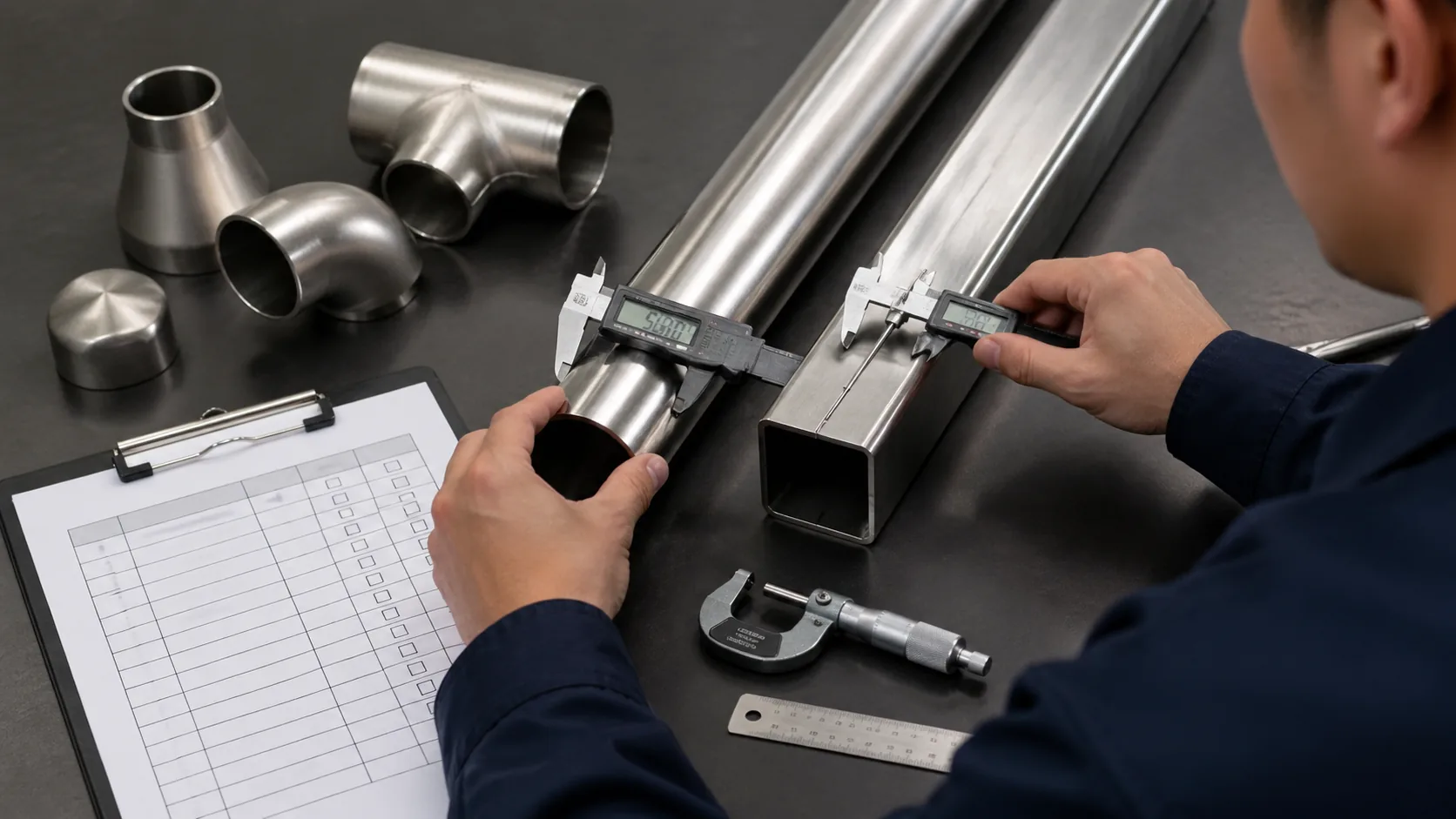
Write the product language clearly
Use this checklist before sending the RFQ:
| RFQ item | For pipe | For tube |
|---|---|---|
| Product name | Stainless steel pipe | Stainless steel tube |
| Size | NPS plus schedule, or specified pipe OD/wall if required | Actual OD and wall; square/rectangular dimensions if shaped |
| Grade | 304, 304L, 316L, 2205, 2507, 310S, or project grade | Same, matched to environment and fabrication |
| Manufacturing route | Seamless or welded if required | Seamless, welded, drawn, polished, or shaped if required |
| End condition | Plain end, beveled, threaded, grooved, flanged | Cut, deburred, polished, mitered, capped, or assembly-ready |
| Surface finish | Industrial, pickled, polished, sanitary, or project-specific | 2B, polished, brushed, mirror, mill, or custom finish |
| Documents | MTC, heat number, inspection report, pressure/test records if needed | MTC, dimensional report, finish check, heat traceability |
Ask supplier questions before comparing prices
Before price comparison, ask:
- Are you quoting pipe or tube under the correct sizing system?
- Does the quoted size match the drawing, fittings, clamps, or mating parts?
- Is the material welded or seamless, and does that matter for the application?
- What tolerance applies to OD, wall, length, straightness, and ovality?
- Are cutting, bending, welding, polishing, or packing included?
- How will heat numbers remain traceable after processing?
For welded assemblies, supplier evaluation should include welding capability, document control, inspection, and surface cleanup. That is why pipe and tube decisions often connect to stainless steel welding service rather than raw material price alone.
Conclusion
Choose stainless steel pipe when the project is mainly a flow, pressure, or process connection problem. Choose stainless steel tube when actual dimensions, shape, tolerance, appearance, bending, or structural behavior control the part.
The safest RFQ does not rely on the words pipe or tube alone. It names the product form, size system, grade, wall, standard, tolerance, finish, end condition, processing scope, documents, and packing requirement. That is how buyers compare real offers instead of matching two quotes that describe different products.
Author: NewQiujing Group