I’ve managed welding fabrication projects for 20 years. I’ve audited dozens of shops, watched welds fail in service, and written off entire batches of work because someone picked the cheapest quote. The pattern is always the same: you save 15% on the welding contract and spend 10 times that fixing the damage.
This framework is what I use now. Eight evaluation points that separate reliable welding providers from the ones that will cost you money.
Why Most Buyers Get Welding Service Selection Wrong
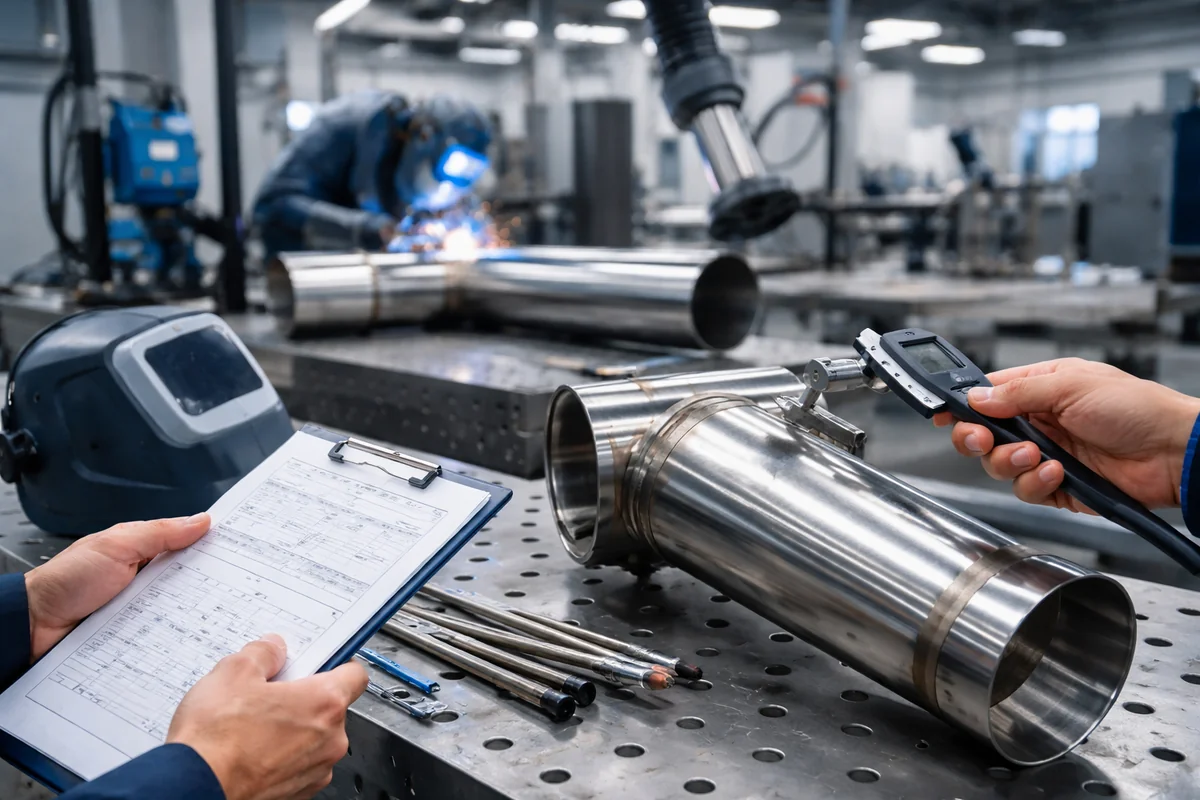
Most procurement teams treat welding services like commodity purchases. They send out an RFQ, collect bids, and award the job to whoever comes in lowest. I’ve watched this approach blow up projects too many times.
A bad weld doesn’t just fail — it fails at the worst possible time. I’ve seen a single defective circumferential weld on a pressure vessel shut down a processing line for three weeks. The original weld cost $1,200. The total cost of detection, removal, re-welding, re-inspection, and lost production exceeded $60,000. That’s a 50x multiplier, and it’s not unusual.
The real cost of a bad weld includes detection through NDE or in-service failure, removal by grinding or carbon arc gouging, surface preparation, the re-welding itself, re-inspection, production downtime, and potential safety incidents. Even a straightforward rework scenario runs 10 to 15 times the original cost. When you factor in downtime and safety risk, the number climbs fast.
You need to evaluate welding services the same way you’d evaluate a structural engineer or a quality lab. Look at capability, qualification, systems, and track record — not just price. The same principles that apply when you’re evaluating stainless steel laser cutting service quality metrics apply here: technical competence and quality infrastructure matter more than the number on the bottom line.
Point 1 — Welding Process Capability Assessment
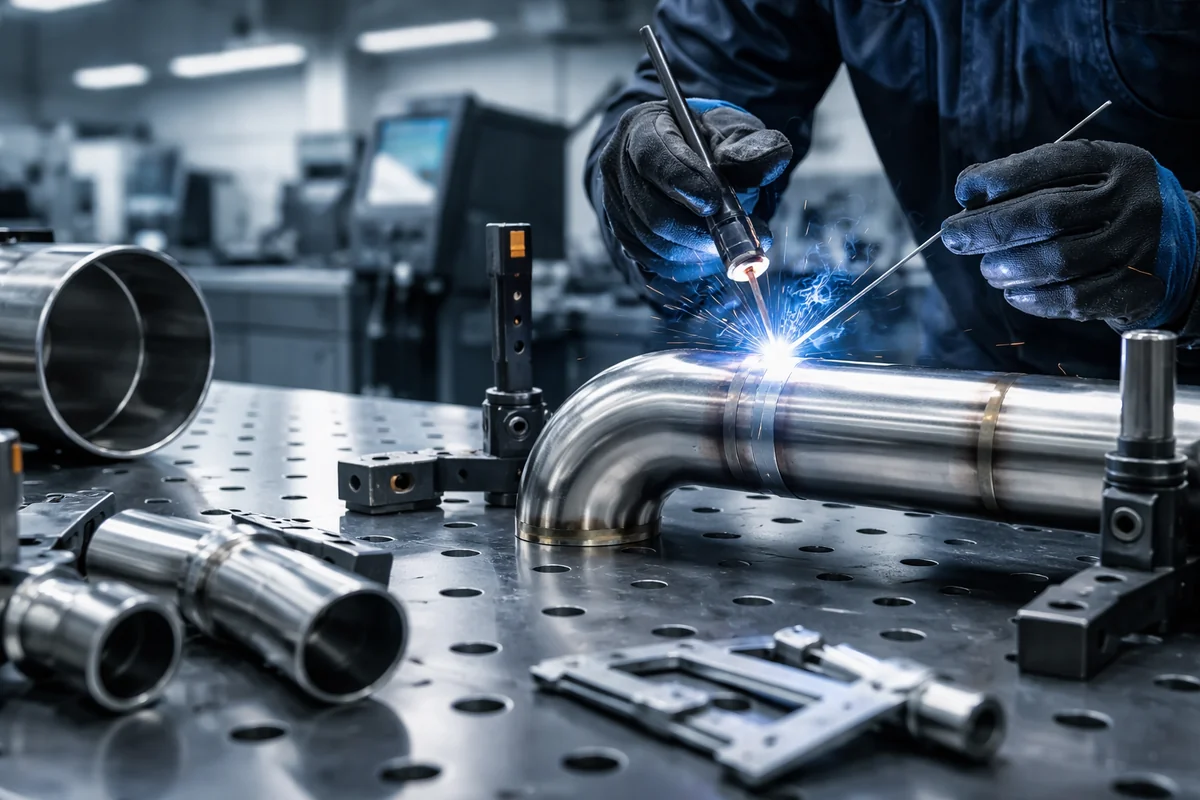
The first thing I check is whether the shop has the right welding processes for your application. Not every shop can do everything well, and the process you choose directly affects weld quality, speed, and cost.
TIG/GTAW — When and Why It’s the Default for Stainless Steel
TIG (Tungsten Inert Gas) welding, also called GTAW, is the go-to process for stainless steel in most applications. It gives you excellent weld quality with precise heat input control. No spatter, no slag to chip, and full visibility of the weld pool. For thin-wall tubing, sanitary fittings, and anything where surface finish matters, TIG is non-negotiable.
The tradeoff is speed. TIG is slow — a skilled TIG welder deposits 2 to 4 inches per minute on thin stainless. It also requires high skill level: the operator coordinates the torch, filler rod, and gas flow simultaneously. Typical thickness range is 0.5 to 6mm. Beyond that, you’re looking at multi-pass welds that eat labor hours.
MIG/MAG — Acceptable Applications and Limitations
MIG (Metal Inert Gas) welding, or GMAW, is faster than TIG with deposition rates 3 to 5 times higher. For structural stainless work above 3mm, MIG is often the right call from a cost standpoint.
The risk with stainless MIG is porosity. Stainless is more sensitive to shielding gas contamination than carbon steel. You need the right gas mix — typically argon with a small percentage of CO2 or helium — and clean base material. Without a dedicated stainless welding area with proper ventilation and cleanliness controls, you’ll get porosity defects that show up in NDE.
SAW — For Thick Plate and Pressure Vessel Work
SAW is the heavy hitter — high deposition rates, deep penetration, and easily automated. For thick plate fabrication, pressure vessel longitudinal seams, and large-diameter circumferential welds, SAW delivers consistent results.
The limitation is positional: SAW works in flat and horizontal positions only. If your part requires out-of-position welding, you need a different process. Also, SAW uses flux — verify it’s appropriate for stainless, since some fluxes introduce hydrogen or contaminants that affect corrosion resistance.
Laser and Hybrid Welding — Emerging Capabilities
Laser welding and laser-MIG hybrid welding are gaining ground in stainless fabrication. They produce a narrow heat-affected zone (HAZ), high welding speeds, and minimal distortion. For thin-wall applications where dimensional tolerance is tight, laser welding can eliminate post-weld straightening.
Not every shop has laser welding capability. When they do, understand what equipment they’re running and what thickness range they can handle.
Here’s how the processes match up to common applications:
| Process | Best Thickness Range | Deposition Rate | Position Capability | Typical Applications |
|———|———————|—————–|——————–|——————–|
| TIG/GTAW | 0.5–6mm | Low (2–4 in/min) | All positions | Sanitary tubing, thin-wall, precision |
| MIG/MAG | 3–25mm | Medium-High | All positions | Structural, thick-wall, general fabrication |
| SAW | 6–100mm+ | Very High | Flat/Horizontal only | Pressure vessels, thick plate seams |
| Laser | 0.5–12mm | Medium | All positions | Thin-wall, high-precision, low-distortion |
| Hybrid (Laser-MIG) | 3–20mm | High | All positions | Medium-thick, high-speed, structural |
Match the process to your application before you compare quotes. A shop that quotes TIG for a job that should be MIG-welded is either padding the price or doesn’t have the right equipment. Either way, you’re paying for it. For more detail on process selection by material grade, see this guide on stainless steel laser cutting parameters by grade.
Point 2 — Welder Qualification and Certification
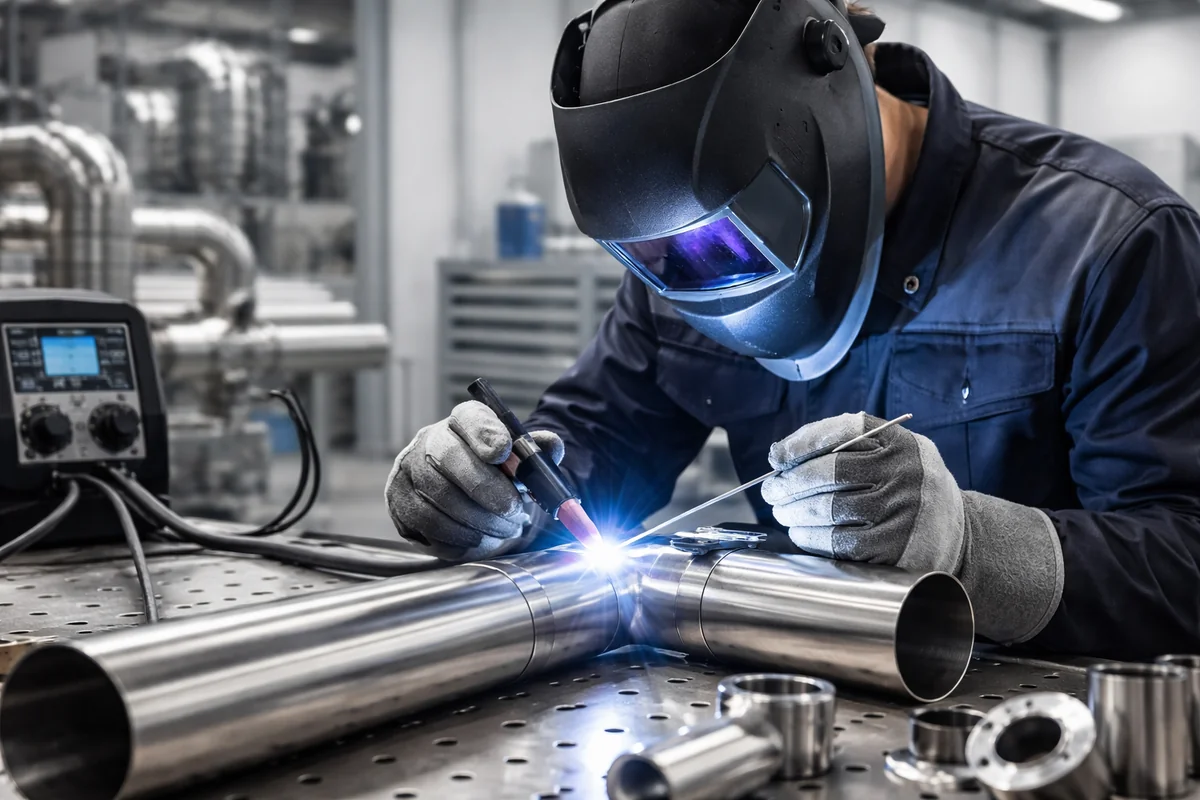
A shop can have the best equipment in the world, but if the welders aren’t qualified for your specific joint, material, and position, you’ll get bad welds. Welder qualification is a code requirement for most applications.
ASME Section IX is the most widely referenced standard in North America and much of Asia. A welder qualification record (WQR) shows the welding process, base metal group, filler metal, joint configuration, position, and thickness range the welder is qualified to perform. Read the actual record — don’t just accept “we have ASME-certified welders” as a blanket statement. A welder qualified for TIG on 304 in 2G is not automatically qualified for MIG on 316L in 5G.
ISO 9606-1 is the European equivalent — process-specific with more granular detail about base metal and filler metal ranges. If your project needs CE marking, ISO 9606-1 qualifications are what the inspector will look for.
AWS D1.6 covers structural welding of stainless steel specifically, including requirements for welder qualification, procedure qualification, and inspection tailored to stainless. If your project falls under structural codes, D1.6 qualifications are mandatory.
Check the expiry dates. ASME welder qualifications are valid for 6 months and must be re-qualified through production welding on the same or more restrictive range. ISO 9606-1 qualifications have a 3-year validity period. Ask for current certificates — expired qualifications mean the welder hasn’t demonstrated recent competence.
Understand the difference between welder qualification and procedure qualification. A WQR proves the individual can produce a sound weld using a specific procedure. A PQR proves the welding procedure itself produces acceptable mechanical properties. You need both. A qualified welder running an unqualified procedure is a code violation waiting to happen. For background on the material standards these qualifications reference, check this comparison of ASTM A240 vs A276 stainless steel standards.
Point 3 — WPS and PQR Review
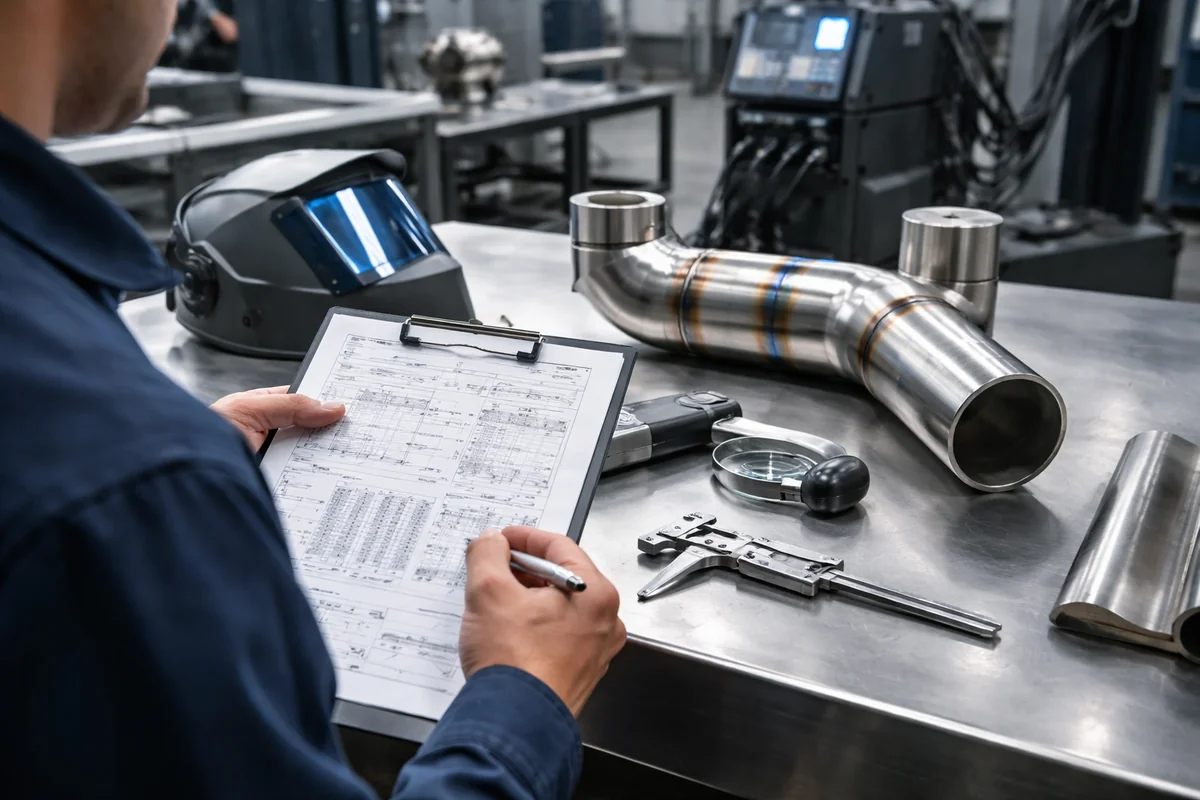
The Welding Procedure Specification (WPS) is the shop’s written instruction for how a specific weld should be made. The Procedure Qualification Record (PQR) is the test data that proves the procedure works. Together, they’re the backbone of quality welding.
A proper WPS should list the welding process, base metals with UNS or AISI designations, filler metal with AWS classification, joint type and preparation, all welding positions covered, voltage, amperage, and wire feed speed ranges, preheat and interpass temperature requirements, and shielding gas composition and flow rate. If any are missing, the WPS is incomplete.
The PQR shows the actual parameters used during qualification — not ranges, but specific values. It includes test results: tensile strength, bend test results, impact toughness if required. The PQR should reference the WPS it qualifies.
Watch for red flags: the WPS doesn’t match what you see on the shop floor, the qualification date is expired, the parameter range is too narrow, or the listed filler metal doesn’t match what’s in stock. These are signs the shop’s quality system is paperwork, not practice.
Essential variables matter. Under ASME Section IX, essential variables are the ones that require re-qualification if changed. For GTAW on stainless, these include filler metal classification, base metal P-number, position, and thickness range. A WPS qualified for 3mm does not cover 12mm. Make sure the WPS covers your actual material thickness and joint configuration.
Point 4 — Non-Destructive Examination (NDE) Capability
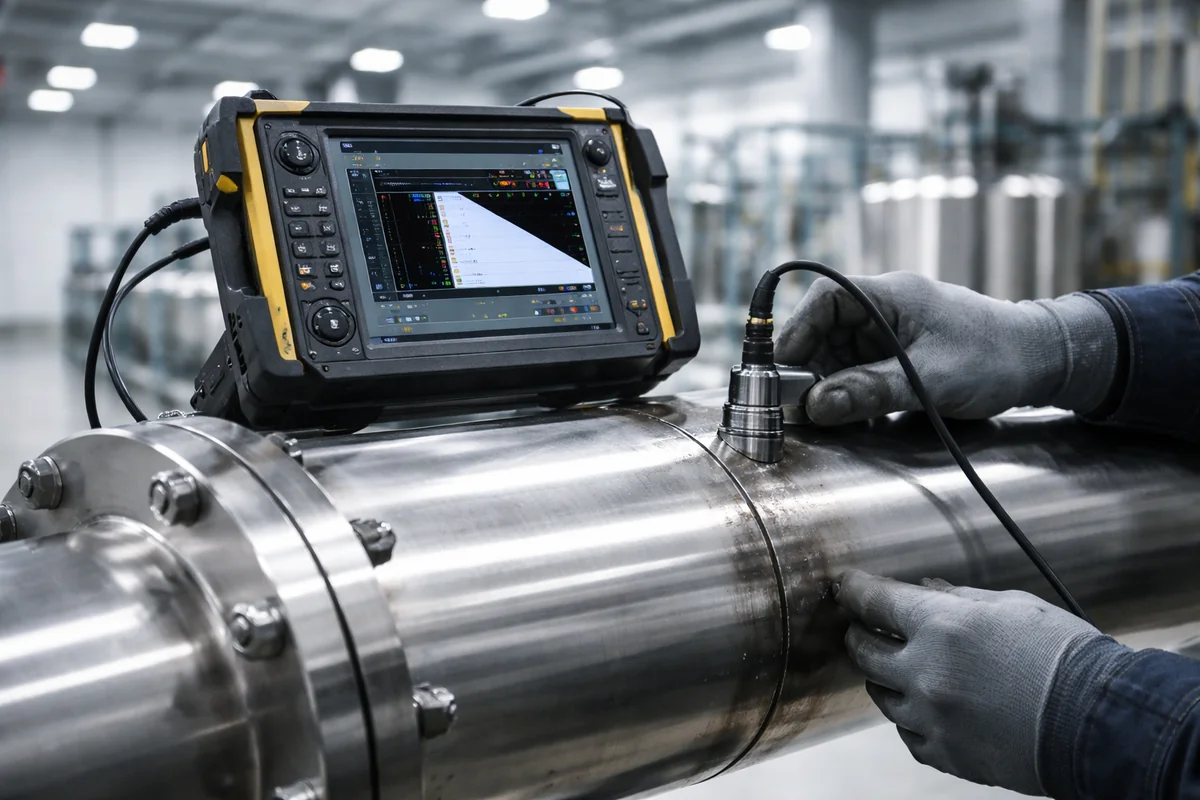
You can’t manage what you don’t measure. NDE is how you verify welds are sound without destroying them. A shop’s NDE capability tells you how seriously they take quality.
Visual Testing (VT) — Baseline Requirement
Visual testing is required by every welding code. A qualified VT examiner checks for undercut, porosity, incomplete fusion, surface cracks, excessive reinforcement, and arc strikes. Acceptance criteria per ASME B31.3: no visible cracks, no incomplete fusion, undercut not exceeding 0.8mm or 10% of wall thickness (whichever is less), porosity within code limits.
Don’t underestimate VT. A good visual examiner catches 60 to 70% of defects before you spend money on other NDE methods. But VT alone isn’t sufficient for anything structural, pressure-retaining, or safety-critical.
Radiographic Testing (RT) — When Required
RT is the standard for pressure vessels and critical structural joints. It produces a permanent record and detects volumetric defects like porosity, slag inclusions, and lack of penetration. RT requires film quality verification through penetrameters, with sensitivity typically at 2% of material thickness.
RT has limitations: it requires access to both sides, can’t reliably detect planar defects in certain orientations, and requires radiation safety controls that not every shop has in-house.
Ultrasonic Testing (UT) — For Thick Sections
UT has advantages over RT for thick sections: no radiation hazard, faster on thick material, and better at detecting planar defects like lack of fusion and cracks. Modern phased-array UT (PAUT) provides imaging that approaches RT clarity with better defect characterization.
The limitation is operator dependency. Ask for the technician’s certification level — Level II minimum for production testing, Level III for complex evaluations.
Dye Penetrant (PT) and Magnetic Particle (MT)
PT works on all metals and is the standard surface NDE method for austenitic stainless (304, 316, etc.) because they’re non-magnetic. It detects surface-breaking defects by capillary action — penetrant seeps into cracks and is drawn out by a developer. Simple, inexpensive, effective for surface cracks, porosity, and lack of fusion at the surface.
MT only works on ferromagnetic materials. For austenitic stainless, it’s useless. But for ferritic and martensitic grades (400 series, 17-4PH), MT is faster and more sensitive than PT for surface defects.
Here’s the comparison:
| Method | Defect Type | Thickness Range | Advantages | Limitations |
|——–|————|—————-|————|————-|
| VT | Surface | All | Low cost, immediate results | Only surface defects, subjective |
| RT | Volumetric (internal) | All | Permanent record, code-recognized | Radiation hazard, poor for planar defects |
| UT | Volumetric + planar | >6mm typical | No radiation, good for thick sections | Operator-dependent, near-surface dead zone |
| PT | Surface-breaking | All | Works on all metals, simple | Surface only, requires cleaning |
| MT | Surface/subsurface | Ferromagnetic only | Fast, sensitive | Only magnetic materials |
Make sure the shop can provide the NDE methods your code requires, performed by certified technicians, with documented acceptance criteria. If your application doesn’t specify NDE methods, you should — it’s your insurance policy.
Point 5 — Post-Weld Treatment Capabilities
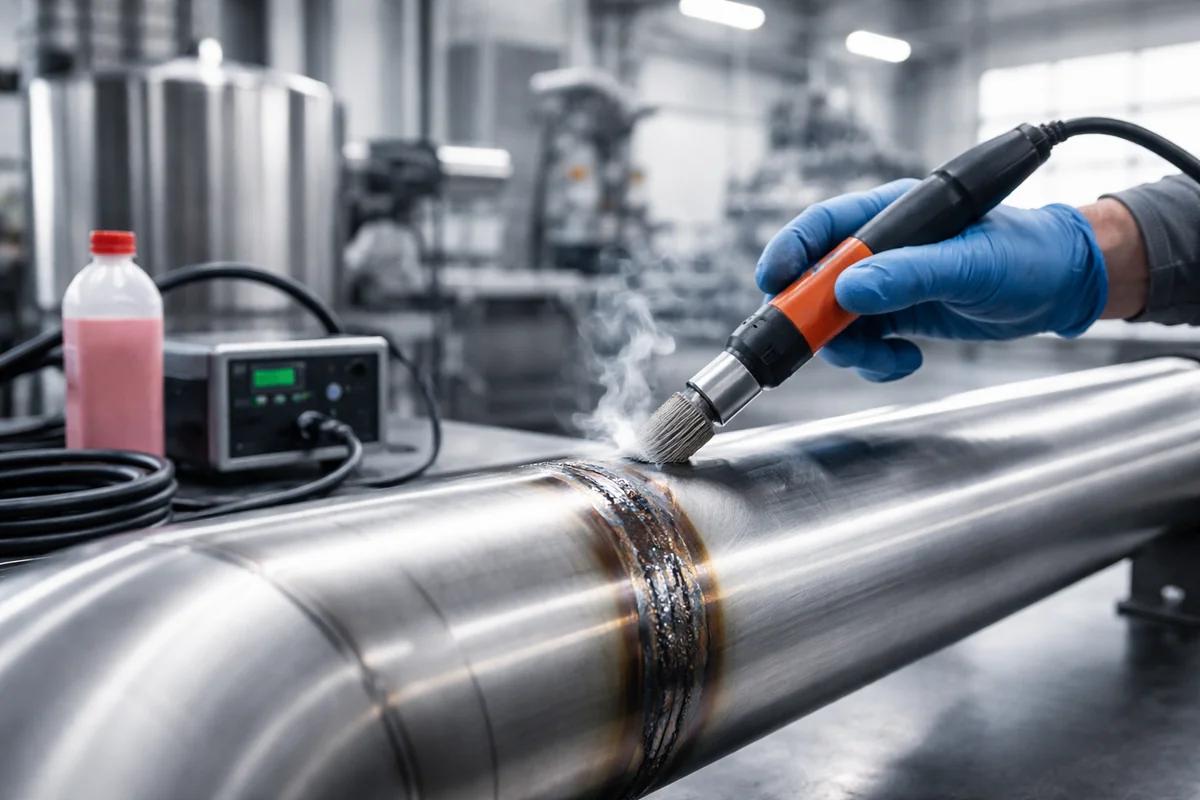
Welding changes the metallurgy of stainless steel. If the shop can’t undo that damage, your welds will corrode faster than the base material. Post-weld treatment isn’t optional for many applications.
Heat Tint Removal and Passivation
When you weld stainless, the heat creates a discolored zone called heat tint. That discoloration isn’t just cosmetic — it’s a disrupted chromium oxide layer. The chromium has been depleted from the surface, and the protective oxide film is compromised. In corrosive environments, heat tint becomes an initiation site for pitting and crevice corrosion.
Chemical passivation restores the chromium oxide layer. Nitric acid (20-50% concentration, 20-60 minute immersion) is the traditional method per ASTM A967 and ASTM A380. Citric acid is gaining acceptance as a safer, more environmentally friendly alternative with comparable results. Ask which method the shop uses and whether they follow the applicable ASTM standard.
Solution Annealing for Critical Applications
For heavy-wall components, weldments exposed to chloride environments, or applications with stress corrosion cracking (SCC) risk, solution annealing may be required. This involves heating the entire weldment to 1040-1120°C, holding for a time proportional to thickness (typically 1 hour per 25mm), then water quenching. This dissolves chromium carbides that precipitated during welding and restores full corrosion resistance.
Solution annealing requires a furnace large enough for your component. Not every welding shop has this capability in-house — many subcontract it. That’s fine, but you need to know whether it’s part of the scope and who’s responsible for scheduling and quality verification.
Surface Finishing After Welding
For sanitary applications — food processing, pharmaceutical, dairy — the weld surface must match the base material finish. That means grinding, blending, and polishing to the specified Ra value. Typical requirement is Ra ≤ 0.8 μm for sanitary applications, with some processes requiring Ra ≤ 0.4 μm.
This finishing work is labor-intensive and requires skill. A poorly blended weld creates crevices where bacteria can harbor, defeating the purpose of using stainless steel. Verify the shop has the equipment and experience to achieve your required surface finish consistently. For more on material selection in food-grade applications, see this guide on stainless steel for dairy processing grade selection.
Point 6 — Quality Documentation and Traceability
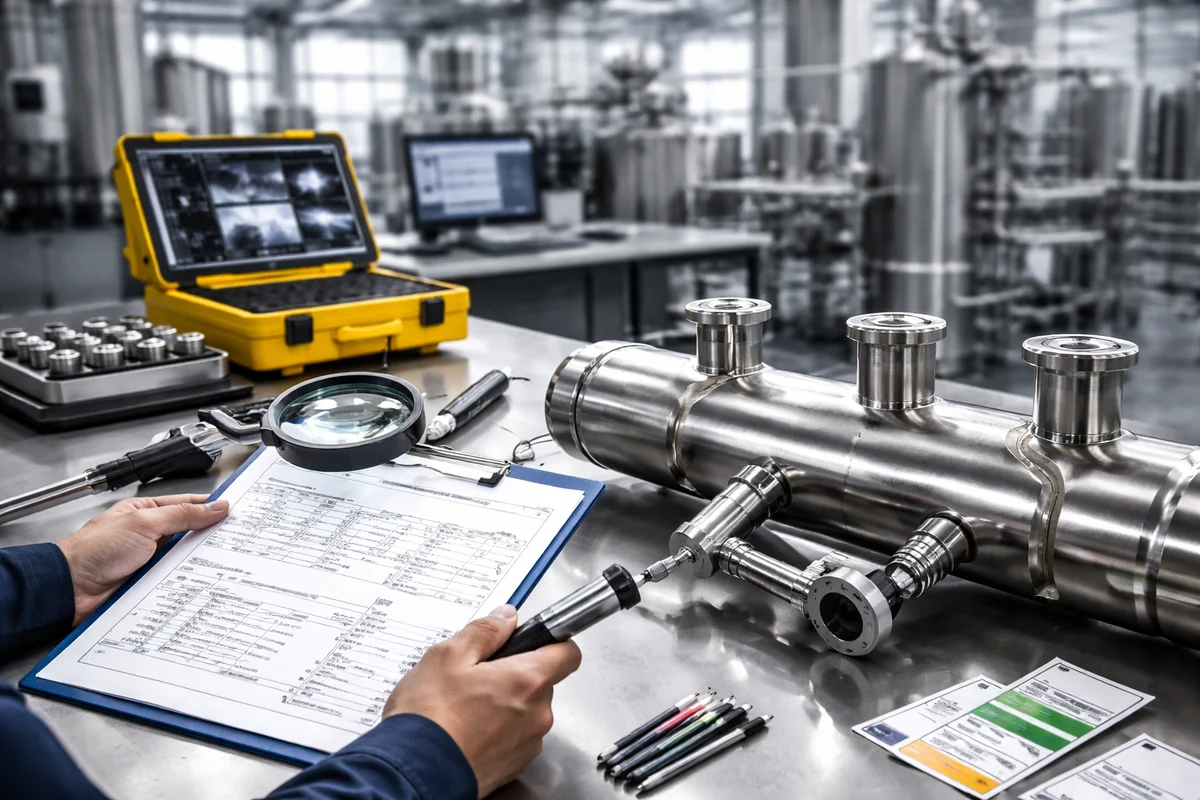
If you can’t trace it, you can’t prove it. Documentation is how you demonstrate that every weld was made to specification, by a qualified welder, using qualified materials and procedures.
Material certificates are the starting point. EN 10204 Type 3.1 certificates are issued by the material manufacturer and validated by the supplier’s inspection department. Type 3.2 certificates go further — validated by the purchaser’s designated representative or a third-party inspector. For critical applications, Type 3.2 provides additional independence.
Weld maps track every weld to its specific WPS, welder ID, NDE results, and date of completion. If a defect shows up in service, the weld map lets you trace back to exactly who welded it, when, and with what procedure. A shop without weld maps can’t take responsibility for their work.
Inspection and Test Plans (ITP) define inspection and testing requirements. An ITP specifies hold points (work stops until inspection is complete), witness points (inspector may attend), and review points (documentation only). The ITP is agreed between you and the shop before work begins. If a shop doesn’t offer to develop an ITP with you, that’s a warning sign.
Dimensional reports and final inspection records document that the finished product meets drawing tolerances. These records should be available for your review before shipment.
Understanding material standards matters here. The differences between ASTM A240 vs A276 stainless steel standards affect how you specify material and verify that certificates match your requirements.
Point 7 — Pricing Structure and Transparency
Welding quotes can vary by a factor of three for the same scope. That spread reflects differences in labor rates, material markup, overhead allocation, and how NDE and post-weld treatment are costed.
The biggest mistake buyers make is comparing lump-sum quotes. A $50,000 lump-sum and a $75,000 itemized quote might look different on paper, but the itemized quote might include NDE, passivation, and documentation that the lump-sum doesn’t. You’re not comparing the same thing.
Here’s what a transparent quote should include:
| Line Item | Description | Should Be Included? |
|———–|————-|——————-|
| Labor — Welding | Hours × rate, broken out by process | Yes |
| Labor — Fit-up/Assembly | Preparation and tacking | Yes |
| Material — Base Metal | Grade, specification, quantity, unit price | Yes |
| Material — Filler Metal | Classification, quantity | Yes |
| Consumables | Shielding gas, flux, electrodes | Yes |
| NDE — Visual Testing | Per weld or per hour | Yes |
| NDE — RT/UT/PT/MT | Per film, per inch, or per joint | Yes |
| Post-Weld Treatment | Passivation, heat treatment, finishing | Yes |
| Documentation | WPS/PQR, material certs, weld maps, ITP | Yes |
| Overhead/Shop Charges | Usually a percentage | Should be disclosed |
| Profit Margin | Usually a percentage | Should be disclosed |
Red flags in a welding quote: no NDE line item, no post-weld treatment listed, vague scope description, and a price significantly below the other bids. A shop that’s either cutting corners or will hit you with change orders.
Get itemized quotes. Compare line by line. Ask questions about anything missing or unclear. A transparent shop will explain their pricing. A shop that pushes back on itemization doesn’t want you to see what you’re actually paying for.
Point 8 — Track Record and References
Past performance is the best predictor of future results — but only if you ask the right questions.
When you request references, be specific. Ask for references from projects similar to yours in application (pressure vessel, structural, sanitary), volume, and applicable code (ASME, AWS, PED). A shop great at small-batch sanitary tubing may not have the capacity for heavy-wall pressure vessel work, and vice versa.
Call the references. Don’t just email — call. Ask: What was the rework rate? What was on-time delivery performance? How did the shop handle quality issues? Would you use them again? The answers tell you more than any certification.
Review their portfolio. Look for photos, test reports, and relevant certifications. A pressure vessel shop should have ASME U-stamp or National Board R-stamp credentials. A food equipment shop should have experience with 3-A Sanitary Standards or EHEDG guidelines.
Industry-specific experience matters. In chemical processing, the shop should understand chloride stress corrosion cracking, the difference between Inconel 625 vs Hastelloy C-276 for chemical processing applications, and post-weld treatment for corrosion-resistant alloys. In food processing, they should understand sanitary weld finish requirements and clean-in-place compatibility.
A shop’s track record isn’t just about what they’ve done — it’s about whether they’ve done what you need them to do.
The Evaluation Scorecard
I use a weighted scoring matrix to evaluate every welding vendor. It forces you to score each criterion objectively and prevents the cheapest quote from winning by default.
| Evaluation Point | Weight | Score (1-5) | Weighted Score |
|—————–|——–|————-|—————-|
| 1. Process Capability | 15% | ___ | ___ |
| 2. Welder Qualification | 15% | ___ | ___ |
| 3. WPS/PQR Documentation | 10% | ___ | ___ |
| 4. NDE Capability | 15% | ___ | ___ |
| 5. Post-Weld Treatment | 10% | ___ | ___ |
| 6. Quality Documentation | 10% | ___ | ___ |
| 7. Pricing Transparency | 10% | ___ | ___ |
| 8. Track Record | 15% | ___ | ___ |
| Total | 100% | | ___/5.00 |
Score each point 1-to-5: 1 = unacceptable, 2 = below expectations, 3 = acceptable minimum, 4 = above average, 5 = excellent.
The rule I follow: any score below 3 on Points 1 through 4 — process capability, welder qualification, WPS/PQR, and NDE — is an automatic disqualification. These are the technical fundamentals. A shop that can’t meet the minimum on any one is a liability, regardless of price.
Use this scorecard in your RFQ process. Send it to every vendor. Score them after the site visit and document review. The numbers won’t lie.
Practical tip: do a site visit before you score. Walk the shop floor. Look at cleanliness, equipment condition, material organization, and how welders work. A shop that takes care of its facility usually takes care of its welds. A shop with rust on the stainless storage racks and grinding dust everywhere is telling you everything you need to know about their quality culture.
This framework won’t guarantee a perfect weld every time, but it will consistently eliminate the shops most likely to cost you money. After 20 years of managing welding projects, I can tell you that avoiding the bad vendors is worth more than finding the cheapest one.
Author: NewQiujing Group