314 vs 306 Stainless Steel: Why Neither One Replaces 304 (and When You Actually Need Them)
Google autocorrects “314 vs 306 stainless steel” to “304 vs 316.” That should tell you something: most of the internet has no idea what these two grades are. Half the articles about 306 claim it does not exist. The other half describe it with 304 properties copy-pasted in. Both are wrong.
314 and 306 are real, ASTM-standardized grades. They are also completely different animals. One resists heat up to 1100 C. The other resists concentrated sulfuric acid. Comparing them is like comparing a furnace brick to an acid-proof lining — the question is not which is “better” but what problem you are solving.
After 25 years in stainless steel sourcing, I can tell you this: the biggest material selection mistakes happen when someone picks a grade by number instead of by service condition. If you landed here because a spec sheet or supplier quote threw one of these grade numbers at you, keep reading. I will tell you exactly what each grade does, where the online confusion comes from, and how to decide what you actually need.
What Is 314 Stainless Steel
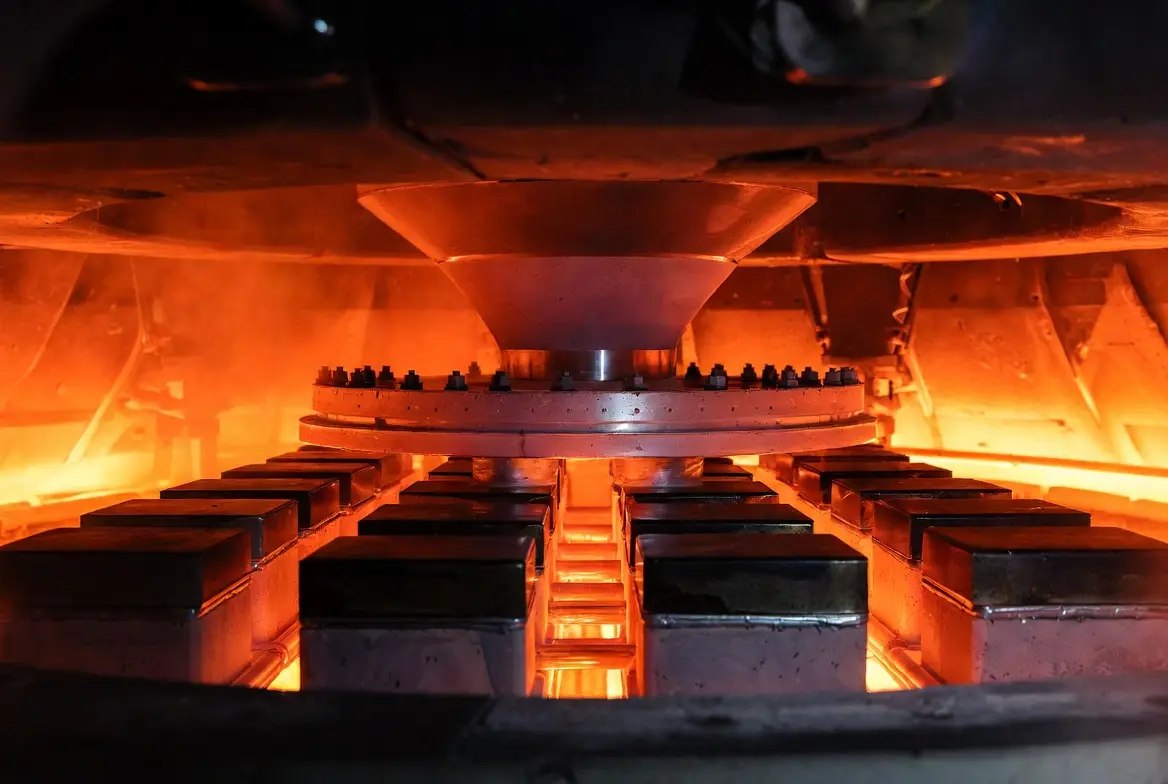
314 stainless steel radiant tubes and furnace components in high-temperature service
314 (UNS S31400) is a high-chromium, high-nickel austenitic grade built for extreme heat. The composition tells the story: 23-26% chromium, 19-22% nickel, and 1.5-3.0% silicon. That silicon is the key — it forms a protective SiO2 oxide layer on the surface that resists scaling at temperatures where most stainless steels give up.
Continuous service rating: 1050 C (1922 F) in air. Intermittent peaks: 1100 C (2012 F). 304 starts scaling well before that threshold. 314 picks up where the common grades quit.
But here is what no supplier brochure mentions: sigma phase embrittlement. 314’s high chromium and silicon content makes it particularly vulnerable to sigma phase precipitation between 540 C and 925 C. When sigma phase forms, the microstructure separates into a hard, brittle intermetallic phase that concentrates at grain boundaries. Ductility drops sharply — impact toughness craters while tensile strength barely changes. The part looks fine on the outside but becomes brittle under load, and the failure mode is sudden rather than progressive. This is not a theoretical concern; it is the reason many furnace components made with 314 develop micro-cracks at welds after a few thermal cycles, even though the original tensile test passed.
314 excels in static high-temperature service — furnace parts, kiln linings, radiant tubes, afterburner components. It struggles when the component cycles repeatedly through the 540-925 C danger zone. Solution annealing at 1038-1121 C dissolves sigma phase and restores ductility, but that means taking the equipment offline, reheating to temperature, and cooling under controlled conditions. For equipment that cycles thermally, this becomes a maintenance line item. If weldability matters more than peak temperature rating, 310S handles similar conditions with less sigma risk and better availability. The tradeoff: 310S tops out at 1150 C but has better fabricability and is stocked more widely.
One more practical note: 314 machines poorly compared to 304 or even 316. The high silicon content increases work hardening rate, so you need carbide tooling and reduced cutting speeds. If your component requires complex machining, factor in the tooling cost and tool change frequency before specifying 314.
What Is 306 Stainless Steel
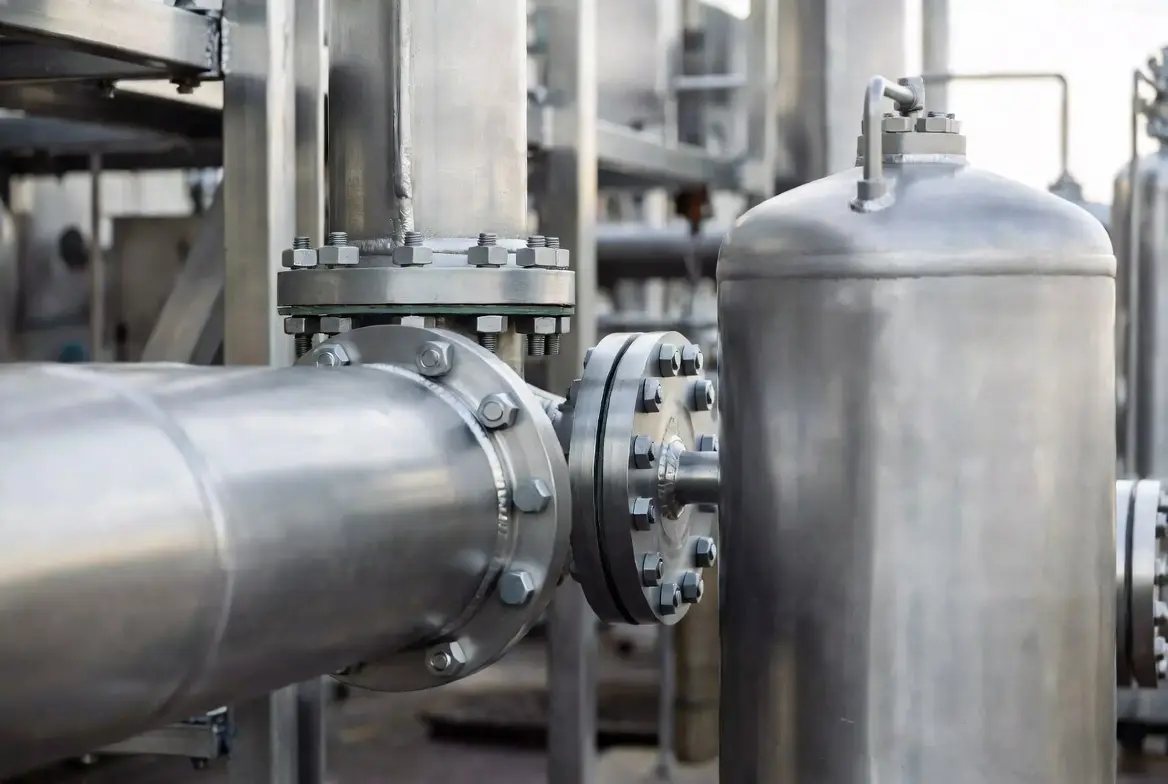
306 stainless steel pipes and vessels for concentrated sulfuric acid processing
306 stainless steel is where the internet falls apart. Search for it and you will find two camps: one says it does not exist, and the other describes it with properties that sound suspiciously like 304 or 316. Both are wrong, and the confusion can cost real money.
306 is UNS S30600, covered by ASTM A240 (plate, sheet, strip), A182 (forgings and flanges), and A312 (seamless and welded pipe). It was commercially produced by ATI Allegheny Ludlum under the trade name AL 610. European designation: EN 1.4361, or X1CrNiSi18-15-4. This is not an obscure footnote — it is a fully standardized grade with a specific job.
That job is sulfuric acid resistance. The composition makes the purpose obvious: 17-18.5% chromium, 14-15.5% nickel, and 3.7-4.3% silicon. The ultra-low carbon (0.018% max) and high silicon create a passive film that withstands concentrated sulfuric acid environments where 304 and 316 would dissolve. At 4% silicon, the passive layer becomes substantially more stable in acidic conditions than what you get from the 0.5-1.0% silicon typical of standard austenitic grades. This is not incremental improvement — it is a different mechanism of corrosion resistance.
For context: 316L, widely regarded as a chemical-process standard, contains only 0.5-1.0% silicon and relies primarily on its molybdenum addition (2-3%) for acid resistance. In concentrated sulfuric acid at typical process temperatures, 316L fails where 306 holds. The penalty for specifying the wrong grade is not just replacement cost — in a sulfuric acid circuit, a failed component can mean process downtime, environmental spill handling, and safety escalation.
The applications that actually use 306 are narrow but critical: sulfuric acid cooling coils, acid concentration evaporators, and pickling equipment in metal finishing. These are not general fabrications. They are purpose-built components where the acid grade is specified by a chemical engineer who looked up the corrosion tables and found 306 listed for the specific concentration and temperature range.
If a supplier quotes you “306 stainless” without mentioning its silicon content or acid service application, they probably pulled a generic datasheet off the internet and relabeled it. Ask for the UNS number. Ask for the mill test certificate showing silicon at 3.7% or above. If they cannot produce either, find a different supplier. The grade designation is not enough — verify the actual chemistry.
314 vs 306 Stainless Steel Compared
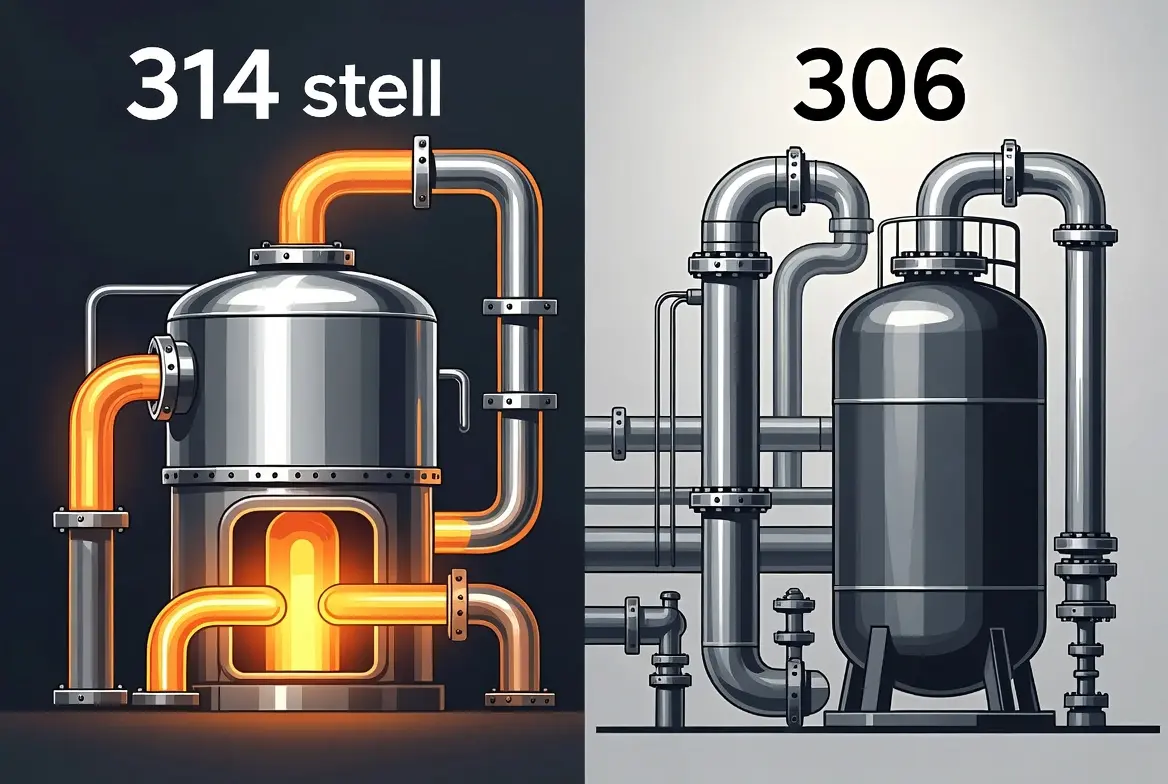
visual comparison of 314 and 306 stainless steel for heat resistance and acid resistance
The table below makes one thing clear: these grades share an alloy family but almost nothing else.
| Property | 314 (UNS S31400) | 306 (UNS S30600) |
|---|---|---|
| Chromium | 23-26% | 17-18.5% |
| Nickel | 19-22% | 14-15.5% |
| Silicon | 1.5-3.0% | 3.7-4.3% |
| Carbon | 0.25% max | 0.018% max |
| Tensile strength | 655 MPa min | 540 MPa min |
| Yield strength | 330 MPa min | 240 MPa min |
| Max service temp | 1050 C continuous | Not a heat-resistant grade |
| Primary resistance | High-temperature oxidation | Concentrated sulfuric acid |
| Weldability | Fair (preheat recommended) | Good |
| Machinability | Poor | Moderate |
| Availability | Specialty, limited stock | Ultra-niche, order-to-make |
| Typical applications | Furnace components, kilns | Acid cooling, pickling equipment |
The numbers that matter most: silicon and carbon. 314 uses moderate silicon to build an oxide barrier at high temperature. 306 pushes silicon to 4% to create acid passivity at ambient temperature. Same element, opposite applications. Carbon behaves inversely — 306’s ultra-low 0.018% maximum prevents sensitization in welded sections exposed to acidic media, while 314’s higher carbon (up to 0.25%) makes it more prone to grain boundary carbide precipitation if cooled slowly after welding.
Availability is another practical gap. 314 is stocked by specialty service centers but not by general steel distributors. Expect 4-8 weeks lead time on mill orders. 306 is essentially order-to-make — most distributors do not carry it, and mill minimums are high. If your project timeline is tight, both grades will create procurement challenges that 304 and 316L will not.
Both grades cost multiples of what you would pay for 304 or 316 and ship on longer lead times. Neither one belongs in a general-purpose application. If a fabricator recommends 314 or 306 without a specific service condition justification, get a second opinion.
How to Choose Between 314 and 306
engineer selecting between 314 and 306 stainless steel based on service conditions
Start with the service condition, not the grade number. Three questions settle this:
Is your application above 600 C? 314 is your candidate. It handles continuous service at 1050 C with excellent oxidation resistance. Just confirm the component will not cycle repeatedly through the 540-925 C sigma phase window. If the part sees thermal cycling — daily startup-shutdown cycles, for example — the sigma phase risk becomes real and the solution annealing requirement becomes a maintenance burden. If weldability is critical, if the design involves complex weld geometries, or if budget is tight, evaluate 310S as a near-equivalent alternative with better fabrication characteristics and less embrittlement risk. The trade-off is marginal: 310S tops out about 100 C lower in peak temperature but is substantially more forgiving in fabrication.
Does your application involve concentrated sulfuric acid? 306 (S30600) is purpose-built for this. No other common austenitic grade matches its acid passivity at the 4% silicon level. If you are evaluating 306, you probably already know this because a chemical engineer specified it after consulting corrosion data. But if someone is suggesting 306 for a general fabrication or a non-acid application, that is a red flag. 306 is not a premium general-purpose grade — it is a niche acid alloy with limited availability and higher cost.
Neither extreme condition? Then you almost certainly need 304, 316L, or another mainstream grade — not a specialty alloy that costs more and ships slower. This is where most material selection errors happen: a spec writer sees “stainless steel” and picks a higher-numbered grade thinking it is “better,” when in fact 304 covers the vast majority of ambient and moderate temperature applications at the lowest cost and fastest lead time.
Whichever grade you specify, verify it. Request the mill test certificate and check the actual chemical composition against the UNS specification. At NewQIujing, every shipment includes full MTC documentation with heat-traceable composition data — because if the grade on the paper does not match the steel on the truck, nothing else matters.
The Bigger Risk
The real danger is not choosing 314 when you needed 306, or the reverse. Those two grades target such different conditions that confusing them is unlikely once you understand the basics above. The far more common and costly mistake is reaching for either of these specialty grades when a standard 304 or 316L would have done the job at a fraction of the cost and lead time.
I have seen projects where the specification called for 314 for a tank that operated at 200 C — room temperature by any measure. The fabricator supplied it, the inspector approved it, and the project paid 3x the material cost for a grade that offered zero benefit over 316L in that service. I have also seen 306 specified for a general-purpose chemical storage tank that handled dilute acetic acid, not sulfuric — another grade doing work it was never designed for, because someone copied a spec from a different project.
Every specialty grade exists for a reason. 314 earns its price in furnace-temperature oxidation resistance. 306 earns its price in concentrated sulfuric acid. Outside those specific service conditions, they are expensive solutions to problems you do not have. Check the service condition first. Check the mill cert second. Everything else follows from there.
Related material guides
Author: NewQiujing Group