Stainless Steel for Dairy Processing Plants: Complete Grade Selection Guide for Tanks, Pipes, and Equipment
I’ve specified stainless steel for over 40 dairy plant builds across six countries. The single most expensive mistake I see on every project? Using one grade everywhere.
Plants either go all-in on 316L because “it’s food grade” — blowing budgets by 20-30% on equipment that never touches product or harsh chemicals — or they go all-in on 304 to save money, then watch tanks pit and pipes corrode within three years of CIP operation.
The right approach is equipment-by-equipment grade selection. Match the stainless steel grade to the actual service conditions: what product contacts the surface, what cleaning chemicals hit it, and at what temperature. Done correctly, this saves 15-25% on material costs while actually improving hygiene performance and equipment life.
This guide walks through every major equipment category in a dairy plant — storage tanks, piping, valves, heat exchangers, and structural components — and tells you exactly which grade to use, why, and where you can safely save money without compromising food safety.
Why Dairy Plants Can’t Use a One-Size-Fits-All Stainless Steel Grade
Here’s the pattern I see on project after project: the engineering firm writes “316L stainless steel” on every line of the equipment specification. Every tank, every pipe, every valve, every platform, every cladding panel. It’s lazy spec-writing, and it costs the plant owner hundreds of thousands of dollars on a mid-sized facility.
The reverse happens too. A cost-conscious owner sees 316L quoted at 30-40% more than 304 and tells the contractor to “use 304 where we can.” Without proper engineering judgment, that becomes 304 in product-contact tanks. Within 18 months, the CIP system with chlorinated sanitizers starts pitting the tank walls. You’re looking at premature replacement, production shutdowns, and potentially a contamination event that triggers a recall.
The real cost of wrong grade selection in dairy isn’t just the material price difference. It’s the production downtime when a corroded tank needs emergency replacement. It’s the batch of product you dump because corrosion products contaminated the milk. It’s the regulatory scrutiny when an inspector finds pitting in a product-contact surface. These costs dwarf the material savings from picking the wrong grade — or the material overspend from picking the right grade for every single component.
This guide covers the five major equipment categories where grade selection matters: storage and process tanks, piping systems, valves and pumps, heat exchangers, and structural components. For each one, I’ll tell you what grade to use, what surface finish to specify, and where you can safely cut costs.
Understanding the Three Grades That Matter in Dairy: 304, 316L, and Duplex 2205
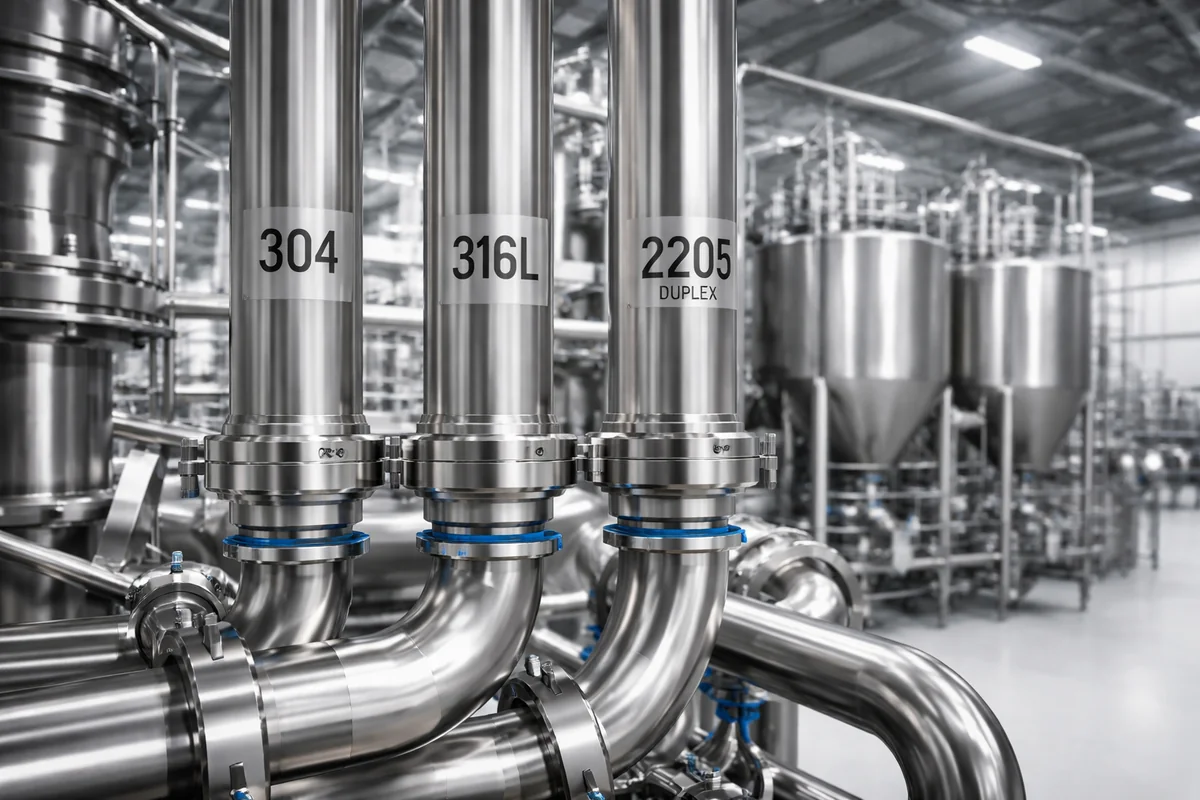
You only need to know three stainless steel grades for dairy plant construction. Forget the dozens of exotic grades in the metallurgy textbooks. Dairy service is about corrosion resistance to cleaning chemicals, product compatibility, and weldability. Three grades cover it all.
| Property | 304/304L | 316L | Duplex 2205 |
|---|---|---|---|
| Chromium (Cr%) | 18 | 16-18 | 22 |
| Nickel (Ni%) | 8-10 | 10-14 | 5 |
| Molybdenum (Mo%) | 0 | 2-3 | 3 |
| Nitrogen (N%) | — | — | 0.17 |
| PREN | ~18 | ~25 | ~35 |
| Yield Strength (MPa) | 205 | 170 | 450 |
| Cost Premium vs 304 | Baseline | +30-40% | +50-60% |
Grade 304/304L: The Workhorse for Non-Contact and Mild Environments
Grade 304 contains 18% chromium and 8-10% nickel with no molybdenum. It’s the most widely produced stainless steel in the world, which means excellent availability and the lowest cost of the three grades.
In dairy plants, 304 handles everything that doesn’t see product or aggressive cleaning chemicals. Structural frames, wall and ceiling cladding, external tank surfaces, platforms, stairways, and non-acidic dry-contact surfaces all perform well in 304.
The limitation is chloride resistance. Without molybdenum, 304 has a PREN (Pitting Resistance Equivalent Number) of only about 18. That means it’s vulnerable to pitting corrosion from chloride-containing solutions. If your CIP system uses sodium hypochlorite (chlorinated sanitizer), 304 surfaces exposed to that solution will eventually pit. For this reason, I never specify 304 on any surface that will see chlorinated CIP chemicals, even intermittently.
For a deeper comparison of these two common grades, see our 304 vs 316 stainless steel breakdown.
Grade 316L: The Dairy Industry Standard for Product Contact
Grade 316L contains 16-18% chromium, 10-14% nickel, and critically, 2-3% molybdenum. That molybdenum addition boosts the PREN to approximately 25, giving it roughly 5x the pitting resistance of 304 in chloride environments.
The “L” in 316L stands for low carbon — maximum 0.03% carbon versus 0.08% in standard 316. This matters enormously in dairy because every tank, pipe, and vessel in a dairy plant is welded. During welding, standard 316 can experience sensitization: chromium carbides precipitate at grain boundaries in the heat-affected zone, depleting chromium locally and creating preferential corrosion paths. The low carbon in 316L prevents this sensitization, which is critical because CIP chemicals will attack sensitized weld zones preferentially.
I specify 316L for every product-wetted surface in a dairy plant: tank inner shells, all product-contact piping, valve bodies and wetted internals, pump casings and impellers, and heat exchanger product-side surfaces. It handles the full range of dairy CIP chemicals — caustic, acid, and most sanitizers — at typical operating temperatures.
For a detailed comparison of how these grades perform specifically in food processing applications, our 304 vs 316 for food processing equipment article covers the specifics.
Duplex 2205: When Brine and Chlorinated CIP Demand More
Duplex 2205 (UNS S32205/S31803) contains 22% chromium, 5% nickel, 3% molybdenum, and 0.17% nitrogen. The dual-phase microstructure — roughly 50% austenite, 50% ferrite — gives it a PREN of about 35 and a yield strength of 450 MPa, nearly triple that of 316L.
You need duplex 2205 in dairy when chloride concentrations exceed what 316L can handle. The most common application is cheese brine tanks, where sodium chloride concentrations can reach 20-25% and temperatures may be elevated. Brine systems with chlorides above 1000 ppm at elevated temperatures will cause stress corrosion cracking in 316L over time. Duplex 2205 resists this.
High-chloride CIP systems are another trigger. If your plant water supply has high chloride content (common in coastal or hard-water areas), and you’re running chlorinated sanitizers at elevated temperatures, 316L may not be sufficient fo
r the CIP return lines and tanks that see the highest chloride exposure.
The cost premium is about 50-60% over 304, or about 20% more than 316L. But with double the yield strength, you can often reduce wall thickness by 30-40%, which offsets much of the per-ton premium. Our duplex 2205 vs 316L stainless steel comparison covers the detailed trade-offs.
Equipment-by-Equipment Grade Selection
This is where the money is saved or wasted. Grade selection should happen equipment by equipment, component by component, based on actual service conditions.
Storage and Process Tanks: 316L for Product Contact, 304 for Structural
A dairy storage tank has multiple components with different service conditions. Specifying 316L for every piece is wasteful.
Inner shell (product contact): 316L, minimum 3mm thickness for tanks up to 50,000L. The inner shell sees product, CIP chemicals, and thermal cycling. No compromise here.
Tank bottom: 316L, 4-5mm thickness. I go slightly thicker on the bottom because it sees the most abrasion during CIP — the cleaning solution pools there, and mechanical cleaning tools contact it most aggressively. In my experience, tank bottoms are the first place corrosion appears if you under-spec thickness.
Outer shell/jacket: 304 is acceptable if there’s no product contact. The jacket typically sees glycol, steam, or hot water — none of which require 316L. If you’re using a dimple jacket or half-pipe coil, the contact surface with the utility medium is the inner shell anyway.
Structural supports, legs, and frame: 304. These never see product or CIP chemicals. Using 316L for tank legs and support structures is throwing money away.
Typical surface specification: 2B finish on external surfaces, Ra ≤ 0.8μm on all internal product-contact surfaces.
Piping Systems: 316L with Specific Weld and Surface Requirements
All product-contact piping must be 316L. This is non-negotiable in my specifications. The pipe sees product, cleaning chemicals, and thermal cycles continuously.
Schedule: Schedule 10 for lines 2″ and smaller (most dairy process piping). Schedule 40 for lines above 2″ or where higher pressure ratings are needed. Sanitary tubing (3A compliant) is an alternative for small-bore lines.
Weld quality matters as much as grade selection. Every weld in product-contact piping must be full penetration with the internal weld bead ground flush or orbital-welded smooth. A proud internal weld bead creates a crevice where bacteria shelter from CIP chemicals. I reject piping with visible internal weld beads on sanitary lines, regardless of grade.
Surface finish: Electropolished to Ra ≤ 0.4μm for all sanitary product-contact lines. Mechanical polishing can achieve this Ra value, but electropolishing provides a more uniform chromium-enriched passive layer that resists corrosion better.
Pipe OD and wall thickness recommendations:
| Nominal Pipe Size | OD (mm) | Sch 10 Wall (mm) | Sch 40 Wall (mm) |
|---|---|---|---|
| 1″ | 33.4 | 1.65 | 3.38 |
| 1.5″ | 48.3 | 1.65 | 3.68 |
| 2″ | 60.3 | 1.65 | 3.91 |
| 3″ | 88.9 | 1.65 | 5.49 |
| 4″ | 114.3 | 2.11 | 6.02 |
Valves, Fittings, and Pumps: Where 316L Is Non-Negotiable
Every wetted part in valves, fittings, and pumps must be 316L. These components see concentrated product, high-velocity flow, and the full force of CIP chemicals. There’s no structural-only component to downgrade to 304.
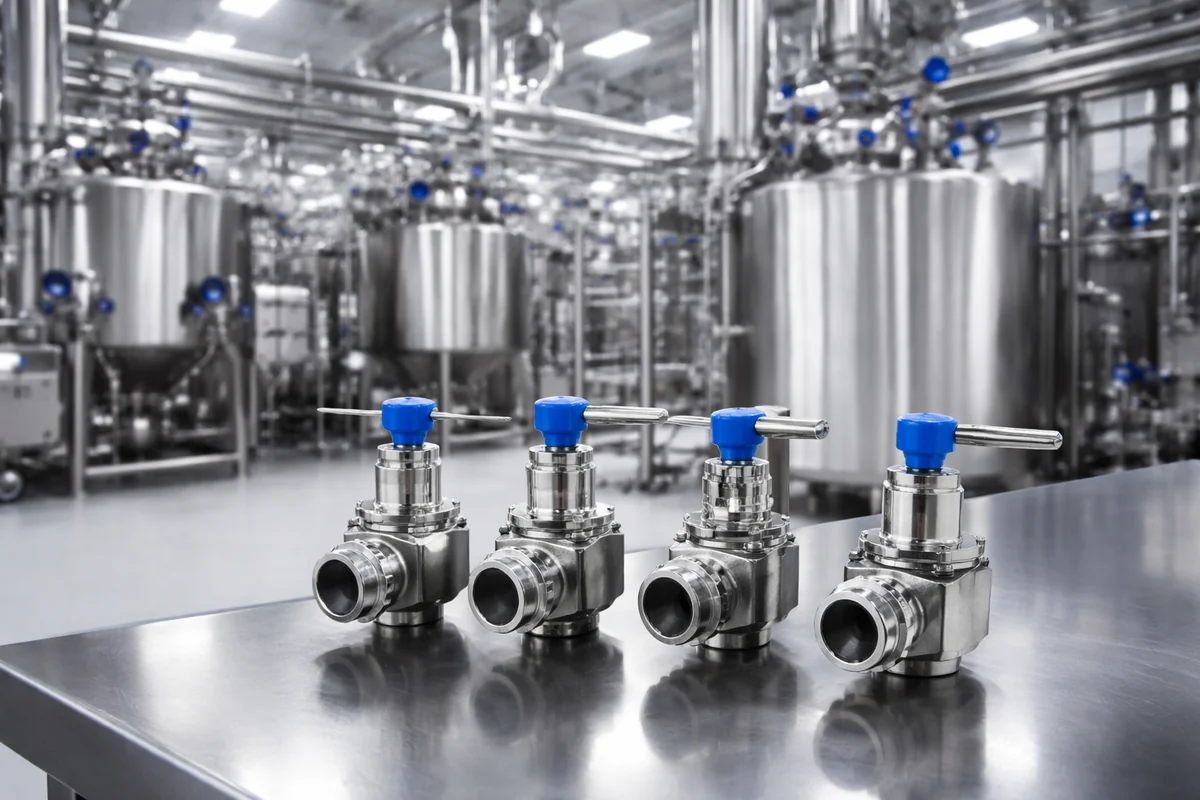
Valve type matters for dairy hygiene. I specify diaphragm valves as the primary valve type in dairy process lines. Diaphragm valves have no dead legs, no pockets where product can accumulate, and the diaphragm creates a complete seal between the process fluid and the valve mechanism. Ball valves are acceptable for some applications but require careful selection to avoid dead-leg cavities.
Pump specifications: Casings in 316L, impellers in 316L, shaft seals in silicon carbide or tungsten carbide. For centrifugal pumps handling milk, cream, or yogurt, the entire wet end must be 316L.
Gaskets: EPDM or PTFE only. Never rubber. EPDM handles the full range of dairy CIP chemicals and temperatures. PTFE is superior for aggressive chemical resistance but costs more. Avoid Buna-N and neoprene — they degrade with caustic CIP solutions.
Heat Exchangers: 316L Minimum, Duplex for Brine Side
Heat exchangers in dairy plants handle multiple fluid streams at different conditions, so grade selection varies by side.
Product side (milk, cream, yogurt): 316L tubes or plates. The product side sees acidic conditions during CIP (phosphoric or nitric acid rinses) and must resist pitting from any chloride carryover. 316L is the minimum.
Utility side (steam, hot water, cooling water): 304 is acceptable for clean steam and hot water circuits where chloride levels are controlled. If your cooling water has elevated chlorides (above 200 ppm), upgrade to 316L on the utility side as well.
Brine/coolant side with chlorides: Duplex 2205 tubes. Cheese brine heat exchangers and any system using chloride-containing coolant must use duplex. 316L will fail under stress corrosion cracking in hot brine service.
Plate heat exchangers: 316L plates are standard for dairy. Check gasket compatibility — EPDM gaskets handle most dairy services, but verify chemical compatibility for any specialty cleaning agents.
Structural Frames and Cladding: 304 Is Sufficient
This is where the biggest savings come from resisting the urge to over-specify.
Support frames, platforms, stairways, and handrails: 304. These structural elements never see product, never see CIP chemicals, and exist purely for mechanical support and personnel access. For detailed guidance on structural stainless steel applications, our stainless steel for construction spe
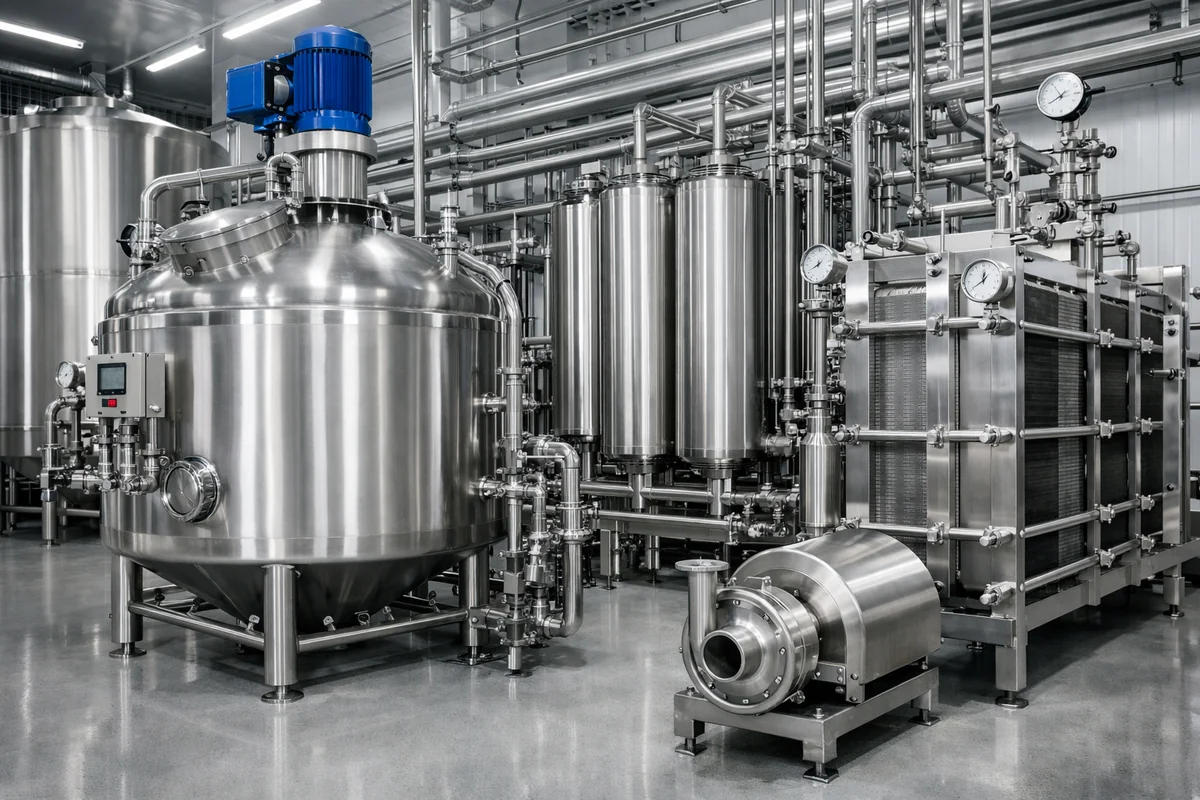
cification guide covers the full range of structural applications.
Wall and ceiling cladding: 304, 2B or BA (bright annealed) finish. Cladding panels provide a cleanable surface for the processing room environment but don’t contact product directly. The BA finish provides a smoother surface that resists bacterial adhesion better than 2B, but both are acceptable under 3-A standards for non-product-contact surfaces.
Floor grating: 304 with anti-slip surface (typically a serrated or grip-strut pattern). Floors see washdown water, which may contain some cleaning chemicals, but the exposure is dilute and brief.
The exception: If your processing room has a washdown protocol that uses chlorinated sanitizers on walls and structural surfaces multiple times per day, upgrade cladding and frames in the direct washdown zone to 316L. This is uncommon but worth checking in your cleaning SOPs.
Cleaning Method Impact on Grade Selection
Your CIP protocol directly determines which grades survive and which corrode. This is the section most dairy plant engineers skip, and it’s the section that causes the most expensive failures.
CIP Chemical Compatibility by Grade
| Chemical | Concentration (typical CIP) | 304 | 316L | Duplex 2205 |
|---|---|---|---|---|
| NaOH (caustic) | 0.5-3% | Compatible | Compatible | Compatible |
| HNO₃ (nitric acid) | 0.5-2% | Compatible | Compatible | Compatible |
| NaOCl (sodium hypochlorite) | 50-200 ppm | Not Recommended | Compatible | Compatible |
| H₃PO₄ (phosphoric acid) | 0.5-1.5% | Limited | Compatible | Compatible |
| Peracetic acid | 100-200 ppm | Limited | Compatible | Compatible |
NaOH and nitric acid are the workhorses of dairy CIP, and all three grades handle them without issue. The problems start with chlorinated sanitizers. Sodium hypochlorite at CIP concentrations will pit 304 within months. Even 316L has limits with chlorinated sanitizers at elevated temperatures.
For a more detailed analysis of grade selection specifically for food processing equipment cleaning scenarios, the 304 vs 316 for food processing equipment article provides additional data.
Chloride Limits: When CIP Becomes the Corrosion Enemy
Chloride concentration is the single most important factor in stainless steel grade selection for dairy. Here are the safe operating windows at amb
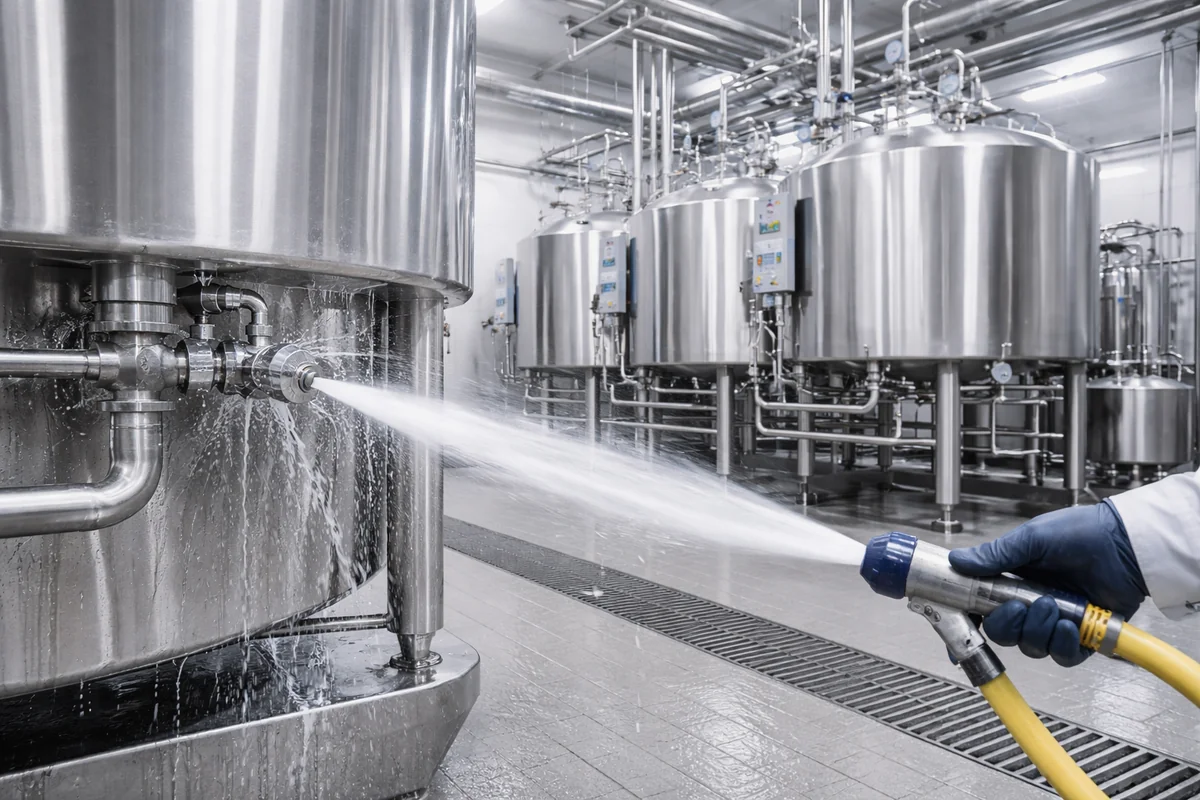
ient temperature (20-25°C):
- 304: Safe up to approximately 200 ppm chloride. Above this, pitting risk increases rapidly.
- 316L: Safe up to approximately 1000 ppm chloride. This covers most municipal water supplies and standard CIP chemical concentrations.
- Duplex 2205: Safe up to approximately 3000+ ppm chloride. Required for brine service and high-chloride water supplies.
Temperature changes everything. Higher temperatures reduce the safe chloride limit for all grades. At 60°C (typical hot CIP temperature), the safe chloride limit for 316L drops to roughly 500 ppm. At 80°C, it drops further. This is why hot CIP cycles with chlorinated sanitizers are the most dangerous combination for 316L — and why duplex 2205 exists.
Practical tip: Measure the chloride content of your CIP water supply. Don’t assume it’s low. I’ve seen plants in coastal areas with incoming water at 400-600 ppm chloride — well within 316L range at ambient temperature, but marginal during hot CIP cycles. If your water supplier changes the source or treatment process, chloride levels can shift without warning.
Surface Finish Requirements for Dairy Equipment
Surface finish isn’t optional in dairy — it’s a food safety requirement. A rough surface harbors bacteria that resist CIP cleaning, leading to biofilm formation, product contamination, and eventually regulatory action.
| Equipment Type | Minimum Ra (μm) | Recommended Ra (μm) | Finish Type |
|---|---|---|---|
| Product-contact tank interior | 0.8 | 0.4-0.8 | 2B, BA, or electropolished |
| Sanitary piping (product) | 0.4 | 0.25-0.4 | Electropolished |
| Valve wetted surfaces | 0.8 | 0.4 | Electropolished |
| Pump internals | 0.8 | 0.4-0.8 | Electropolished or BA |
| Non-product-contact cladding | 1.5 | 0.8-1.5 | 2B or BA |
Electropolishing vs Mechanical Polishing
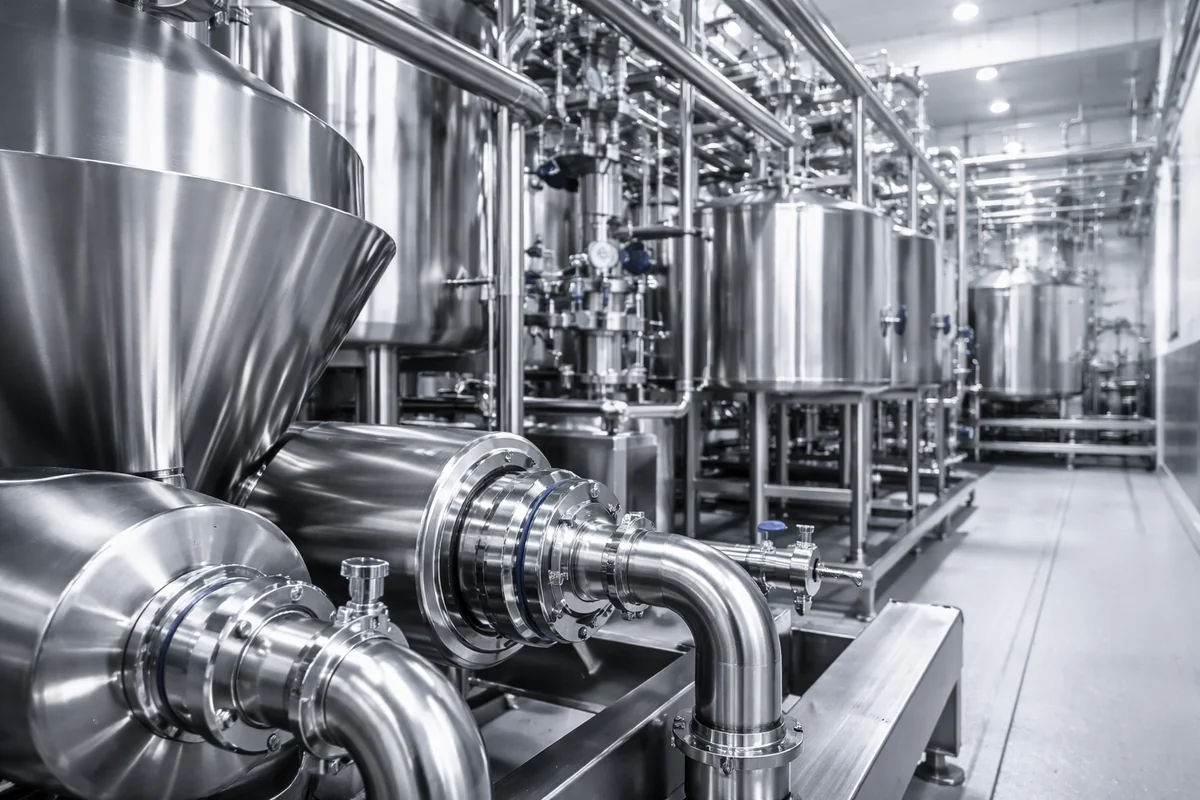
Mechanical polishing removes material through abrasive contact to achieve a target Ra value. It works well for large flat surfaces like tank interiors and cladding panels. The limitation is consistency — it’s difficult to achieve uniform Ra values in corners, welds, and complex geometries.
Electropolishing uses an electrochemical process to dissolve surface peaks preferentially, producing a uniform, smooth surface with a chromium-enriched passive layer. It’s the preferred method for piping, valves, fittings, and any component with complex geometry. The chromium enrichment from electropolishing also improves corrosion resistance beyond what mechanical polishing achieves.
For dairy sanitary piping, I specify electropolishing exclusively. The cost premium is 15-25% over mechanical polishing, but the improved corrosion resistance and cleanability justify it on every project I’ve worked on.
<h
3 style=”font-size:18px;font-weight:600;margin:1.2em 0 0.4em;color:#333;”>3-A Sanitary Standards Surface Requirements
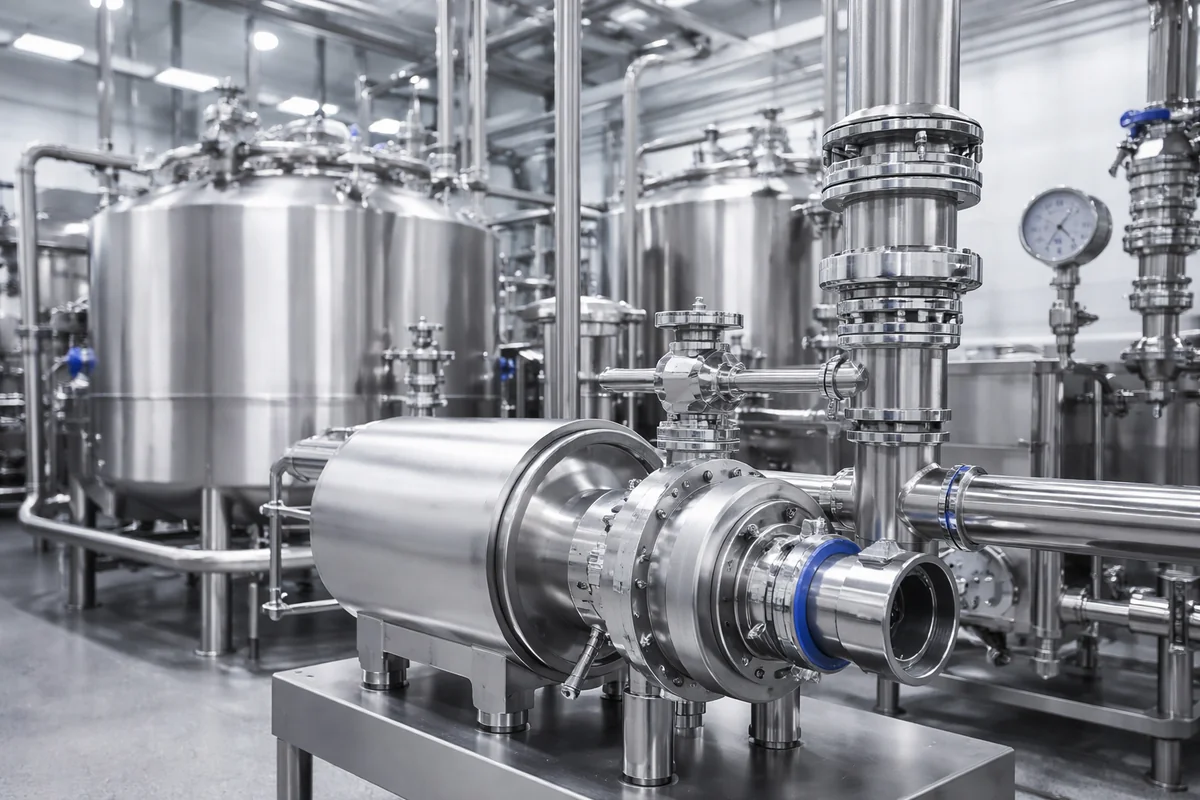
3-A Sanitary Standards specify minimum surface finish requirements for dairy equipment. For product-contact surfaces, the standard requires Ra ≤ 0.8μm (32 μin) for general product-contact surfaces and Ra ≤ 0.4μm (16 μin) for surfaces in high-risk areas like fillers and aseptic systems. These are minimums — I typically specify one step better than the minimum to provide a safety margin.
Regulatory Compliance: 3-A, EHEDG, and FDA Requirements
Grade selection in dairy isn’t just engineering — it’s regulatory. Three standards frameworks drive material and design requirements.
3-A Sanitary Standards are the primary standard for dairy equipment in the United States and many international markets. 3-A defines acceptable materials (austenitic stainless steel grades 304 and 316L are explicitly listed), surface finish requirements, and hygienic design criteria. Equipment bearing the 3-A symbol has been evaluated and certified to meet these standards. Most dairy processors require 3-A compliance on all product-contact equipment.
EHEDG (European Hygienic Engineering & Design Group) provides guidelines focused on hygienic design principles: no dead legs, self-draining surfaces, cleanability, and material compatibility. EHEDG guidelines align closely with 3-A requirements but are more prevalent in European markets. Key principles include minimum 3:1 length-to-diameter ratios for pipe dead legs and self-draining angles of at least 3° on horizontal surfaces.
FDA 21 CFR 175-178 regulates food contact surfaces in the United States. Stainless steel grades 304 and 316L are listed as approved materials for repeated food contact. The regulation focuses on ensuring that the material doesn’t migrate harmful substances into food — stainless steel’s inert surface makes compliance straightforward.
In practice, specifying 316L for product-contact surfaces and 304 for structural components satisfies all three frameworks simultaneously. The standards don’t create conflicting requirements — they converge on the same material and design principles.
Cost Analysis: When 316L Premium Pays for Itself in Dairy
Let’s talk numbers. Grade selection is ultimately a cost decision, and the right answer depends on your specific dairy product and operating conditions.
| Grade | Typical Price (USD/ton) | Price per kg | Premium vs 304 |
|---|---|---|---|
| 304/304L | 2,800-3,200 | 2.80-3.20 | Baseline |
| 316L | 3,800-4,400 | 3.80-4.40 | +30-40% |
| Duplex 2205 | 4,500-5,200 | 4.50-5.20 | +50-60% |
Note: Prices are indicative and vary by region, quantity, thickness, and market conditions. Always obtain current quotes from your supplier.
Break-Even Analysis by Dairy Product Type
Fresh milk processing: 304 may suffice for some equipment. Raw milk and pasteurized milk are near-neutral pH and have low chloride content. For bulk milk storage tanks where CIP uses only caustic and nitric acid (no chlorinated sanitizers), 304 can work for the inner shell — though I still default to 316L because the cost difference is small relative to the tank’s total cost and the risk of future CIP protocol changes.
Cheese production (brine): 316L minimum for everything touching brine. Duplex 2205 for brine tanks and brine circulation systems. Cheese brine is a high-chloride environment that will destroy 304 rapidly and stress-crack 316L over time in hot applications.
Yogurt and fermented products: 316L for all product-contact surfaces. Fermented dairy products are acidic (pH 4.0-4.6), and the combination of acid plus CIP chemicals creates a more aggressive environment than neutral milk. 304 doesn’t handle the acid-chloride combination well.
Butter and cream: 316L for all product-contact surfaces. Cream is high in fat, which requires more aggressive CIP cleaning with higher caustic concentrations. The fat also creates a film that can trap cleaning chemicals against the surface, intensifying corrosion.
Example: 10,000L Milk Storage Tank — 304 vs 316L Lifecycle Cost
Consider a 10,000L milk storage tank with approximately 1,200 kg of stainless steel in the inner shell and bottom.
| Cost Factor | 304 Tank | 316L Tank |
|---|---|---|
| Material cost (inner shell) | $3,840 | $5,280 |
| Fabrication cost | $8,000 | $8,500 |
| Total capital cost | $11,840 | $13,780 |
| Expected service life (with CIP) | 12-15 years | 25-30 years |
| CIP-related maintenance (15 yr) | $3,000-5,000 | $500-1,000 |
| Risk of premature replacement | Moderate-High | Low |
| 15-year total cost | $14,840-16,840 | $14,280-14,780 |
The 316L tank costs $1,940 more upfront. But over 15 years, the 304 tank accumulates maintenance costs from corrosion remediation and carries a real risk of needing replacement before the 316L tank reaches half its service life. The break-even point is typically around year 8-10. After that, the 316L tank is pure savings.
This analysis assumes standard CIP with caustic and acid cycles. If you add chlorinated sanitizers, the 304 tank’s maintenance costs accelerate dramatically and the break-even point moves to year 4-5.
Procurement Checklist for Dairy Plant Stainless Steel
Before you place any order, run through this checklist. Every item has a purpose, and skipping any one of them creates risk.
- [ ] Request MTR (Mill Test Report) for every heat/lot — this is your proof that the material is actually the grade you specified. Without it, you’re trusting the supplier’s label.
- [ ] Verify grade composition against ASTM A240 (plate/sheet) or ASTM A312 (pipe/tube) — the MTR should show chemical composition within the spec range. Check chromium, nickel, molybdenum, and carbon content specifically.
- [ ] Confirm surface finish Ra value with measurement report — don’t accept “smooth finish” as a specification. Require actual profilometer measurements.
- [ ] Check weld quality: full penetration, no crevice, ground flush — inspect before shipment if possible. For orbital welds, request weld logs showing parameters stayed within qualified range.
- [ ] Request 3-A compliance documentation — the equipment manufacturer should provide 3-A compliance letters or certificates. Don’t assume compliance without documentation.
- [ ] Verify protective film and packaging for transit — stainless steel scratches during shipping create corrosion initiation sites. Require protective film on all finished surfaces and proper crating.
- [ ] Confirm lead time and MOQ with supplier — specialty grades like duplex 2205 may have 8-12 week lead times. Plan procurement early in the project schedule.
- [ ] Sample inspection before bulk order — for large orders, request a sample piece and have it tested independently. Verify grade, surface finish, and dimensional accuracy before committing to the full order.
For custom-cut components, verify that the supplier’s stainless steel laser cutting parameters are appropriate for the grade and thickness you’re ordering — improper cutting parameters can damage the passive layer and create corrosion-prone edges.
Author: NewQiujing Group