How to Evaluate a Stainless Steel Laser Cutting Service: Quality Metrics, Tolerances, and Supplier Checklist
I’ve been managing laser cutting suppliers for 20 years. I’ve watched procurement teams make the same mistake: evaluating cutting services on price and lead time, then wondering why parts don’t fit, welds fail, and rework eats their margin.
A part that costs $2 to cut but $50 to fix because the edges are rough or the heat-affected zone wrecked your weld prep — that’s not a bargain. That’s a liability.
I’ve audited dozens of cutting shops and rejected more than I’ve approved. The ones I rejected? Their prices were usually the most attractive. You need a systematic way to separate shops that know what they’re doing from those that just own a laser and know how to push buttons.
This article walks you through the five technical criteria that define cutting quality, the tolerance standards you should understand, and a 10-point checklist you can take into your next supplier evaluation.
Why Price-First Procurement Fails for Laser Cut Stainless Steel
Let me tell you about a procurement manager I worked with — call him Dave. Dave was under pressure to cut costs on stainless steel brackets for a food processing equipment manufacturer. He found a new cutting service quoting 15% less. He switched.
Three months later, Dave’s rework costs had tripled. The parts were dimensionally within tolerance — barely. But the edges were rough, with consistent dross along the bottom. Welders couldn’t get clean joints without grinding each piece first. The HAZ was visibly wider, and we started seeing corrosion along weld seams within six months. The client rejected an entire batch.
Dave’s $2-per-part savings turned into $50 per part in grinding labor, weld rework, and rejected shipments.
This story isn’t unusual. It’s the norm when buyers evaluate cutting services without understanding what determines quality. The real costs show up in places your quote doesn’t cover:
- Rework labor. Grinding and reworking edges at $40-80/hour for skilled welders adds up fast.
- Assembly fit problems. Parts out of tolerance don’t align with jigs or mate with other components.
- Weld failures. A bad edge or wide HAZ means welds don’t penetrate properly or corrode prematurely.
- Downstream delays. Rework bottlenecks your production line. One bad batch can hold up an entire order.
- Reputation damage. When your customer gets parts that fail in the field, you eat the cost.
You can’t see these costs on a cutting quote. But they’re real, and the only way to avoid them is to evaluate suppliers on the technical criteria that actually matter.
The Five Technical Criteria That Define Cutting Quality
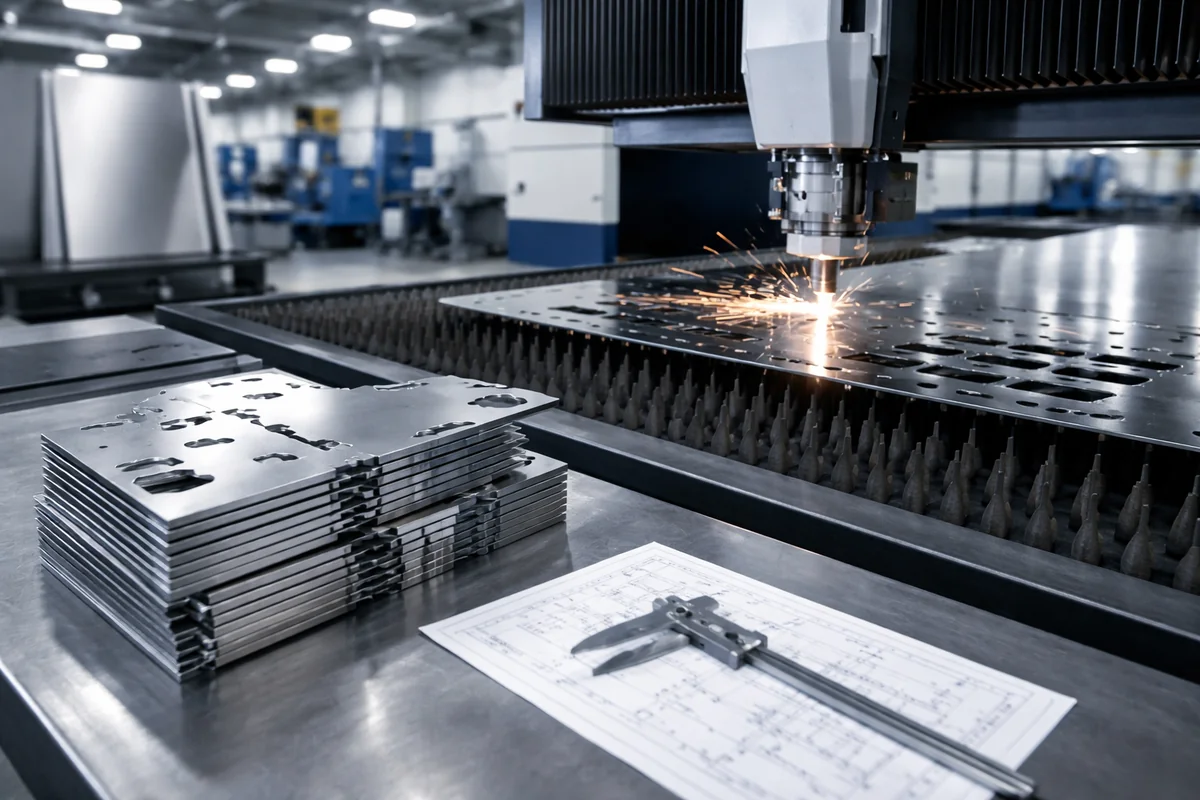
When I audit a cutting shop, I focus on five measurable factors that determine whether your parts will work.
Dimensional Tolerance: What ±0.1mm Actually Means for Your Assembly
Tolerance is how far a cut part can deviate from the nominal dimension on your drawing. At ±0.1mm, a 100mm part could measure anywhere from 99.9mm to 100.1mm. Sounds small, but tolerances stack.
If you’re assembling a bracket from four laser-cut pieces, each with ±0.1mm on two mating dimensions, you could accumulate ±0.4mm of error. If your bolt holes have 0.5mm clearance, you’ve eaten 80% of your margin. One slightly off part and the bolts won’t line up.
Typical tolerance ranges:
- Thin material (under 2mm): ±0.05mm with fiber lasers on well-maintained machines.
- Medium material (2-6mm): ±0.1mm is the standard.
- Thick material (6-12mm): ±0.15mm as the kerf widens.
Not every part needs tight tolerance. Precision brackets mating with machined components need ±0.05mm or better. Structural brackets might be fine at ±0.15mm. Know what your assembly requires and ask for it.
When evaluating a supplier, ask for their tolerance spec sheet and check it against your drawings. If they can’t produce one, that tells you something about their quality process.
For more detail on how cutting parameters affect tolerance by grade, see our guide on stainless steel laser cutting parameters by grade.
Edge Quality: Roughness, Dross, and the ISO 9013 Classification
Edge quality is the first thing I check on a sample part. You can tell a lot about a shop’s capability by running your finger along the cut edge.
ISO 9013 classifies laser cut edge quality into five ranges. Here’s the buyer’s translation:
| ISO 9013 Range | Roughness Rz (μm) | Typical Applications | Should You Request It? |
|---|---|---|---|
| Range 1 | ≤ 10 | Precision components, medical devices, visible surfaces | Only if your application demands it — costs more |
| Range 2 | ≤ 16 | High-quality fabrication, weld-prep edges, precision assemblies | Request for critical parts and weld applications |
| Range 3 | ≤ 25 | General fabrication, structural brackets, standard industrial parts | The standard for most stainless steel cutting |
| Range 4 | ≤ 40 | Rough fabrication, non-critical structural parts | Acceptable for parts that get further processed |
| Range 5 | ≤ 60 | Rough cutting, parts with extensive secondary processing | Only if you’re doing significant post-cut machining |
For most stainless steel fabrication, Range 2 or Range 3 is what you want. Range 2 gives clean edges that weld well without grinding. Range 3 is the workhorse for structural and industrial applications.
If a shop can’t tell you what ISO 9013 range they achieve, ask what edge roughness they guarantee. If they don’t know, walk away.
Dross is solidified metal hanging off the bottom edge of a cut. A little is normal on thicker material. A lot means the shop hasn’t optimized their parameters.
Look at the bottom edge. Good cutting leaves a clean edge with minimal or no visible dross. A thin, easily removable burr on thick material (8mm+) is acceptable. Heavy, welded-on dross requiring grinding is not.
For welding, edge roughness matters. An Rz above 25μm means your TIG weld pool won’t wet evenly, causing inconsistent penetration.
Heat-Affected Zone: The Invisible Problem That Causes Weld Failures
The heat-affected zone (HAZ) is the area of metal adjacent to the cut that was heated but not melted. It changes the metallurgy of stainless steel in ways that cause problems.
Grades like 304 rely on chromium in the iron matrix for corrosion resistance. When you heat 304 to 450-850°C, chromium carbides precipitate at grain boundaries — this is sensitization. It depletes chromium and kills corrosion resistance right at the cut edge.
316L is more resistant due to lower carbon content (the “L” means under 0.03%). But it’s not immune. Duplex grades like 2205 have their own HAZ concerns related to phase balance.
How to assess HAZ:
Visual check. Light straw or blue discoloration along the cut edge is normal. Wide bands of dark blue, purple, or black indicate excessive heat input.
Hardness test. With a portable hardness tester, check hardness at the cut edge versus base material. A significant increase indicates rapid cooling and potential embrittlement.
What good suppliers do. Modern fiber lasers with optimized parameters produce very narrow HAZ — often less than 0.1mm on thin material. The key variables are laser power, cutting speed, and assist gas pressure. Shops that tune these for each grade produce minimal HAZ. Shops that run the same settings for everything do not.
Ask how they control HAZ for different stainless steel grades. If they look at you blankly, that’s a problem.
Material Traceability: Mill Certificates and Heat Number Verification
Stainless steel isn’t stainless steel. There’s a meaningful difference between mill-certified 304 from a reputable mill and “304” from a supplier who can’t prove where it came from.
An MTR (Mill Test Report) proves your material meets the specified grade. It should contain:
- Material grade (e.g., ASTM A240 Type 304)
- Heat number — unique identifier tied to the specific batch produced at the mill
- Chemical composition — actual measured values for chromium, nickel, molybdenum, carbon, etc.
- Mechanical properties — tensile strength, yield strength, elongation, hardness
- Mill information — producing mill’s name and location
The heat number lets you trace material back to the exact batch. If a corrosion failure shows up, you can determine whether it’s a material or processing problem.
Red flags:
- “We can get an MTR if you need it.” They don’t routinely track material.
- Mismatched heat numbers. The numbers on MTRs don’t match markings on the actual material.
- Missing chemistry data. An MTR that only says “conforms to ASTM A240” without actual measured values is incomplete.
- No mill name. An MTR without the producing mill is worthless for traceability.
How to verify: when material arrives, check the heat number stamped or marked on the sheet against the MTR. They should match.
For more on material standards, see our comparison of ASTM A240 vs A276 stainless steel standards.
Surface Condition: Scratches, Discoloration, and Protective Film
Surface condition isn’t just cosmetic. On visible parts — architectural panels, food equipment housings — surface defects mean a quality reject. Even on non-visible parts, deep scratches become stress concentrators.
Common defects from cutting and handling:
- Scratches from parts stacked without protection or dragged across workbenches.
- Burn marks from laser spatter not cleaned off after cutting.
- Fingerprints and oils from bare-hand handling, which can cause localized corrosion.
- Protective film damage — if scored or torn during cutting, the exposed surface is vulnerable.
Good cutting shops preserve the protective film that comes on stainless
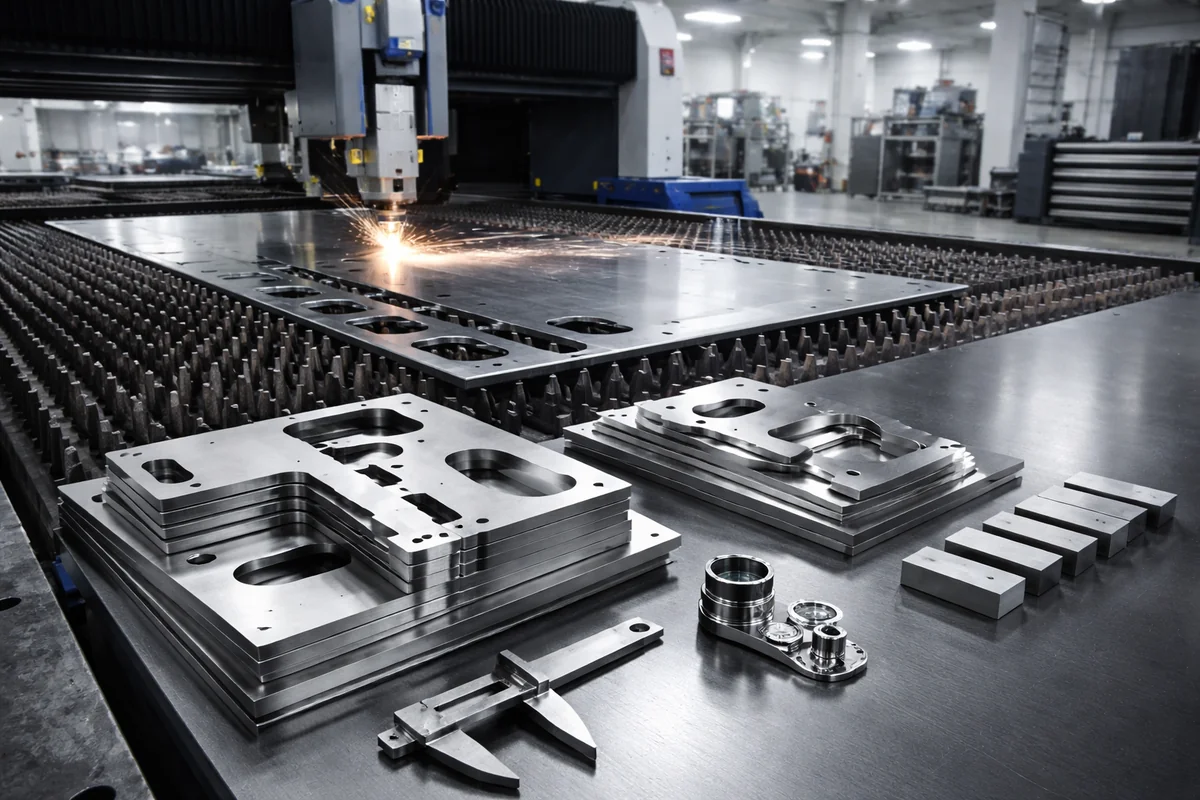
sheet. The laser cuts through the film without removing it, so parts arrive with surface protection intact.
When evaluating a supplier, look at how they handle material. Are parts stacked with interleaving? Is protective film intact? Are workers using gloves?
For visible parts, specify the surface finish standard (BA, #4 brushed, #8 mirror, etc.) and require the cutting service preserve it. For internal components, a visual inspection for major defects is usually sufficient.
Tolerance Standards Explained: ISO 9013 vs Industry Practice
The ISO 9013 standard provides a framework for specifying laser cutting quality. Most professional shops work to it, but not all volunteer the information.
ISO 9013 Tolerance Ranges: A Buyer’s Translation
| ISO 9013 Range | Tolerance (mm) for < 10mm | Roughness Rz (μm) | What It Means in Practice |
|---|---|---|---|
| Range 1 | ± 0.05 | ≤ 10 | Precision quality. Requires optimized parameters and tight process control. Request for medical, aerospace, or precision instruments. |
| Range 2 | ± 0.10 | ≤ 16 | High quality. Clean edges suitable for welding without grinding. Good for precision fabrication and critical assemblies. |
| Range 3 | ± 0.15 | ≤ 25 | Standard quality. The default for most industrial cutting. Suitable for structural and general fabrication. |
| Range 4 | ± 0.20 | ≤ 40 | Economy quality. Acceptable for parts that will be heavily machined after cutting. |
| Range 5 | ± 0.40 | ≤ 60 | Rough cutting. Only when extensive secondary operations will remove the cut surface entirely. |
For stainless steel, specify Range 2 for anything welded or visible, and Range 3 for structural parts. Don’t accept Range 4 or 5 without a specific reason.
Achievable Tolerances by Stainless Steel Grade and Thickness
Not all grades cut the same way. Alloy composition affects how material absorbs laser energy, melts, and resolidifies.
| Grade | 1mm | 3mm | 6mm | 10mm |
|---|---|---|---|---|
| 304 | ± 0.05mm | ± 0.08mm | ± 0.12mm | ± 0.15mm |
| 316L | ± 0.05mm | ± 0.08mm | ± 0.12mm | ± 0.15mm |
| 430 (Ferritic) | ± 0.05mm | ± 0.07mm | ± 0.10mm | ± 0.13mm |
| 2205 (Duplex) | 
Stainless steel laser cut parts edge qualitysize:14px;color:#555;”>± 0.06mm |
± 0.10mm | ± 0.15mm | ± 0.18mm |
430 ferritic stainless cuts with tighter tolerances than austenitic grades. If your application allows 430 instead of 304, you may get better dimensional accuracy.
Duplex 2205 is harder to cut cleanly. Its higher strength means wider tolerances and more edge roughness. Make sure your supplier has experience with it.
304 and 316L behave very similarly during laser cutting. The main difference shows up in the HAZ, not dimensional tolerance. For a comparison, see our article on 304 vs 316 stainless steel.
Fiber Laser vs CO2 Laser: What Buyers Need to Know
The type of laser a shop uses affects your part quality. Most modern shops run fiber for stainless steel, but some still use CO2 — and the differences m
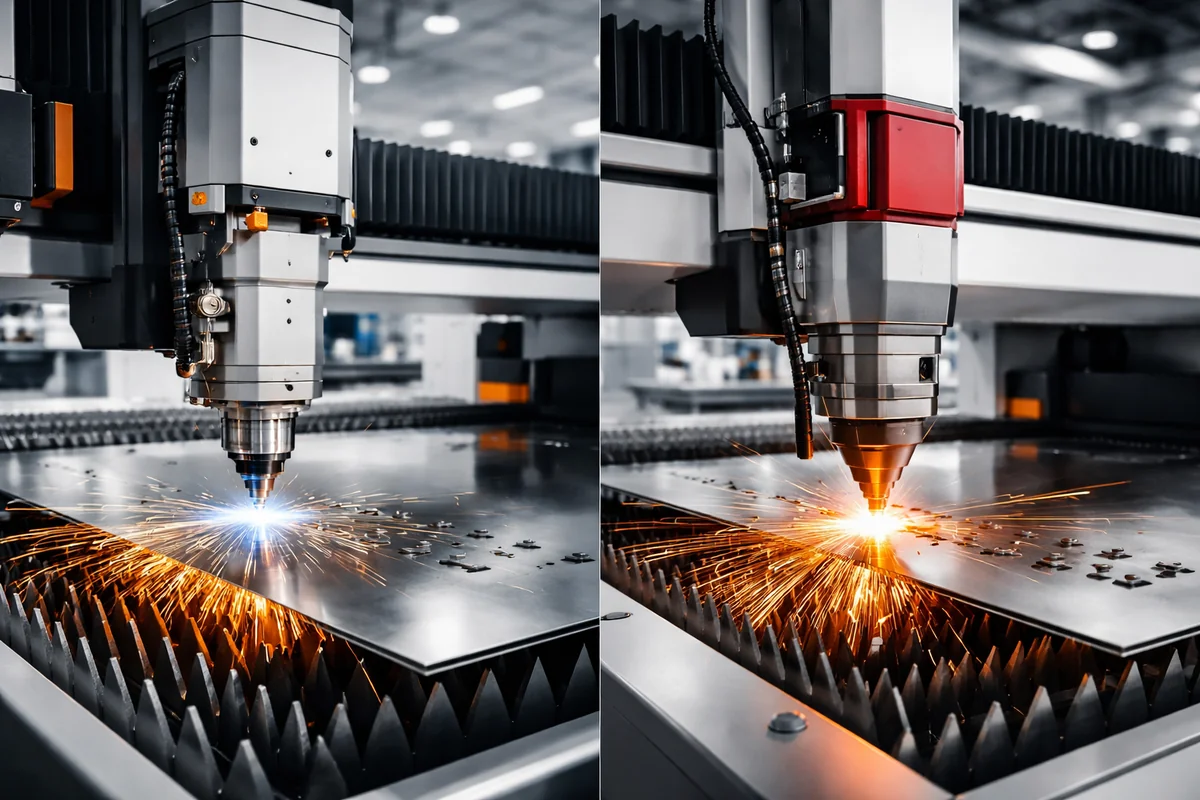
atter.
Fiber lasers use a solid-state beam. The wavelength (~1.06μm) is absorbed efficiently by stainless steel, producing cleaner cuts, narrower kerf, and less heat input. Better edge finish on thin to medium material (up to ~8mm), faster cutting, lower operating costs.
CO2 lasers use an excited gas mixture. The wavelength (10.6μm) is less efficiently absorbed by metals, requiring more power and producing more heat. Still used for thicker material (above 12mm). Produces smoother edges on thick plate but with wider HAZ.
For stainless steel under 8mm, fiber is the better choice. Above 10mm, some high-power fiber lasers (6kW+) handle thick material well.
What to ask your supplier:
- “What laser equipment do you run?” (Brand and wattage)
- “Is it fiber or CO2?” (For stainless under 8mm, you want fiber)
- “What’s your maximum thickness for stainless?” (Claims of 25mm+ on a 3kW laser should be met with skepticism)
A 3kW fiber laser comfortably cuts stainless up to about 8mm. A 6kW machine extends that to about 16mm. Above that, you need very high-power equipment or alternative processes.
How to Inspect Laser Cut Parts: Practical Methods for Buyers
You don’t need a metrology lab to evaluate cutting quality. Here’s what I do on every incoming shipment.
Visual Inspection: What to Look for on Every Part
Pull a random sample — don’t just look at the top piece. Then check:
- Edge consistency. The cut edge should be straight and uniform from top to bottom.
- Dross and burrs. Run your finger along the bottom edge. Smooth or lightly burred is acceptable. Hard, welded-on dross is not.
- Surface scratches. Under good lighting, look for deep scratches that catch your fingernail or cross a visible surface.
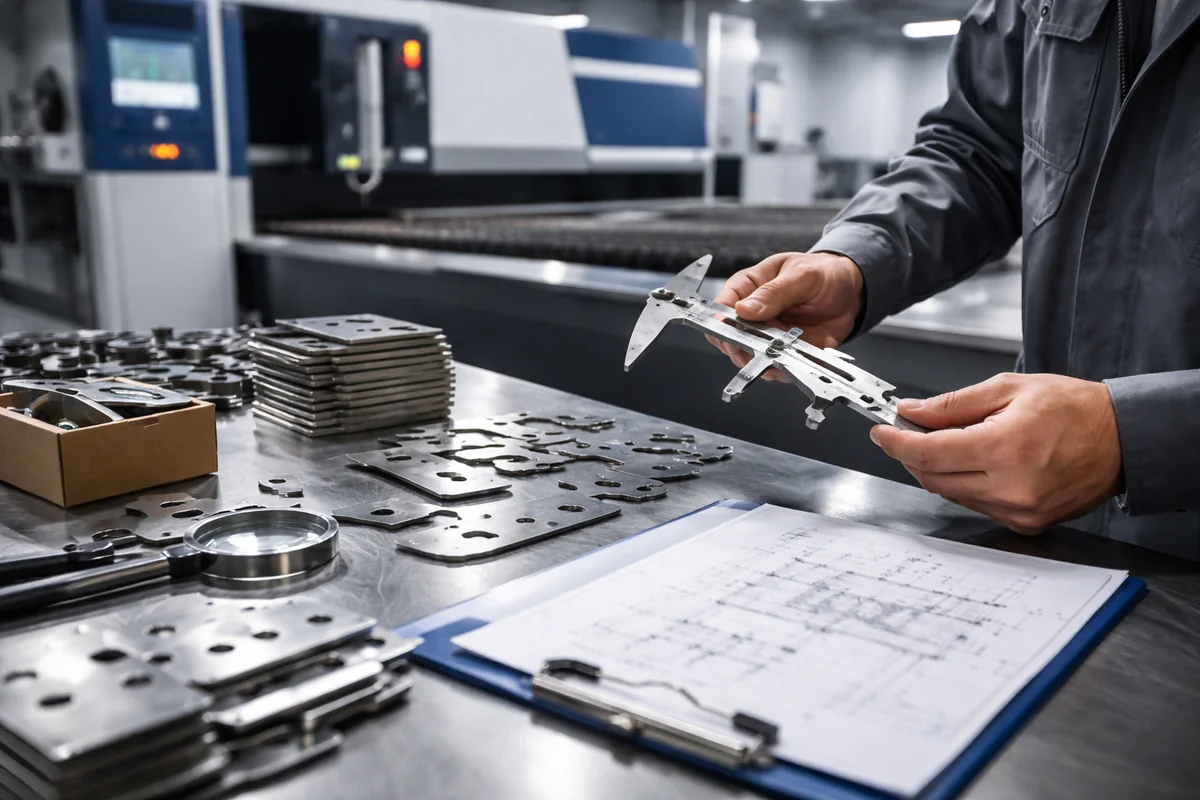
- Discoloration. Light straw or blue within 1-2mm of the edge is normal. Dark blue, purple, or black extending more than 3mm means excessive heat i

Stainless steel laser cutting documentation requirements nput.
Dimensional Verification: Sampling Plans and Measurement Points
For batch orders, use AQL sampling. For 500 parts, pull 20-30 pieces and measure critical dimensions. If you find more than 1-2 defective parts, reject the batch or require 100% inspection.
Critical dimensions to measure:
- Hole sizes. Laser-cut holes tend to be slightly smaller than programmed.
- Slot widths. Same issue as holes — verify width matches your spec.
- Overall dimensions. Length and width at multiple points to check for taper or bow.
- Positional accuracy. Hole-to-edge and hole-to-hole distances.
Digital calipers handle most incoming inspection. For tolerances under ±0.05mm, use a micrometer. For complex geometries, a CMM inspection on a first article is worth the cost.
Surface and Edge Assessment: Simple Tests on the Shop Floor
The fingernail test. Run your fingernail across the cut edge. If it catches, edge roughness is probably above Rz 25μm. If smooth or slightly textured, you’re in Range 2 or better.
Reference sample comparison. Keep known-good sample parts from your best supplier. Compare edge quality side by side with new batches. If noticeably different, investigate.
Tape test. Apply strong adhesive tape to the cut edge and pull quickly. If significant material comes off, you have loose dross or burrs.
Documentation Requirements: What to Ask for Before Ordering
Professional suppliers produce documentation. Hobby shops don’t. Require these before placing any order:
MTR/Mill certificates. Prove your material is what it claims to be. Require them with every shipment.
Cutting parameter records. Good shops log laser power, cutting speed, assist gas pressure, and focus position for each job. No records means no root cause analysis.
First Article Inspection (FAI) reports. For new parts or suppliers, request an FAI — a detailed inspection of the first parts from a new setup before full production.
ISO 9001 certification. Not a guarantee of cutting quality, but it means the shop has a documented quality management system.
The difference between a professional cutting service and a hobby shop often comes down to documentation. A shop that hands you an MTR, FAI report, and ISO certificate without scrambling takes quality seriously. A shop that says “we can get that for you” or “nobody asks for that” is telling you about their process maturity.
For material standards that should appear in your documentation, see our comparison of ASTM A240 vs A276 stainless steel standards.
10-Point Supplier Evaluation Checklist for Stainless Steel Laser Cutting
Use this checklist when evaluating a new cutting service or re-evaluating an existing one.
- Equipment brand and age (fiber laser wattage). What laser do they run? Fiber? How many kilowatts? A modern 3-6kW fiber laser is the baseline.
- Maximum material thickness capability. What’s the thickest stainless they can cut with acceptable quality?
- Tolerance capabilities. Ask for their tolerance spec sheet. Compare it to your drawings.
- ISO 9001 or equivalent quality certification. Do they have it? When was it last audited?
- MTR/traceability documentation process. Do they provide MTRs with every shipment? Do they verify heat numbers?
- Sample parts available for evaluation. Can they provide samples from recent jobs in a similar material and thickness?
- Material handling and storage practices. Are parts stacked with interleaving? Is protective film preserved? Do workers use gloves?
- Protective film application capability. Can they apply protective film after cutting? Can they cut through film without removing it?
- Lead time consistency and communication. Do they hit quoted lead times? Do they communicate proactively about delays?
- Post-cut services (deburring, bending, surface treatment). Do they offer finishing services?
One bonus point: ask about their experience with your specific grade and thickness.
For a professional laser cutting service with documented quality processes, look for suppliers who can check every box on this list.
Red Flags: Warning Signs of a Low-Quality Cutting Service
After auditing enough shops, you see the patterns. Here are the warning signs:
“We can get an MTR if you need it.” Material traceability isn’t part of their standard process.
They can’t show sample parts from recent jobs. Every professional shop keeps samples. If they can’t show recent work, they either lack experience or are embarrassed by their output.
No thickness limits posted. A shop claiming to cut everything from 0.5mm to 25mm+ with equal quality is either lying or doesn’t understand their equipment.
Inconsistent or unusually low pricing. If their quote is 30% below market rate, something is giving. Cheap cutting is expensive cutting; you just don’t know it yet.
Poor material handling. Walk through their shop. Parts stacked without protection? Raw material on the floor? If they don’t care about handling, they don’t care about surface quality.
No quality documentation process. No MTR, no cutting parameter records, no concept of an FAI report. They’re running on instinct, not process.
They can’t explain their tolerance specs. Professional shops know their capabilities by grade, thickness, and machine. They should tell you precisely what they can hold.
These red flags aren’t subtle. But when you’re under pressure to find a supplier fast, it’s easy to overlook them. Don’t. Every red flag I’ve ignored in my career has come back to cost me later.
The best cutting service isn’t the cheapest one. It’s the one that delivers parts you can use without rework, trust without second-guessing, and that makes your downstream operations smoother.
Author: NewQiujing Group